
Infinity Turbine LLC

Battery Failure Analysis and Characterization of Failure Types 2021


Lithium Hazard Technology Report
This comprehensive report provides a technical analysis of large-scale lithium energy storage systems, focusing on 1 MW+ containerized solutions. It delves into the risks of thermal runaway, fire hazards, and toxic gas emissions, along with strategies for fire prevention, monitoring, and site-specific installation considerations. Additionally, it covers the impact of lithium fires on insurance costs and outlines best practices for safety, scalability, and operational efficiency. Emerging technologies and regulatory frameworks are also discussed to provide actionable insights for manufacturers, operators, and policymakers.


Publication Title | Battery Failure Analysis and Characterization of Failure Types 2021

Grid Scale Storage Publications Search

Search Lithium Fire Publications search was updated real-time via Filemaker on:

Search Lithium Fire Publications | Return to Search List

Search Completed | Title | Battery Failure Analysis and Characterization of Failure Types 2021
Original File Name Searched: BESS-White-Papers-1-7-Combined.pdf | Google It | Yahoo | Bing

Previous Page | Next Page
battery-failure-analysis-and-characterization-failure-types--004</TD> <TD valign=

Page | 004

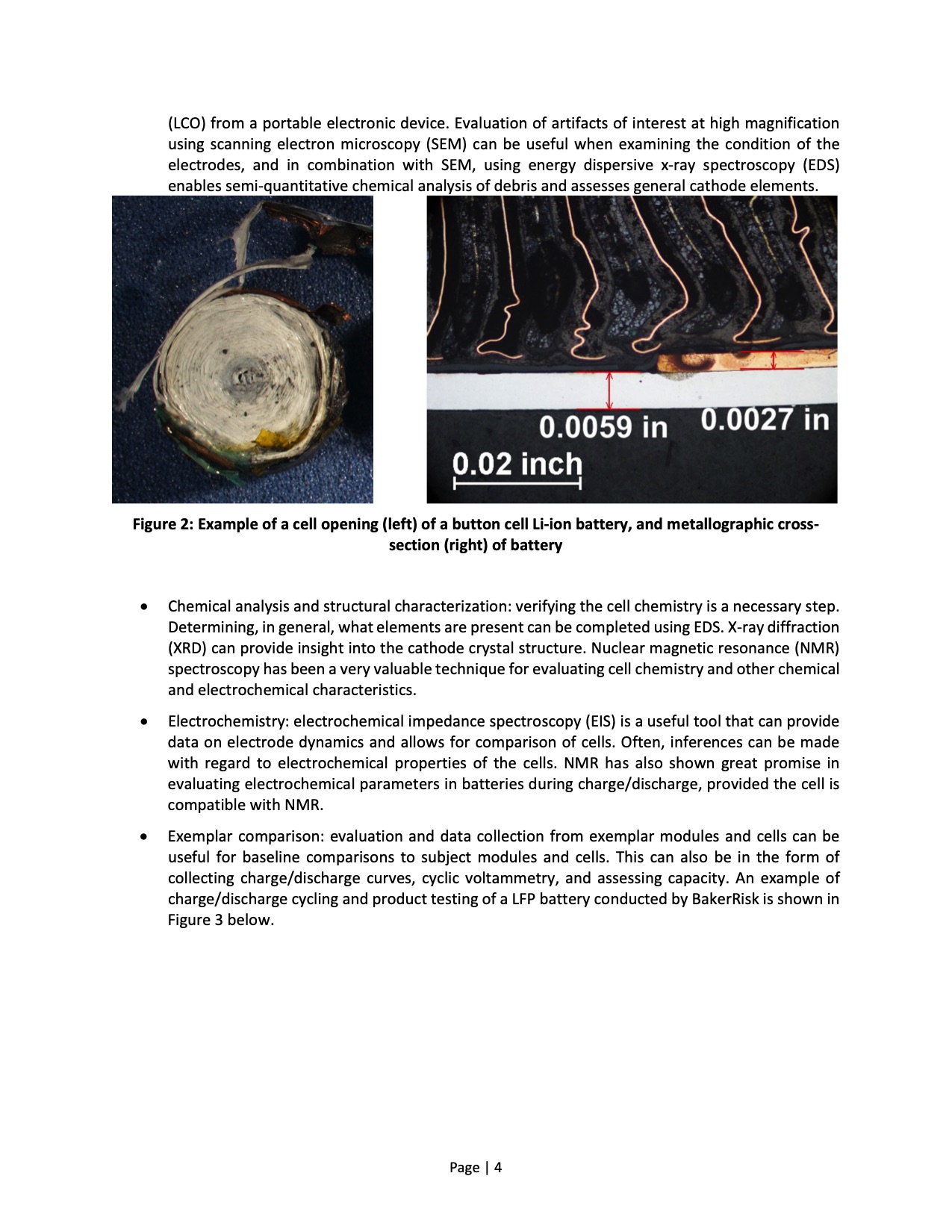
(LCO) from a portable electronic device. Evaluation of artifacts of interest at high magnification using scanning electron microscopy (SEM) can be useful when examining the condition of the electrodes, and in combination with SEM, using energy dispersive x-ray spectroscopy (EDS) enables semi-quantitative chemical analysis of debris and assesses general cathode elements.
Figure 2: Example of a cell opening (left) of a button cell Li-ion battery, and metallographic cross- section (right) of battery
• Chemical analysis and structural characterization: verifying the cell chemistry is a necessary step. Determining, in general, what elements are present can be completed using EDS. X-ray diffraction (XRD) can provide insight into the cathode crystal structure. Nuclear magnetic resonance (NMR) spectroscopy has been a very valuable technique for evaluating cell chemistry and other chemical and electrochemical characteristics.
• Electrochemistry: electrochemical impedance spectroscopy (EIS) is a useful tool that can provide data on electrode dynamics and allows for comparison of cells. Often, inferences can be made with regard to electrochemical properties of the cells. NMR has also shown great promise in evaluating electrochemical parameters in batteries during charge/discharge, provided the cell is compatible with NMR.
• Exemplar comparison: evaluation and data collection from exemplar modules and cells can be useful for baseline comparisons to subject modules and cells. This can also be in the form of collecting charge/discharge curves, cyclic voltammetry, and assessing capacity. An example of charge/discharge cycling and product testing of a LFP battery conducted by BakerRisk is shown in Figure 3 below.
Page | 4

Search Contact: greg@infinityturbine.com