Search Completed | Title | Battery Failure Analysis and Characterization of Failure Types 2021
Original File Name Searched: BESS-White-Papers-1-7-Combined.pdf | Google It | Yahoo | Bing
Page | 008 Standard “simplified equations” used for instrumentation systems generally use the ‘constant’ failure rate value in the ‘useful life’ section of the curve. This is due to the tendency of the random failures being representative of the majority of the instrument’s life-cycle of use. While this approach is widely used for electronic components, it is not appropriate for hazardous evaluation of battery cell failure where significant failure modes of interest tend to be caused by flawed construction (early failures) or degradation (wear out).
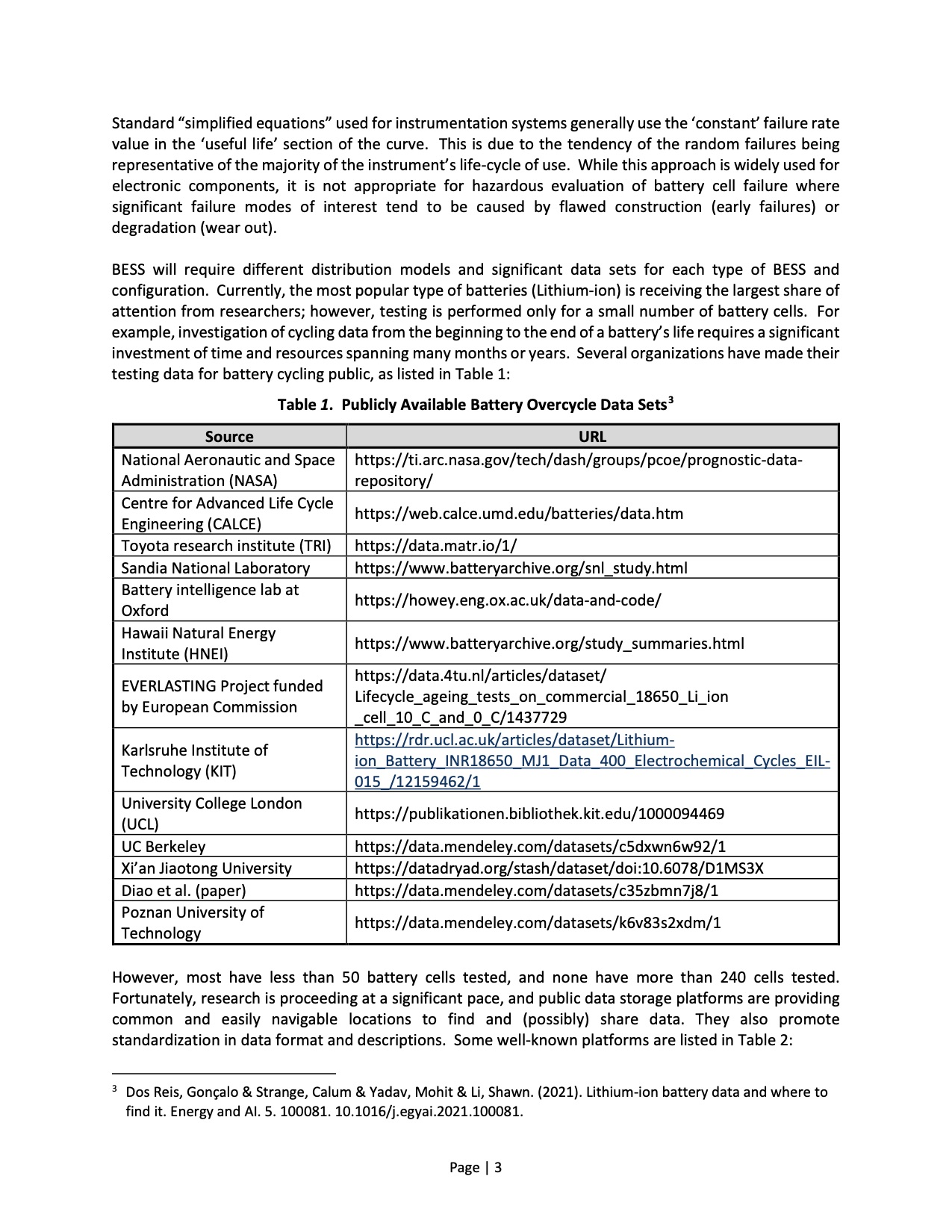
BESS will require different distribution models and significant data sets for each type of BESS and configuration. Currently, the most popular type of batteries (Lithium-ion) is receiving the largest share of attention from researchers; however, testing is performed only for a small number of battery cells. For example, investigation of cycling data from the beginning to the end of a battery’s life requires a significant investment of time and resources spanning many months or years. Several organizations have made their testing data for battery cycling public, as listed in Table 1:
Table 1. Publicly Available Battery Overcycle Data Sets3
Source
URL
National Aeronautic and Space Administration (NASA)
Centre for Advanced Life Cycle Engineering (CALCE)
Toyota research institute (TRI) Sandia National Laboratory Battery intelligence lab at Oxford
Hawaii Natural Energy Institute (HNEI)
University College London (UCL)
UC Berkeley
Xi’an Jiaotong University Diao et al. (paper)
Poznan University of Technology
https://ti.arc.nasa.gov/tech/dash/groups/pcoe/prognostic-data- repository/
https://web.calce.umd.edu/batteries/data.htm
https://data.matr.io/1/ https://www.batteryarchive.org/snl_study.html
https://howey.eng.ox.ac.uk/data-and-code/ https://www.batteryarchive.org/study_summaries.html
https://publikationen.bibliothek.kit.edu/1000094469
https://data.mendeley.com/datasets/c5dxwn6w92/1 https://datadryad.org/stash/dataset/doi:10.6078/D1MS3X https://data.mendeley.com/datasets/c35zbmn7j8/1
https://data.mendeley.com/datasets/k6v83s2xdm/1
EVERLASTING Project funded by European Commission
https://data.4tu.nl/articles/dataset/ Lifecycle_ageing_tests_on_commercial_18650_Li_ion _cell_10_C_and_0_C/1437729
Karlsruhe Institute of Technology (KIT)
https://rdr.ucl.ac.uk/articles/dataset/Lithium- ion_Battery_INR18650_MJ1_Data_400_Electrochemical_Cycles_EIL- 015_/12159462/1
However, most have less than 50 battery cells tested, and none have more than 240 cells tested. Fortunately, research is proceeding at a significant pace, and public data storage platforms are providing common and easily navigable locations to find and (possibly) share data. They also promote standardization in data format and descriptions. Some well-known platforms are listed in Table 2:
3 Dos Reis, Gonçalo & Strange, Calum & Yadav, Mohit & Li, Shawn. (2021). Lithium-ion battery data and where to find it. Energy and AI. 5. 100081. 10.1016/j.egyai.2021.100081.
Page | 3
|