Search Completed | Title | Battery Failure Analysis and Characterization of Failure Types 2021
Original File Name Searched: BESS-White-Papers-1-7-Combined.pdf | Google It | Yahoo | Bing
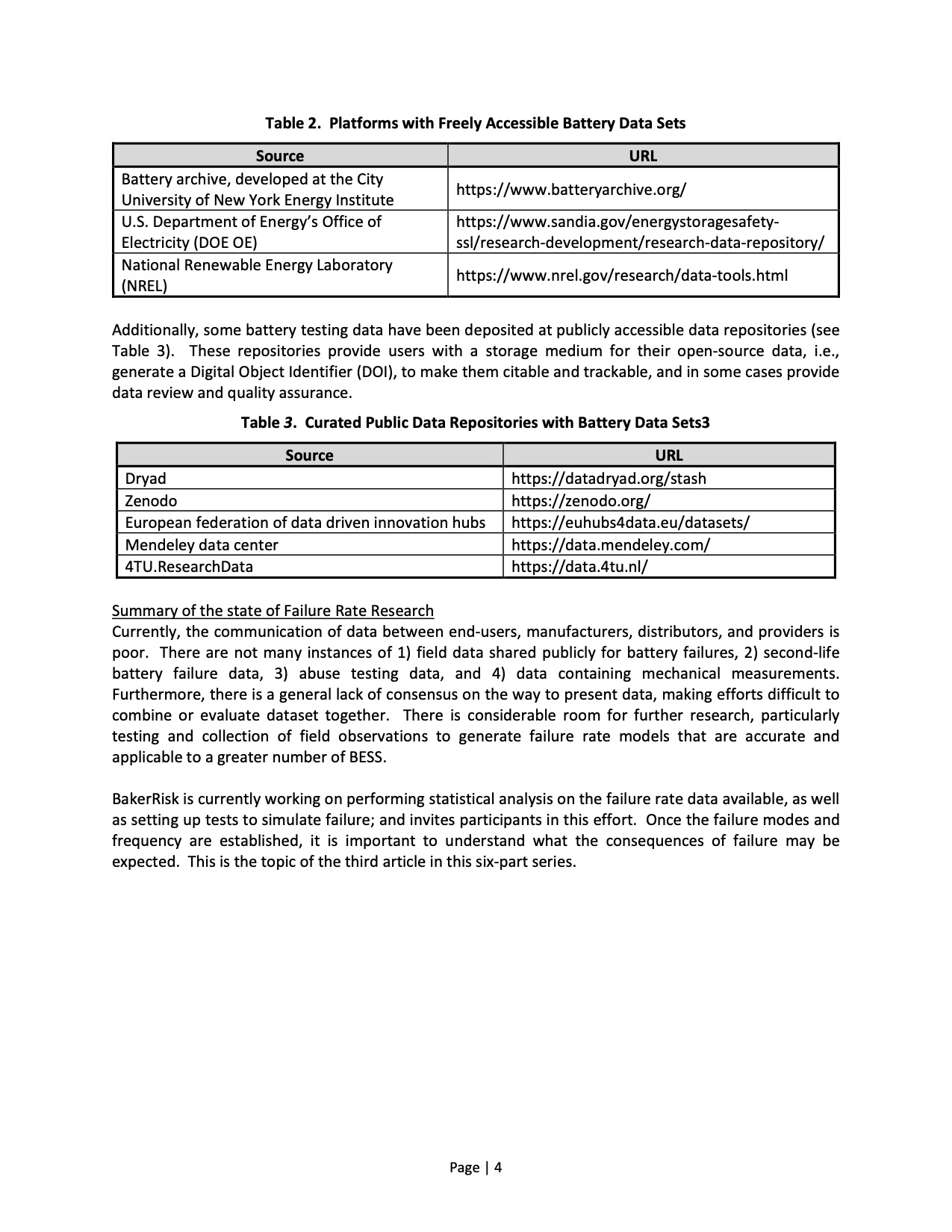
Page | 009 Table 2. Platforms with Freely Accessible Battery Data Sets
Source
URL
Battery archive, developed at the City University of New York Energy Institute U.S. Department of Energy’s Office of Electricity (DOE OE)
National Renewable Energy Laboratory (NREL)
https://www.batteryarchive.org/
https://www.sandia.gov/energystoragesafety- ssl/research-development/research-data-repository/
https://www.nrel.gov/research/data-tools.html
Additionally, some battery testing data have been deposited at publicly accessible data repositories (see Table 3). These repositories provide users with a storage medium for their open-source data, i.e., generate a Digital Object Identifier (DOI), to make them citable and trackable, and in some cases provide data review and quality assurance.
Table 3. Curated Public Data Repositories with Battery Data Sets3
Source
URL
Dryad
Zenodo
European federation of data driven innovation hubs Mendeley data center
4TU.ResearchData
https://datadryad.org/stash https://zenodo.org/ https://euhubs4data.eu/datasets/ https://data.mendeley.com/ https://data.4tu.nl/
Summary of the state of Failure Rate Research
Currently, the communication of data between end-users, manufacturers, distributors, and providers is poor. There are not many instances of 1) field data shared publicly for battery failures, 2) second-life battery failure data, 3) abuse testing data, and 4) data containing mechanical measurements. Furthermore, there is a general lack of consensus on the way to present data, making efforts difficult to combine or evaluate dataset together. There is considerable room for further research, particularly testing and collection of field observations to generate failure rate models that are accurate and applicable to a greater number of BESS.
BakerRisk is currently working on performing statistical analysis on the failure rate data available, as well as setting up tests to simulate failure; and invites participants in this effort. Once the failure modes and frequency are established, it is important to understand what the consequences of failure may be expected. This is the topic of the third article in this six-part series.
Page | 4
|