Search Completed | Title | development application MCU24 0005 Battery Storage Facility
Original File Name Searched: submission_-_britt_and_len_schneider_2.pdf | Google It | Yahoo | Bing
Page | 026 assessments (such as Failure Mode Effectiveness and Criticality (FMECA) analysis) to determine appropriate control measures2.
Managing fires in battery modules poses a particular threat as there is the potential for fires to spread to other modules, emit toxic or flammable gases, with the potential to cause an explosion [31].
3.2.2 Past grid-scale BESS thermal runaway events
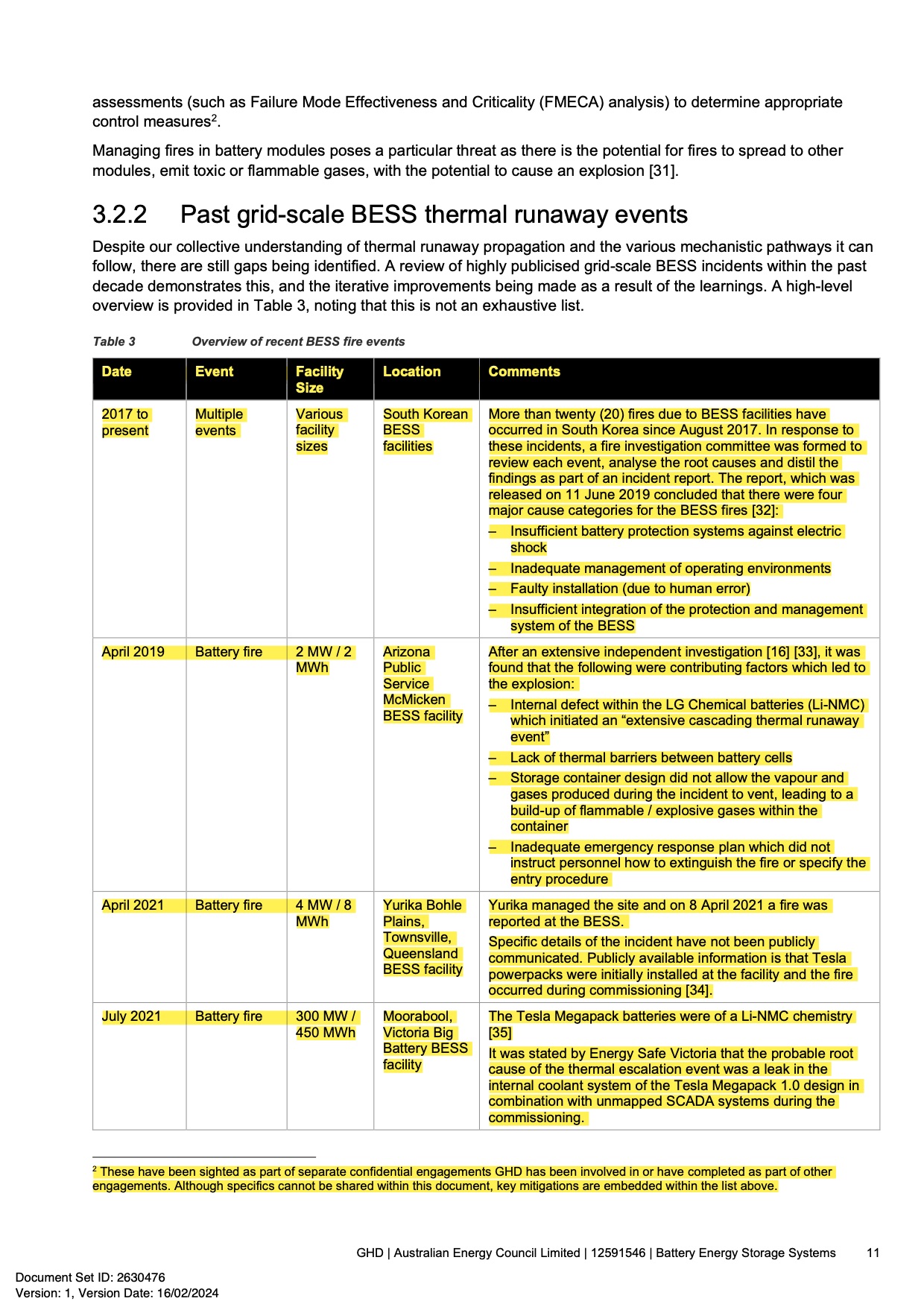
Despite our collective understanding of thermal runaway propagation and the various mechanistic pathways it can follow, there are still gaps being identified. A review of highly publicised grid-scale BESS incidents within the past decade demonstrates this, and the iterative improvements being made as a result of the learnings. A high-level overview is provided in Table 3, noting that this is not an exhaustive list.
Table 3 Overview of recent BESS fire events
Date
Event
Facility Size
Location
Comments
2017 to present
Multiple events
Various facility sizes
South Korean BESS facilities
More than twenty (20) fires due to BESS facilities have occurred in South Korea since August 2017. In response to these incidents, a fire investigation committee was formed to review each event, analyse the root causes and distil the findings as part of an incident report. The report, which was released on 11 June 2019 concluded that there were four major cause categories for the BESS fires [32]:
– Insufficient battery protection systems against electric shock
– Inadequate management of operating environments
– Faulty installation (due to human error)
– Insufficient integration of the protection and management system of the BESS
April 2019
Battery fire
2 MW / 2 MWh
Arizona Public Service McMicken BESS facility
After an extensive independent investigation [16] [33], it was found that the following were contributing factors which led to the explosion:
– Internal defect within the LG Chemical batteries (Li-NMC) which initiated an “extensive cascading thermal runaway event”
– Lack of thermal barriers between battery cells
– Storage container design did not allow the vapour and gases produced during the incident to vent, leading to a build-up of flammable / explosive gases within the container
– Inadequate emergency response plan which did not instruct personnel how to extinguish the fire or specify the entry procedure
April 2021
Battery fire
4 MW / 8 MWh
Yurika Bohle Plains, Townsville, Queensland BESS facility
Yurika managed the site and on 8 April 2021 a fire was reported at the BESS.
Specific details of the incident have not been publicly communicated. Publicly available information is that Tesla powerpacks were initially installed at the facility and the fire occurred during commissioning [34].
July 2021
Battery fire
300 MW / 450 MWh
Moorabool, Victoria Big Battery BESS facility
The Tesla Megapack batteries were of a Li-NMC chemistry [35]
It was stated by Energy Safe Victoria that the probable root cause of the thermal escalation event was a leak in the internal coolant system of the Tesla Megapack 1.0 design in combination with unmapped SCADA systems during the commissioning.
2 These have been sighted as part of separate confidential engagements GHD has been involved in or have completed as part of other engagements. Although specifics cannot be shared within this document, key mitigations are embedded within the list above.
Document Set ID: 2630476
Version: 1, Version Date: 16/02/2024
GHD | Australian Energy Council Limited | 12591546 | Battery Energy Storage Systems 11
|