Search Completed | Title | EPRI Battery Energy Storage Systems (BESS) Failure Incident Database
Original File Name Searched: BESS_FailureIncidentDatabase_AnalysisofFailureRootCause.pdf | Google It | Yahoo | Bing
Page | 002 TABLE OF CONTENTS
Introduction................................ 2 Methodology .............................. 3
The BESS Failure Incident Database ................................. 3
Data Collection ........................ 4
Classification of Failure Incidents.................................. 4
Results ........................................ 5
Results Overview ..................... 5
Root Causes of Incidents ......... 7
Failed Element......................... 9
Biaxial Analysis .......................10
Mitigations and Recommendations..................12
Looking Ahead........................13 Conclusion .................................14
INTRODUCTION
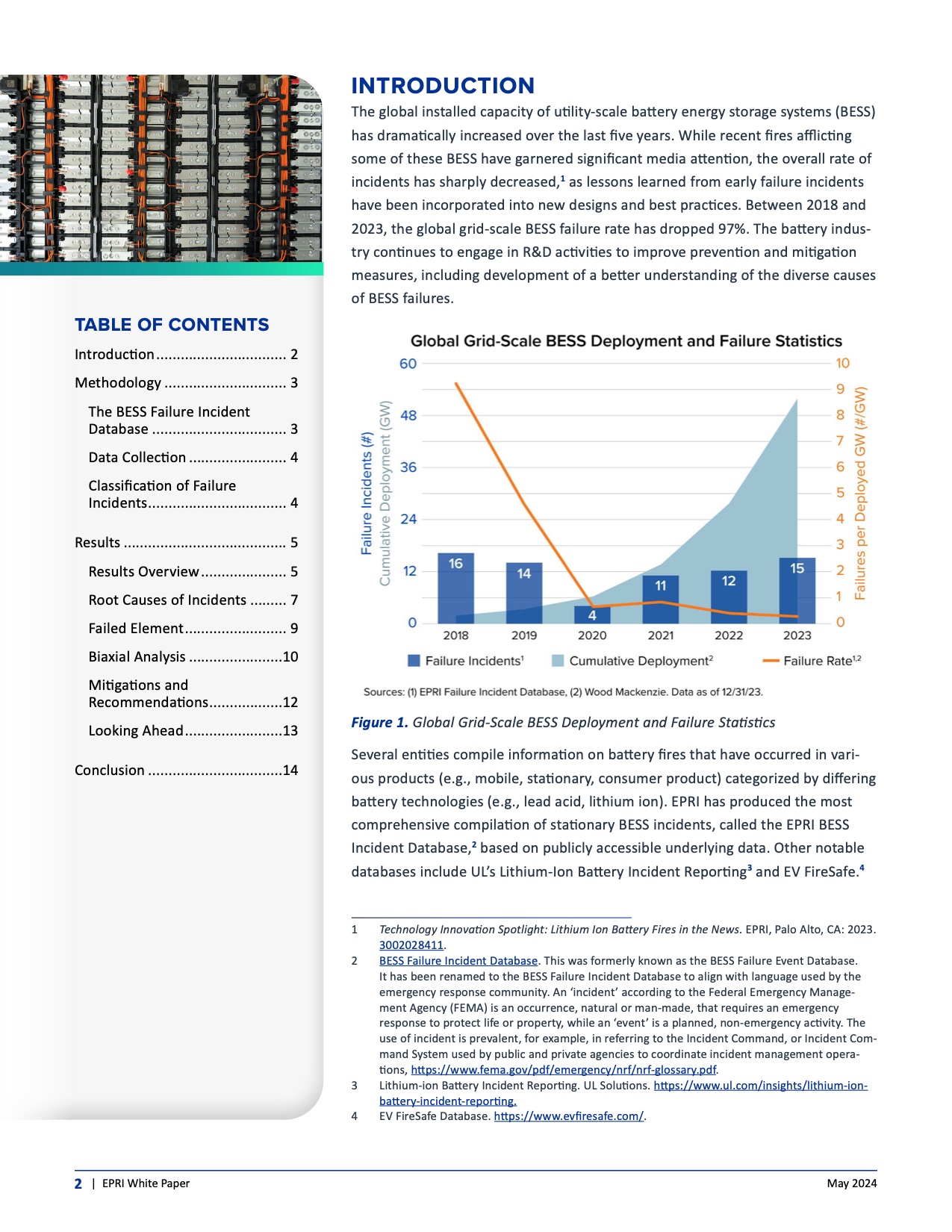
The global installed capacity of utility-scale battery energy storage systems (BESS) has dramatically increased over the last five years. While recent fires afflicting some of these BESS have garnered significant media attention, the overall rate of incidents has sharply decreased,1 as lessons learned from early failure incidents have been incorporated into new designs and best practices. Between 2018 and 2023, the global grid-scale BESS failure rate has dropped 97%. The battery indus- try continues to engage in R&D activities to improve prevention and mitigation measures, including development of a better understanding of the diverse causes of BESS failures.
Figure 1. Global Grid-Scale BESS Deployment and Failure Statistics
Several entities compile information on battery fires that have occurred in vari- ous products (e.g., mobile, stationary, consumer product) categorized by differing battery technologies (e.g., lead acid, lithium ion). EPRI has produced the most comprehensive compilation of stationary BESS incidents, called the EPRI BESS Incident Database,2 based on publicly accessible underlying data. Other notable databases include UL’s Lithium-Ion Battery Incident Reporting3 and EV FireSafe.4
1 Technology Innovation Spotlight: Lithium Ion Battery Fires in the News. EPRI, Palo Alto, CA: 2023. 3002028411.
2 BESS Failure Incident Database. This was formerly known as the BESS Failure Event Database.
It has been renamed to the BESS Failure Incident Database to align with language used by the emergency response community. An ‘incident’ according to the Federal Emergency Manage- ment Agency (FEMA) is an occurrence, natural or man-made, that requires an emergency response to protect life or property, while an ‘event’ is a planned, non-emergency activity. The use of incident is prevalent, for example, in referring to the Incident Command, or Incident Com- mand System used by public and private agencies to coordinate incident management opera- tions, https://www.fema.gov/pdf/emergency/nrf/nrf-glossary.pdf.
3 Lithium-ion Battery Incident Reporting. UL Solutions. https://www.ul.com/insights/lithium-ion- battery-incident-reporting.
4 EV FireSafe Database. https://www.evfiresafe.com/.
2 | EPRI White Paper
15256168
May 2024
|