Search Completed | Title | EPRI Battery Energy Storage Systems (BESS) Failure Incident Database
Original File Name Searched: BESS_FailureIncidentDatabase_AnalysisofFailureRootCause.pdf | Google It | Yahoo | Bing
Page | 010 The BOS and controls account for the vast majority of failed components. The prevalence of BOS failures is corroborated by the recent CEA report cited above, which found that nearly 50% of quality assurance items were in the BOS. Only 3 incidents, or 11% of classified incidents, are attrib- uted directly to the cells. However, it should be noted that many of the failures classified as controls were related to operational issues aimed at restricting cell state of charge (SOC), voltage and current, due to cell limitations. These
were classified as controls failure rather than cell/module since the failures could have been prevented if more limited operational windows were maintained.
Biaxial Analysis
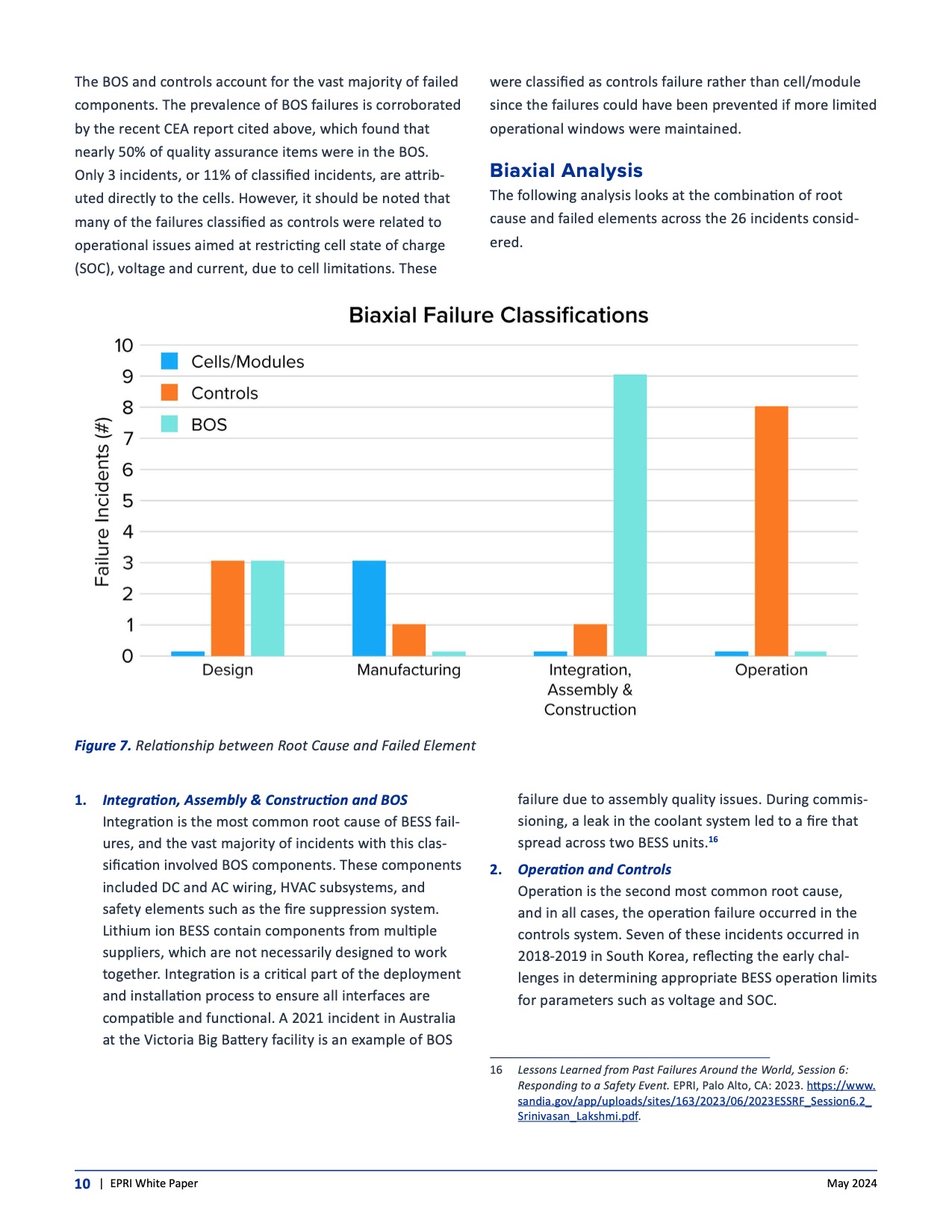
The following analysis looks at the combination of root cause and failed elements across the 26 incidents consid- ered.
Figure 7. Relationship between Root Cause and Failed Element
1. Integration, Assembly & Construction and BOS Integration is the most common root cause of BESS fail- ures, and the vast majority of incidents with this clas- sification involved BOS components. These components included DC and AC wiring, HVAC subsystems, and safety elements such as the fire suppression system. Lithium ion BESS contain components from multiple suppliers, which are not necessarily designed to work together. Integration is a critical part of the deployment and installation process to ensure all interfaces are compatible and functional. A 2021 incident in Australia at the Victoria Big Battery facility is an example of BOS
failure due to assembly quality issues. During commis- sioning, a leak in the coolant system led to a fire that spread across two BESS units.16
2. Operation and Controls
Operation is the second most common root cause,
and in all cases, the operation failure occurred in the controls system. Seven of these incidents occurred in 2018-2019 in South Korea, reflecting the early chal- lenges in determining appropriate BESS operation limits for parameters such as voltage and SOC.
16 Lessons Learned from Past Failures Around the World, Session 6: Responding to a Safety Event. EPRI, Palo Alto, CA: 2023. https://www. sandia.gov/app/uploads/sites/163/2023/06/2023ESSRF_Session6.2_ Srinivasan_Lakshmi.pdf.
10 | EPRI White Paper 15256168
May 2024
|