Search Completed | Title | EPRI Battery Energy Storage Systems (BESS) Failure Incident Database
Original File Name Searched: BESS_FailureIncidentDatabase_AnalysisofFailureRootCause.pdf | Google It | Yahoo | Bing
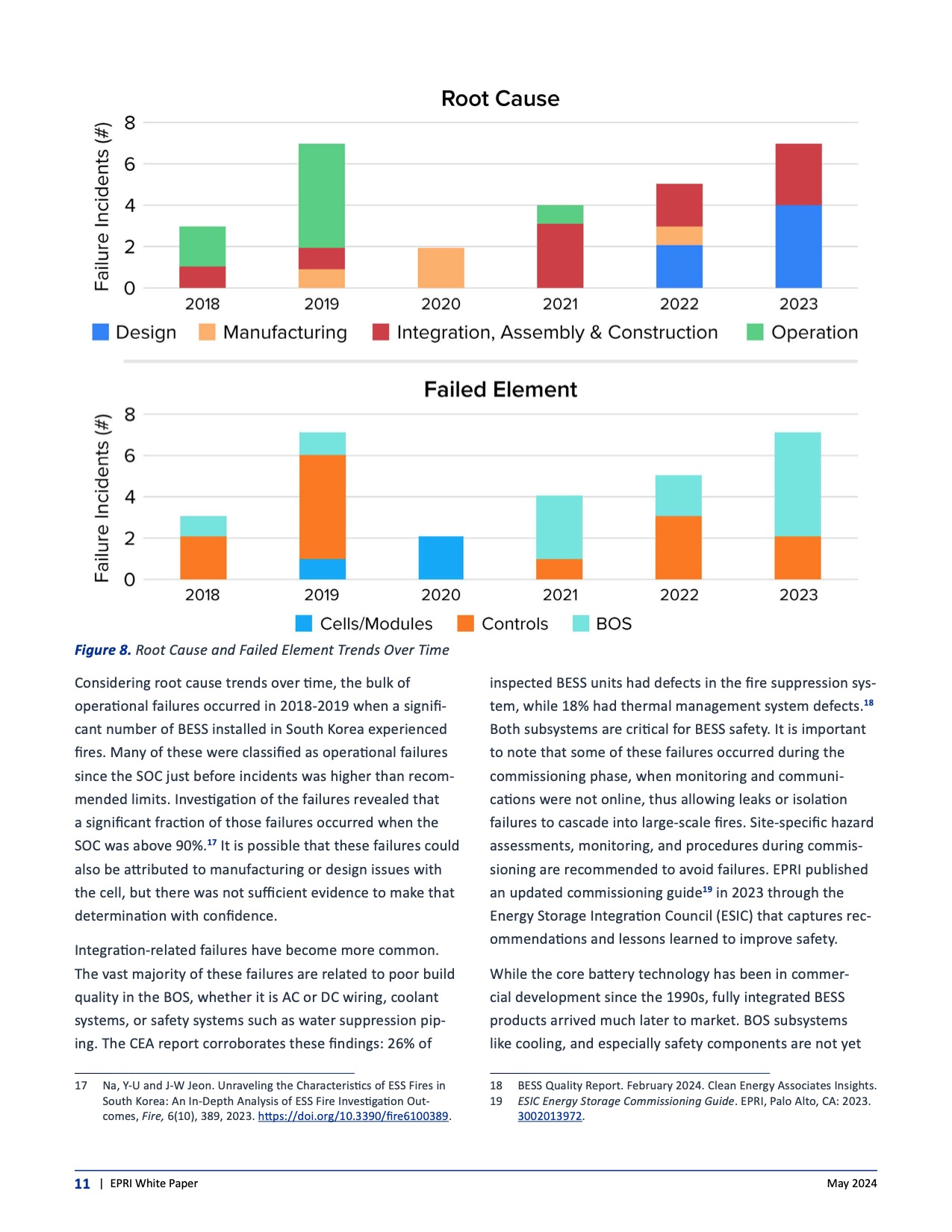
Page | 011 Figure 8. Root Cause and Failed Element Trends Over Time
Considering root cause trends over time, the bulk of operational failures occurred in 2018-2019 when a signifi- cant number of BESS installed in South Korea experienced fires. Many of these were classified as operational failures since the SOC just before incidents was higher than recom- mended limits. Investigation of the failures revealed that
a significant fraction of those failures occurred when the SOC was above 90%.17 It is possible that these failures could also be attributed to manufacturing or design issues with the cell, but there was not sufficient evidence to make that determination with confidence.
Integration-related failures have become more common. The vast majority of these failures are related to poor build quality in the BOS, whether it is AC or DC wiring, coolant systems, or safety systems such as water suppression pip- ing. The CEA report corroborates these findings: 26% of
17 Na, Y-U and J-W Jeon. Unraveling the Characteristics of ESS Fires in South Korea: An In-Depth Analysis of ESS Fire Investigation Out- comes, Fire, 6(10), 389, 2023. https://doi.org/10.3390/fire6100389.
inspected BESS units had defects in the fire suppression sys- tem, while 18% had thermal management system defects.18 Both subsystems are critical for BESS safety. It is important to note that some of these failures occurred during the commissioning phase, when monitoring and communi- cations were not online, thus allowing leaks or isolation failures to cascade into large-scale fires. Site-specific hazard assessments, monitoring, and procedures during commis- sioning are recommended to avoid failures. EPRI published an updated commissioning guide19 in 2023 through the Energy Storage Integration Council (ESIC) that captures rec- ommendations and lessons learned to improve safety.
While the core battery technology has been in commer- cial development since the 1990s, fully integrated BESS products arrived much later to market. BOS subsystems like cooling, and especially safety components are not yet
18 BESS Quality Report. February 2024. Clean Energy Associates Insights.
19 ESIC Energy Storage Commissioning Guide. EPRI, Palo Alto, CA: 2023. 3002013972.
11 | EPRI White Paper 15256168
May 2024
|