Search Completed | Title | Fire Hazard and Risk Assessment Battery Energy Storage System (BESS)
Original File Name Searched: BESS-Amendment-Fire-Hazard-Risk-Assessment.pdf | Google It | Yahoo | Bing
Page | 030 5.2 SUBSTATIONS
The combustible materials in distribution substations and equipment involved in substation fires may include the electrical wire or cable insulation, transformers (e.g., transformer fluids, especially oil), valves, outdoor or indoor oil- insulated equipment, oil-insulated cable, hydrogen-cooled synchronous condensers, PCB-insulated equipment and other items.
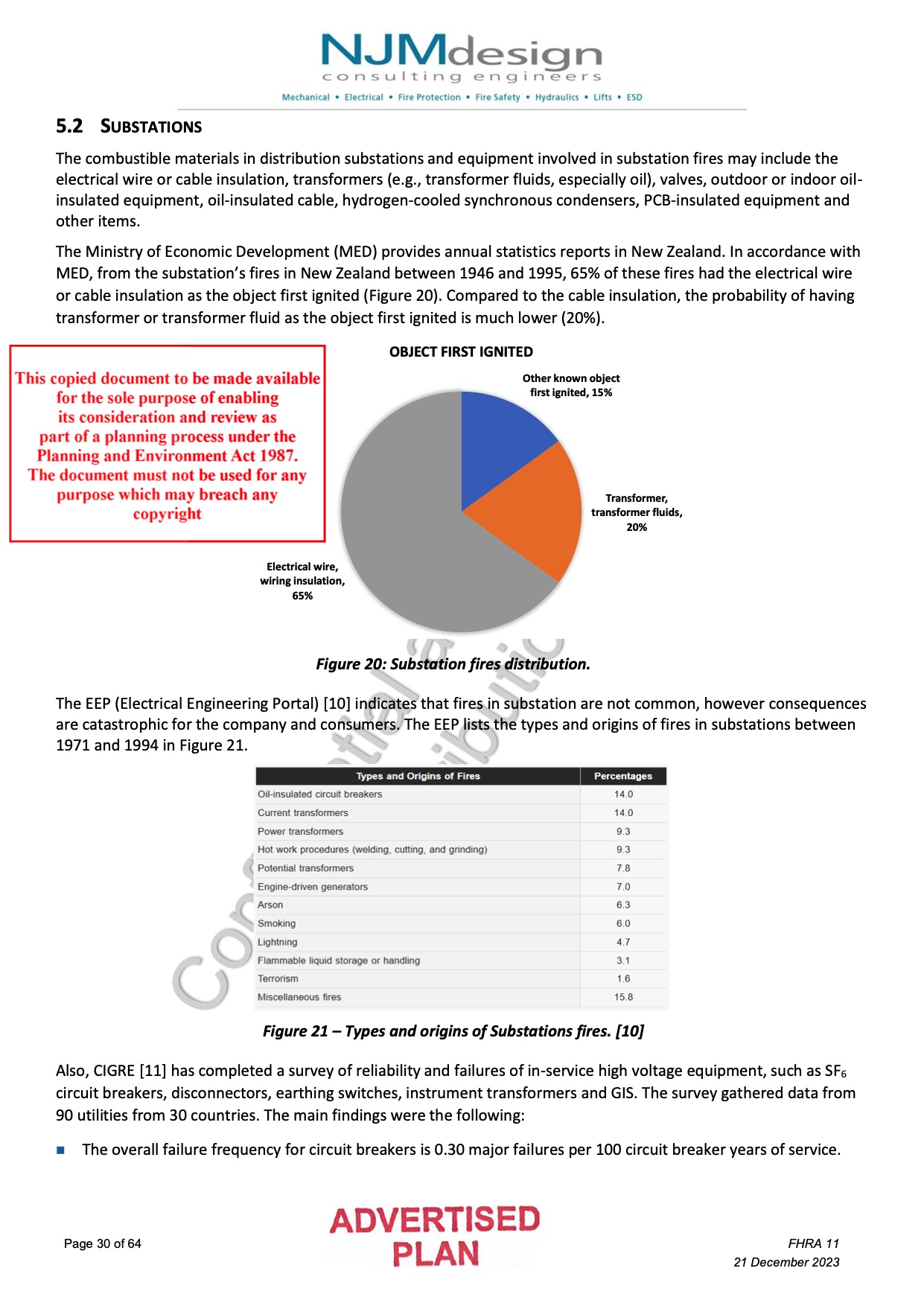
The Ministry of Economic Development (MED) provides annual statistics reports in New Zealand. In accordance with MED, from the substation’s fires in New Zealand between 1946 and 1995, 65% of these fires had the electrical wire or cable insulation as the object first ignited (Figure 20). Compared to the cable insulation, the probability of having transformer or transformer fluid as the object first ignited is much lower (20%).
Figure 20: Substation fires distribution.
The EEP (Electrical Engineering Portal) [10] indicates that fires in substation are not common, however consequences are catastrophic for the company and consumers. The EEP lists the types and origins of fires in substations between 1971 and 1994 in Figure 21.
Figure 21 – Types and origins of Substations fires. [10]
Also, CIGRE [11] has completed a survey of reliability and failures of in-service high voltage equipment, such as SF6 circuit breakers, disconnectors, earthing switches, instrument transformers and GIS. The survey gathered data from 90 utilities from 30 countries. The main findings were the following:
◼ The overall failure frequency for circuit breakers is 0.30 major failures per 100 circuit breaker years of service.
Page 30 of 64 FHRA 11 21 December 2023
OBJECT FIRST IGNITED
Other known object first ignited, 15%
Transformer, transformer fluids, 20%
Electrical wire, wiring insulation, 65%
|