Search Completed | Title | Fire Hazard and Risk Assessment Battery Energy Storage System (BESS)
Original File Name Searched: BESS-Amendment-Fire-Hazard-Risk-Assessment.pdf | Google It | Yahoo | Bing
Page | 069 Fisher Engineering, Inc. Energy Safety Response Group
only limited functionality. This prevented some of the safety features of MP-1 from actively
monitoring and interrupting the electrical fault conditions before escalating into a fire event.
3. The exposure of liquid coolant onto the battery modules likely disabled the power supply to the circuit
that actuates the pyro disconnect.7 With a power supply failure, the pyro disconnect would not receive a signal to sever and would not be able to interrupt a fault current passing through the battery module prior to it escalating into a fire event.
Fire Propagation Investigation
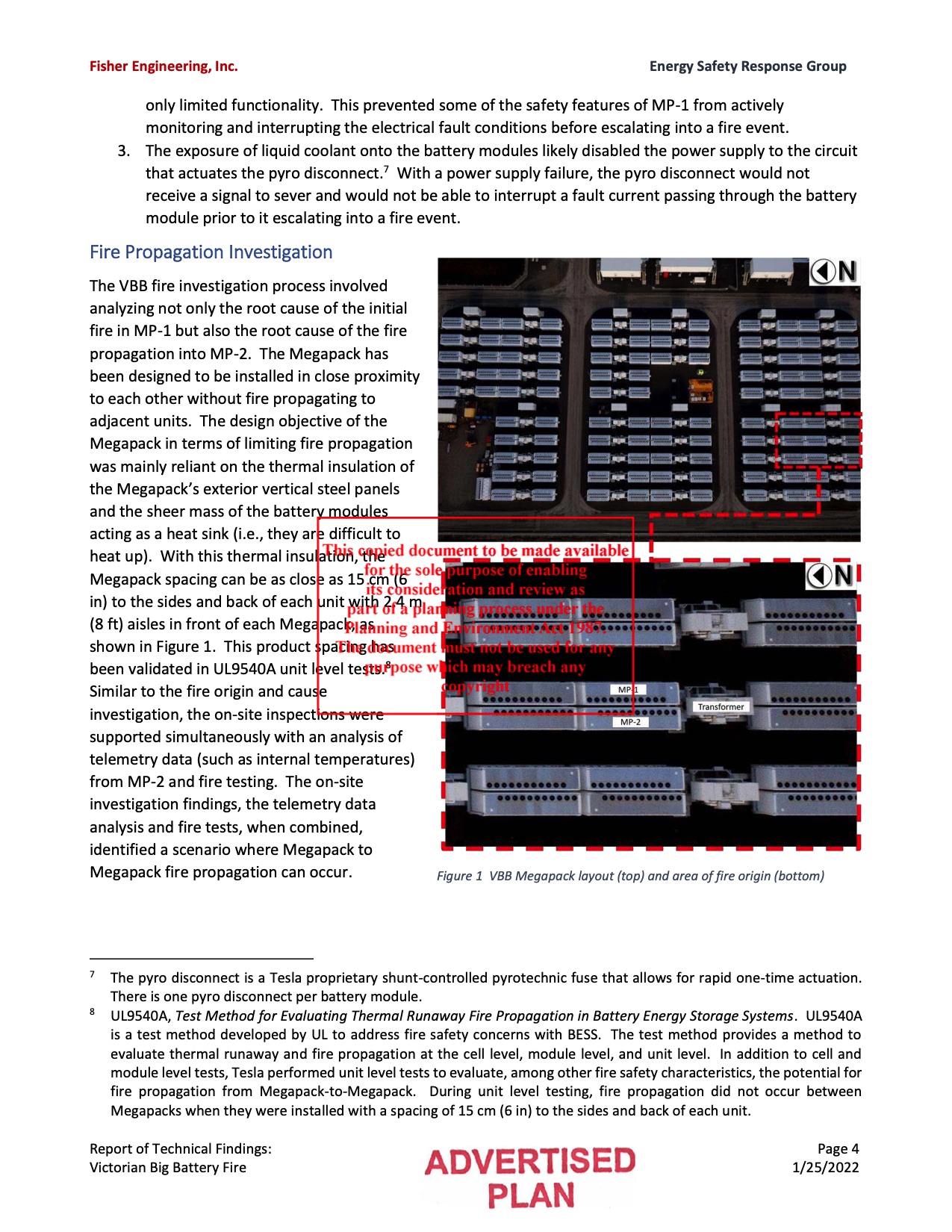
The VBB fire investigation process involved analyzing not only the root cause of the initial fire in MP-1 but also the root cause of the fire propagation into MP-2. The Megapack has been designed to be installed in close proximity to each other without fire propagating to adjacent units. The design objective of the Megapack in terms of limiting fire propagation was mainly reliant on the thermal insulation of the Megapack’s exterior vertical steel panels and the sheer mass of the battery modules acting as a heat sink (i.e., they are difficult to heat up). With this thermal insulation, the Megapack spacing can be as close as 15 cm (6 in) to the sides and back of each unit with 2.4 m (8 ft) aisles in front of each Megapack, as shown in Figure 1. This product spacing has been validated in UL9540A unit level tests.8 Similar to the fire origin and cause investigation, the on-site inspections were supported simultaneously with an analysis of telemetry data (such as internal temperatures) from MP-2 and fire testing. The on-site investigation findings, the telemetry data analysis and fire tests, when combined, identified a scenario where Megapack to Megapack fire propagation can occur.
7
8
Report of Technical Findings: Page 4 Victorian Big Battery Fire 1/25/2022
Figure 1 VBB Megapack layout (top) and area of fire origin (bottom)
The pyro disconnect is a Tesla proprietary shunt-controlled pyrotechnic fuse that allows for rapid one-time actuation. There is one pyro disconnect per battery module.
UL9540A, Test Method for Evaluating Thermal Runaway Fire Propagation in Battery Energy Storage Systems. UL9540A is a test method developed by UL to address fire safety concerns with BESS. The test method provides a method to evaluate thermal runaway and fire propagation at the cell level, module level, and unit level. In addition to cell and module level tests, Tesla performed unit level tests to evaluate, among other fire safety characteristics, the potential for fire propagation from Megapack-to-Megapack. During unit level testing, fire propagation did not occur between Megapacks when they were installed with a spacing of 15 cm (6 in) to the sides and back of each unit.
|