Search Completed | Title | GUIDE Lithium Ion and Sodium Ion Batteries 147 Hazards
Original File Name Searched: Guide_147.pdf | Google It | Yahoo | Bing
Page | 002 Lithium Ion and Sodium Ion Batteries GUIDE 147
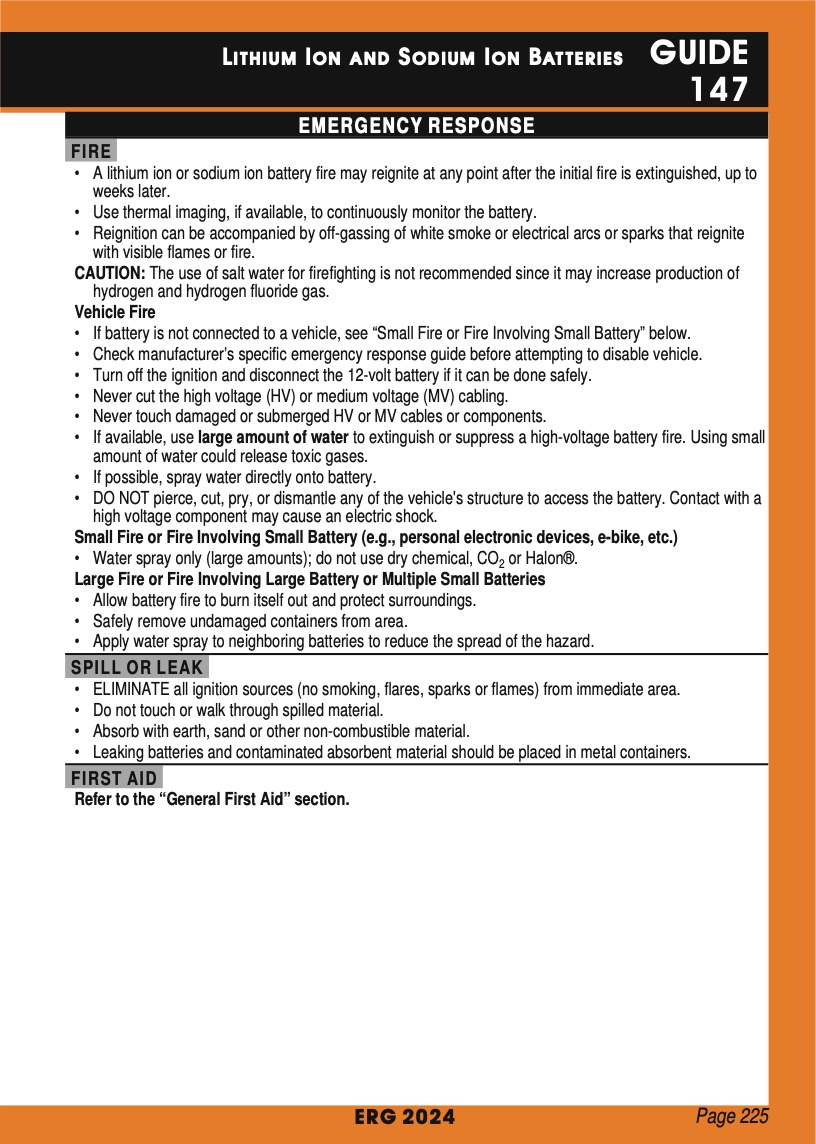
EMERGENCY RESPONSE
FIRE
• A lithium ion or sodium ion battery fire may reignite at any point after the initial fire is extinguished, up to weeks later.
• Use thermal imaging, if available, to continuously monitor the battery.
• Reignition can be accompanied by off-gassing of white smoke or electrical arcs or sparks that reignite
with visible flames or fire.
CAUTION: The use of salt water for firefighting is not recommended since it may increase production of
hydrogen and hydrogen fluoride gas.
Vehicle Fire
• If battery is not connected to a vehicle, see “Small Fire or Fire Involving Small Battery” below.
• Check manufacturer’s specific emergency response guide before attempting to disable vehicle.
• Turn off the ignition and disconnect the 12-volt battery if it can be done safely.
• Never cut the high voltage (HV) or medium voltage (MV) cabling.
• Never touch damaged or submerged HV or MV cables or components.
• If available, use large amount of water to extinguish or suppress a high-voltage battery fire. Using small
amount of water could release toxic gases.
• If possible, spray water directly onto battery.
• DO NOT pierce, cut, pry, or dismantle any of the vehicle's structure to access the battery. Contact with a
high voltage component may cause an electric shock.
Small Fire or Fire Involving Small Battery (e.g., personal electronic devices, e-bike, etc.)
• Water spray only (large amounts); do not use dry chemical, CO2 or Halon®.
Large Fire or Fire Involving Large Battery or Multiple Small Batteries
• Allow battery fire to burn itself out and protect surroundings.
• Safely remove undamaged containers from area.
• Apply water spray to neighboring batteries to reduce the spread of the hazard.
SPILL OR LEAK
• ELIMINATE all ignition sources (no smoking, flares, sparks or flames) from immediate area.
• Do not touch or walk through spilled material.
• Absorb with earth, sand or other non-combustible material.
• Leaking batteries and contaminated absorbent material should be placed in metal containers.
FIRST AID
Refer to the “General First Aid” section.
ERG 2024 Page 225
|