Page | 004 Not All Batteries Are Created Equal
Even within the category of lithium batteries, there lies a host of different battery compositions — and each has their own unique characteristics. These specific characteristics include nominal DC voltage, charge and discharge rate, lifespan, and specific energy (capacity). Different battery types are better suited for different use cases (for example, some are better suited for electric vehicles while others are better suited for cordless tools). Below are a few of the more common types of lithium battery compositions and their associated thermal runaway threshold temperatures according to Battery University.
Lithium Iron Phosphate
Lithium Nickel Manganese Cobalt Oxide
Lithium Nickel Cobalt Aluminum Oxide
Lithium Manganese Oxide Lithium Cobalt Oxide Lithium Titanate Oxide
LiFePO4 - (LFP ) LiNiMnCoO2 - (NMC)
LiNiCoAlO2 - (NCA)
LiMn2O4 - (LMO) LiCoO2 (LCO) Li2TiO3 - (LTO)
270°C 210°C
150°C
250°C 150°C 177°C
Lithium-ion Fires Present a Unique Challenge for Fire Fighters
Thermal runaway presents a unique situation for firefighters that is a major safety concern. In the unfortunate event a battery does experience a complete meltdown, standard firefighting practices may not apply. In a “normal” combustion event as
with flammable and combustible chemicals, the “fire triangle” concept applies. The three points of the triangle are ignition source, air (oxygen), and the fuel source. Remove any one of these three points and the fire is extinguished. In typical portable dry-chemical extinguishers, the fire is extinguished by “smothering” the combustion
process and removing oxygen. This isn’t the case with lithium-ion battery fires, as they are self-fueling by nature.
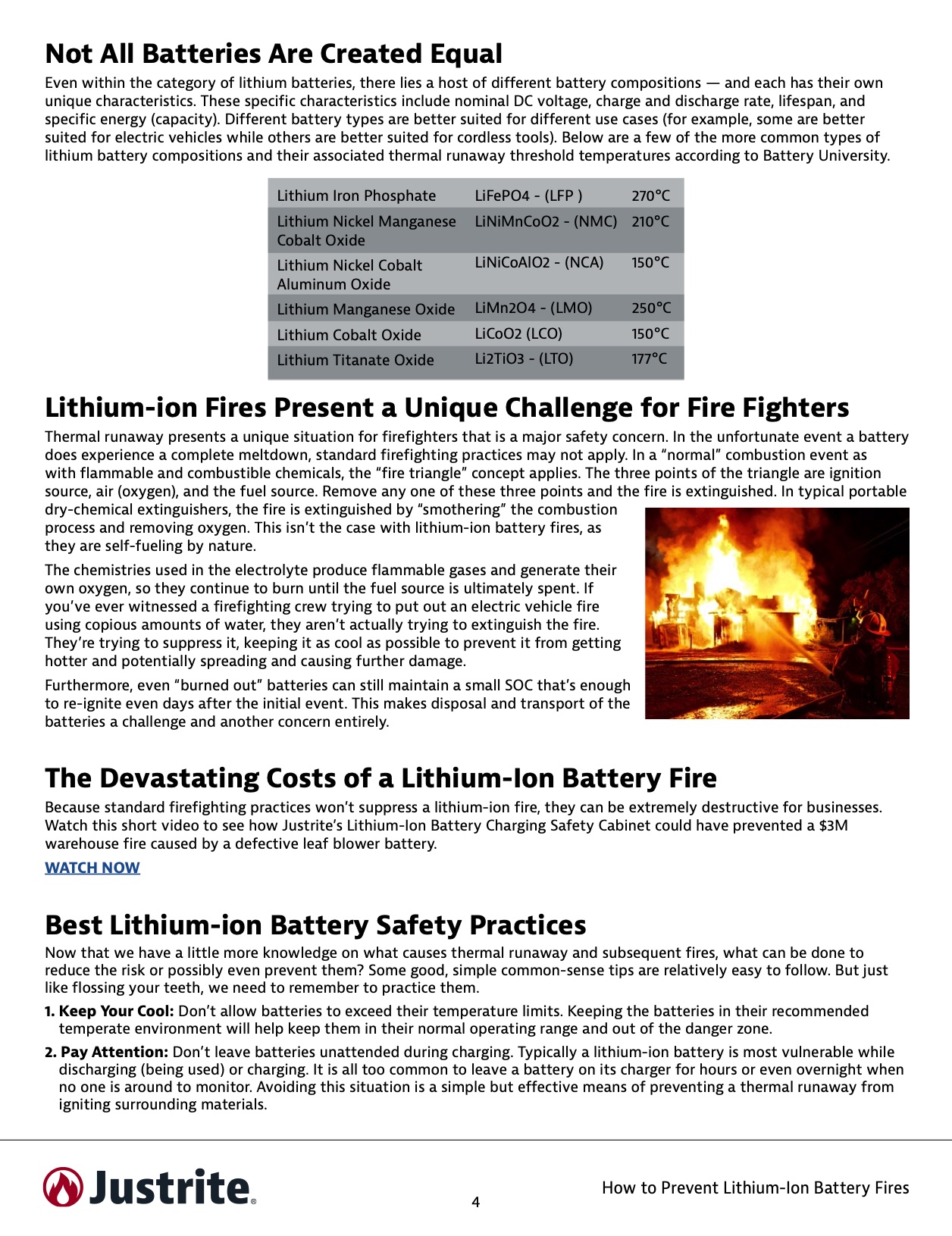
The chemistries used in the electrolyte produce flammable gases and generate their own oxygen, so they continue to burn until the fuel source is ultimately spent. If you’ve ever witnessed a firefighting crew trying to put out an electric vehicle fire using copious amounts of water, they aren’t actually trying to extinguish the fire. They’re trying to suppress it, keeping it as cool as possible to prevent it from getting hotter and potentially spreading and causing further damage.
Furthermore, even “burned out” batteries can still maintain a small SOC that’s enough to re-ignite even days after the initial event. This makes disposal and transport of the batteries a challenge and another concern entirely.
The Devastating Costs of a Lithium-Ion Battery Fire
Because standard firefighting practices won’t suppress a lithium-ion fire, they can be extremely destructive for businesses. Watch this short video to see how Justrite’s Lithium-Ion Battery Charging Safety Cabinet could have prevented a $3M warehouse fire caused by a defective leaf blower battery.
WATCH NOW
Best Lithium-ion Battery Safety Practices
Now that we have a little more knowledge on what causes thermal runaway and subsequent fires, what can be done to reduce the risk or possibly even prevent them? Some good, simple common-sense tips are relatively easy to follow. But just like flossing your teeth, we need to remember to practice them.
1. Keep Your Cool: Don’t allow batteries to exceed their temperature limits. Keeping the batteries in their recommended temperate environment will help keep them in their normal operating range and out of the danger zone.
2. Pay Attention: Don’t leave batteries unattended during charging. Typically a lithium-ion battery is most vulnerable while discharging (being used) or charging. It is all too common to leave a battery on its charger for hours or even overnight when no one is around to monitor. Avoiding this situation is a simple but effective means of preventing a thermal runaway from igniting surrounding materials.
4
How to Prevent Lithium-Ion Battery Fires
|