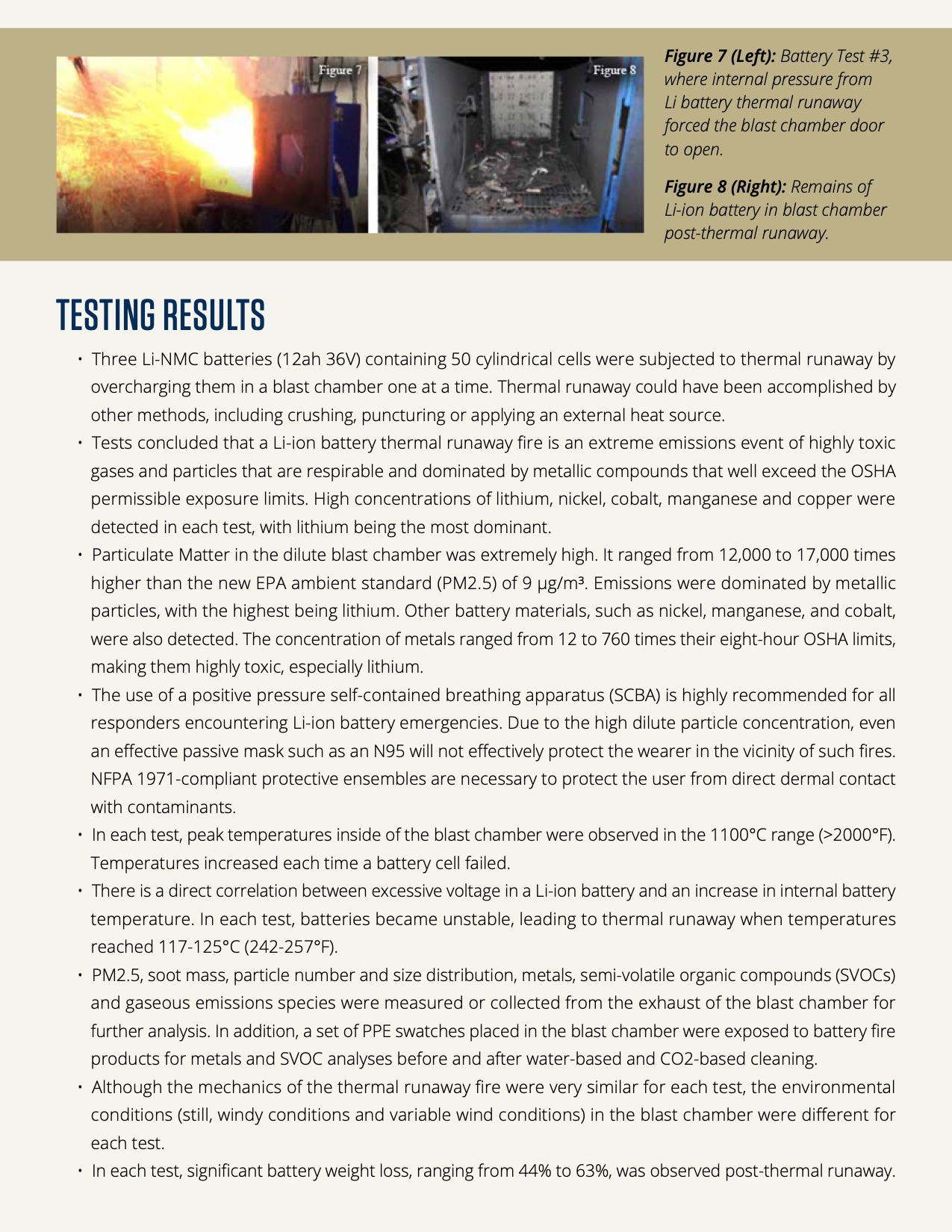
Page | 005 Figure 7 (Left): Battery Test #3, where internal pressure from
Li battery thermal runaway forced the blast chamber door to open.
Figure 8 (Right): Remains of Li-ion battery in blast chamber post-thermal runaway.
TESTING RESULTS
• Three Li-NMC batteries (12ah 36V) containing 50 cylindrical cells were subjected to thermal runaway by overcharging them in a blast chamber one at a time. Thermal runaway could have been accomplished by other methods, including crushing, puncturing or applying an external heat source.
• Tests concluded that a Li-ion battery thermal runaway fire is an extreme emissions event of highly toxic gases and particles that are respirable and dominated by metallic compounds that well exceed the OSHA permissible exposure limits. High concentrations of lithium, nickel, cobalt, manganese and copper were detected in each test, with lithium being the most dominant.
• Particulate Matter in the dilute blast chamber was extremely high. It ranged from 12,000 to 17,000 times higher than the new EPA ambient standard (PM2.5) of 9 μg/m3. Emissions were dominated by metallic particles, with the highest being lithium. Other battery materials, such as nickel, manganese, and cobalt, were also detected. The concentration of metals ranged from 12 to 760 times their eight-hour OSHA limits, making them highly toxic, especially lithium.
• The use of a positive pressure self-contained breathing apparatus (SCBA) is highly recommended for all responders encountering Li-ion battery emergencies. Due to the high dilute particle concentration, even an effective passive mask such as an N95 will not effectively protect the wearer in the vicinity of such fires. NFPA 1971-compliant protective ensembles are necessary to protect the user from direct dermal contact with contaminants.
• In each test, peak temperatures inside of the blast chamber were observed in the 1100°C range (>2000°F). Temperatures increased each time a battery cell failed.
• There is a direct correlation between excessive voltage in a Li-ion battery and an increase in internal battery temperature. In each test, batteries became unstable, leading to thermal runaway when temperatures reached 117-125°C (242-257°F).
• PM2.5, soot mass, particle number and size distribution, metals, semi-volatile organic compounds (SVOCs) and gaseous emissions species were measured or collected from the exhaust of the blast chamber for further analysis. In addition, a set of PPE swatches placed in the blast chamber were exposed to battery fire products for metals and SVOC analyses before and after water-based and CO2-based cleaning.
• Although the mechanics of the thermal runaway fire were very similar for each test, the environmental conditions (still, windy conditions and variable wind conditions) in the blast chamber were different for each test.
• In each test, significant battery weight loss, ranging from 44% to 63%, was observed post-thermal runaway.
|