Search Completed | Title | MEGAPACK 2 XL SAFETY OVERVIEW ENHANCED SAFETY ARCHITECTURE
Original File Name Searched: Megapack_2_XL_Safety_Overview.pdf | Google It | Yahoo | Bing
Page | 002 MEGAPACK 2 XL SAFETY OVERVIEW
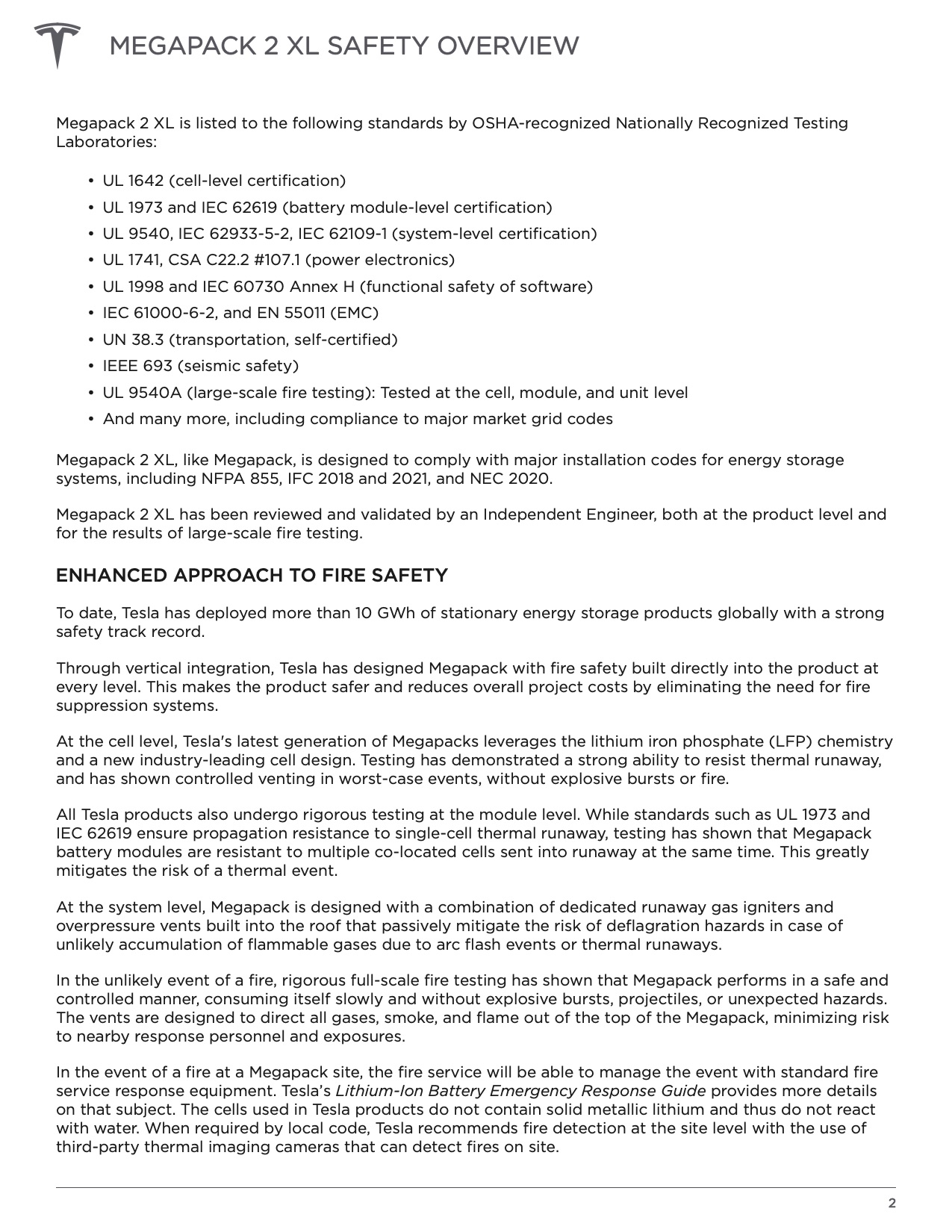
Megapack 2 XL is listed to the following standards by OSHA-recognized Nationally Recognized Testing Laboratories:
• UL 1642 (cell-level certification)
• UL 1973 and IEC 62619 (battery module-level certification)
• UL 9540, IEC 62933-5-2, IEC 62109-1 (system-level certification)
• UL 1741, CSA C22.2 #107.1 (power electronics)
• UL 1998 and IEC 60730 Annex H (functional safety of software)
• IEC 61000-6-2, and EN 55011 (EMC)
• UN 38.3 (transportation, self-certified)
• IEEE 693 (seismic safety)
• UL 9540A (large-scale fire testing): Tested at the cell, module, and unit level • And many more, including compliance to major market grid codes
Megapack 2 XL, like Megapack, is designed to comply with major installation codes for energy storage systems, including NFPA 855, IFC 2018 and 2021, and NEC 2020.
Megapack 2 XL has been reviewed and validated by an Independent Engineer, both at the product level and for the results of large-scale fire testing.
ENHANCED APPROACH TO FIRE SAFETY
To date, Tesla has deployed more than 10 GWh of stationary energy storage products globally with a strong safety track record.
Through vertical integration, Tesla has designed Megapack with fire safety built directly into the product at every level. This makes the product safer and reduces overall project costs by eliminating the need for fire suppression systems.
At the cell level, Tesla's latest generation of Megapacks leverages the lithium iron phosphate (LFP) chemistry and a new industry-leading cell design. Testing has demonstrated a strong ability to resist thermal runaway, and has shown controlled venting in worst-case events, without explosive bursts or fire.
All Tesla products also undergo rigorous testing at the module level. While standards such as UL 1973 and IEC 62619 ensure propagation resistance to single-cell thermal runaway, testing has shown that Megapack battery modules are resistant to multiple co-located cells sent into runaway at the same time. This greatly mitigates the risk of a thermal event.
At the system level, Megapack is designed with a combination of dedicated runaway gas igniters and overpressure vents built into the roof that passively mitigate the risk of deflagration hazards in case of unlikely accumulation of flammable gases due to arc flash events or thermal runaways.
In the unlikely event of a fire, rigorous full-scale fire testing has shown that Megapack performs in a safe and controlled manner, consuming itself slowly and without explosive bursts, projectiles, or unexpected hazards. The vents are designed to direct all gases, smoke, and flame out of the top of the Megapack, minimizing risk to nearby response personnel and exposures.
In the event of a fire at a Megapack site, the fire service will be able to manage the event with standard fire service response equipment. Tesla’s Lithium-Ion Battery Emergency Response Guide provides more details on that subject. The cells used in Tesla products do not contain solid metallic lithium and thus do not react with water. When required by local code, Tesla recommends fire detection at the site level with the use of third-party thermal imaging cameras that can detect fires on site.
2
|