Search Completed | Title | Safety of Grid Scale Lithium-ion Battery Energy Storage Systems
Original File Name Searched: EN010106-004026-DL2-Li-ion-BESS-safety-concerns_Redacted.pdf | Google It | Yahoo | Bing
Page | 025 – 24 – June 5, 2021
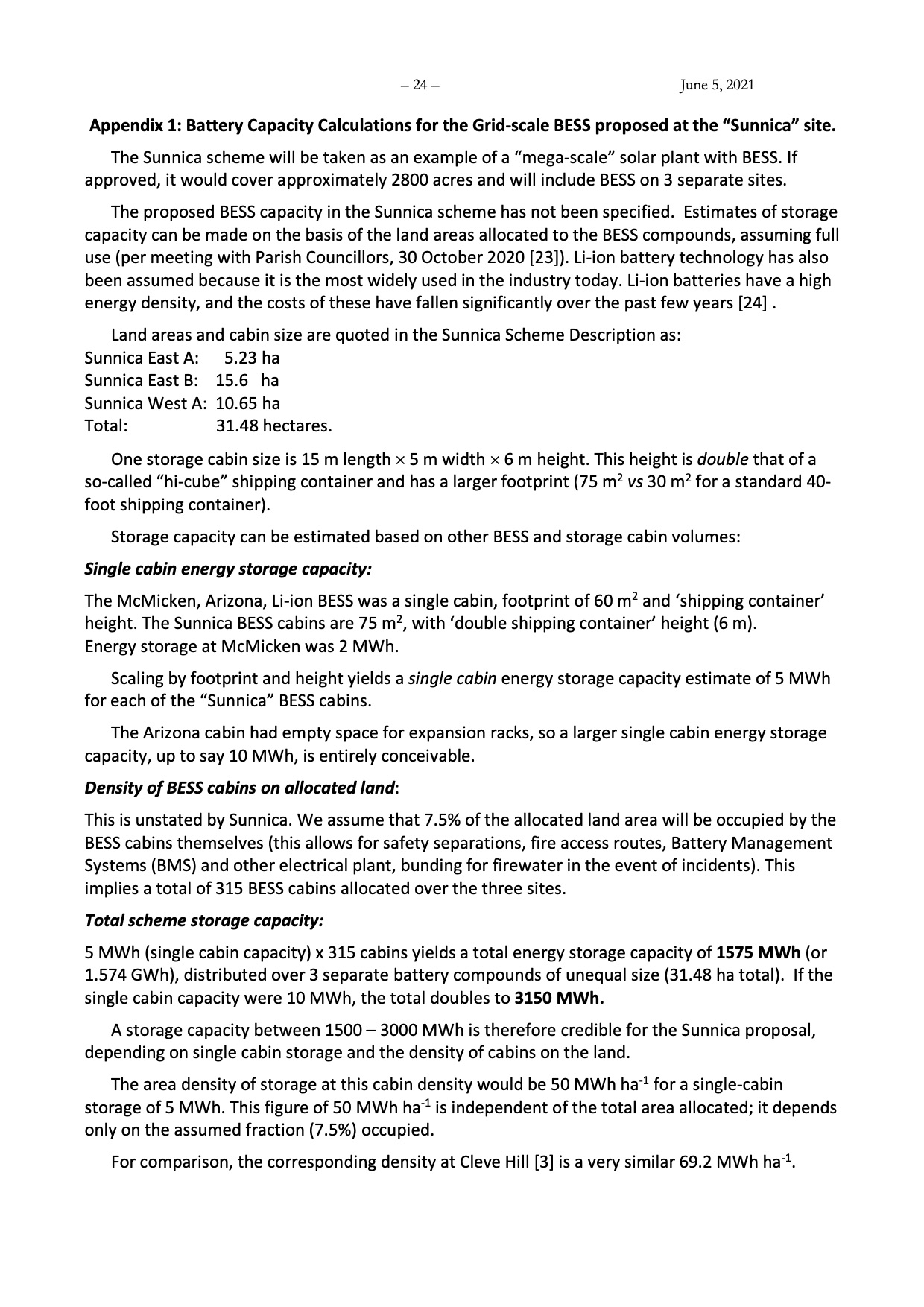
Appendix 1: Battery Capacity Calculations for the Grid-scale BESS proposed at the “Sunnica” site.
The Sunnica scheme will be taken as an example of a “mega-scale” solar plant with BESS. If approved, it would cover approximately 2800 acres and will include BESS on 3 separate sites.
The proposed BESS capacity in the Sunnica scheme has not been specified. Estimates of storage capacity can be made on the basis of the land areas allocated to the BESS compounds, assuming full use (per meeting with Parish Councillors, 30 October 2020 [23]). Li-ion battery technology has also been assumed because it is the most widely used in the industry today. Li-ion batteries have a high energy density, and the costs of these have fallen significantly over the past few years [24] .
Land areas and cabin size are quoted in the Sunnica Scheme Description as: Sunnica East A: 5.23 ha
Sunnica East B: 15.6 ha
Sunnica West A: 10.65 ha
Total: 31.48 hectares.
One storage cabin size is 15 m length ́ 5 m width ́ 6 m height. This height is double that of a so-called “hi-cube” shipping container and has a larger footprint (75 m2 vs 30 m2 for a standard 40- foot shipping container).
Storage capacity can be estimated based on other BESS and storage cabin volumes:
Single cabin energy storage capacity:
The McMicken, Arizona, Li-ion BESS was a single cabin, footprint of 60 m2 and ‘shipping container’ height. The Sunnica BESS cabins are 75 m2, with ‘double shipping container’ height (6 m).
Energy storage at McMicken was 2 MWh.
Scaling by footprint and height yields a single cabin energy storage capacity estimate of 5 MWh for each of the “Sunnica” BESS cabins.
The Arizona cabin had empty space for expansion racks, so a larger single cabin energy storage capacity, up to say 10 MWh, is entirely conceivable.
Density of BESS cabins on allocated land:
This is unstated by Sunnica. We assume that 7.5% of the allocated land area will be occupied by the BESS cabins themselves (this allows for safety separations, fire access routes, Battery Management Systems (BMS) and other electrical plant, bunding for firewater in the event of incidents). This implies a total of 315 BESS cabins allocated over the three sites.
Total scheme storage capacity:
5 MWh (single cabin capacity) x 315 cabins yields a total energy storage capacity of 1575 MWh (or 1.574 GWh), distributed over 3 separate battery compounds of unequal size (31.48 ha total). If the single cabin capacity were 10 MWh, the total doubles to 3150 MWh.
A storage capacity between 1500 – 3000 MWh is therefore credible for the Sunnica proposal, depending on single cabin storage and the density of cabins on the land.
The area density of storage at this cabin density would be 50 MWh ha-1 for a single-cabin storage of 5 MWh. This figure of 50 MWh ha-1 is independent of the total area allocated; it depends only on the assumed fraction (7.5%) occupied.
For comparison, the corresponding density at Cleve Hill [3] is a very similar 69.2 MWh ha-1.
|