
Infinity Turbine LLC

Safety of Grid Scale Lithium-ion Battery Energy Storage Systems


Lithium Hazard Technology Report
This comprehensive report provides a technical analysis of large-scale lithium energy storage systems, focusing on 1 MW+ containerized solutions. It delves into the risks of thermal runaway, fire hazards, and toxic gas emissions, along with strategies for fire prevention, monitoring, and site-specific installation considerations. Additionally, it covers the impact of lithium fires on insurance costs and outlines best practices for safety, scalability, and operational efficiency. Emerging technologies and regulatory frameworks are also discussed to provide actionable insights for manufacturers, operators, and policymakers.


Publication Title | Safety of Grid Scale Lithium-ion Battery Energy Storage Systems

Grid Scale Storage Publications Search

Search Lithium Fire Publications search was updated real-time via Filemaker on:

Search Lithium Fire Publications | Return to Search List

Search Completed | Title | Safety of Grid Scale Lithium-ion Battery Energy Storage Systems
Original File Name Searched: EN010106-004026-DL2-Li-ion-BESS-safety-concerns_Redacted.pdf | Google It | Yahoo | Bing

Previous Page | Next Page
safety-grid-scale-lithium-ion-battery-energy-storage-systems-026</TD> <TD valign=

Page | 026

– 25 – June 5, 2021
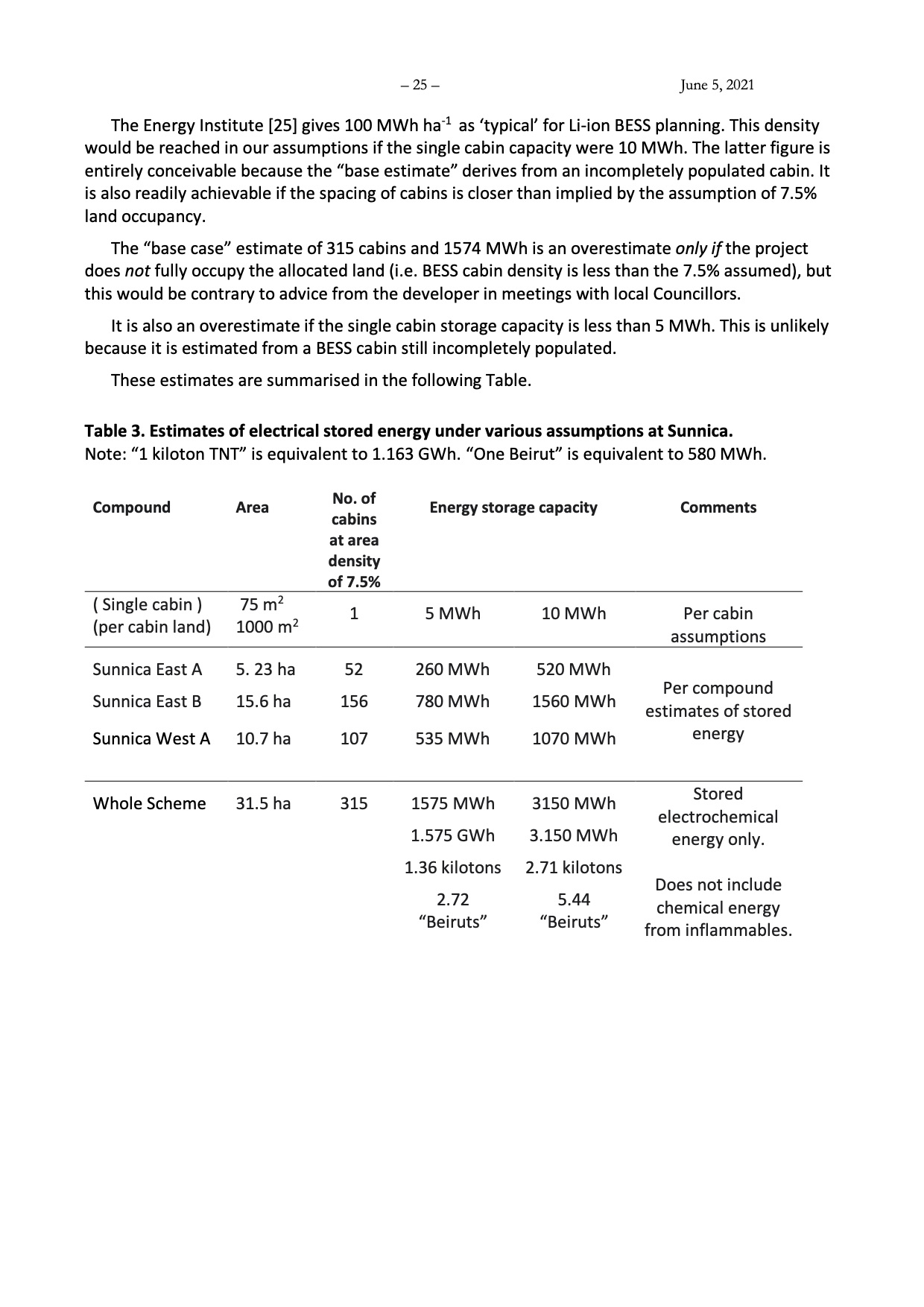
The Energy Institute [25] gives 100 MWh ha-1 as ‘typical’ for Li-ion BESS planning. This density would be reached in our assumptions if the single cabin capacity were 10 MWh. The latter figure is entirely conceivable because the “base estimate” derives from an incompletely populated cabin. It is also readily achievable if the spacing of cabins is closer than implied by the assumption of 7.5% land occupancy.
The “base case” estimate of 315 cabins and 1574 MWh is an overestimate only if the project does not fully occupy the allocated land (i.e. BESS cabin density is less than the 7.5% assumed), but this would be contrary to advice from the developer in meetings with local Councillors.
It is also an overestimate if the single cabin storage capacity is less than 5 MWh. This is unlikely because it is estimated from a BESS cabin still incompletely populated.
These estimates are summarised in the following Table.
Table 3. Estimates of electrical stored energy under various assumptions at Sunnica.
Note: “1 kiloton TNT” is equivalent to 1.163 GWh. “One Beirut” is equivalent to 580 MWh.
Compound
Sunnica East A Sunnica East B
Sunnica West A Whole Scheme
Area
5. 23 ha 15.6 ha
10.7 ha 31.5 ha
No. of cabins
1
52 156
107 315
Energy storage capacity
Comments
at area
density
( Single cabin )
75 m2
of 7.5%
(per cabin land)
1000 m2
5 MWh
260 MWh 780 MWh
535 MWh
1575 MWh
1.575 GWh
1.36 kilotons
2.72
“Beiruts”
10 MWh
520 MWh 1560 MWh
1070 MWh
3150 MWh 3.150 MWh 2.71 kilotons
5.44
“Beiruts”
Per cabin
assumptions
Per compound
estimates of stored
energy
Stored
electrochemical
energy only.
Does not include
chemical energy
from inflammables.

Search Contact: greg@infinityturbine.com