Search Completed | Title | Safety of Grid Scale Lithium-ion Battery Energy Storage Systems
Original File Name Searched: EN010106-004026-DL2-Li-ion-BESS-safety-concerns_Redacted.pdf | Google It | Yahoo | Bing
Page | 027 – 26 – June 5, 2021
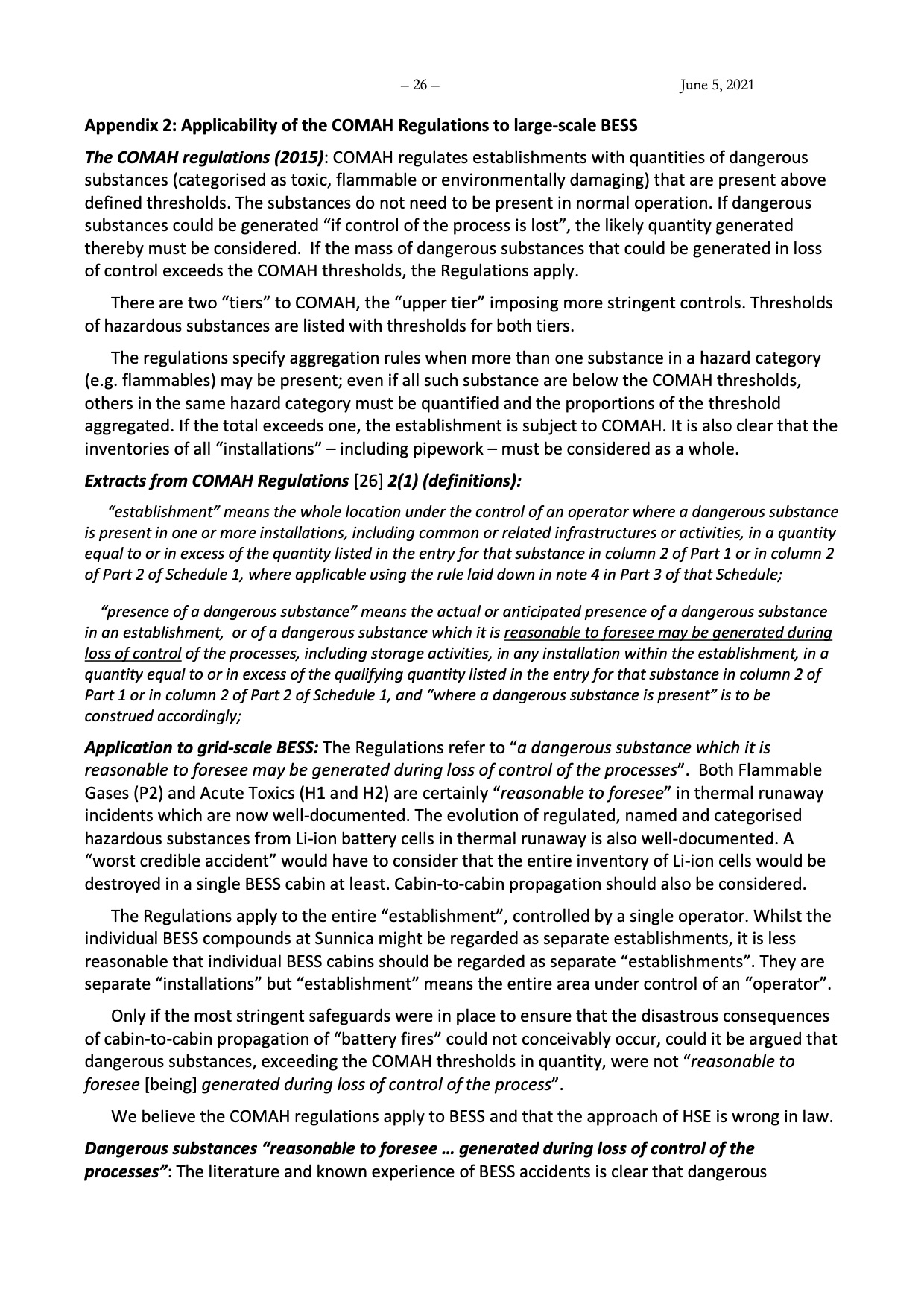
Appendix 2: Applicability of the COMAH Regulations to large-scale BESS
The COMAH regulations (2015): COMAH regulates establishments with quantities of dangerous substances (categorised as toxic, flammable or environmentally damaging) that are present above defined thresholds. The substances do not need to be present in normal operation. If dangerous substances could be generated “if control of the process is lost”, the likely quantity generated thereby must be considered. If the mass of dangerous substances that could be generated in loss of control exceeds the COMAH thresholds, the Regulations apply.
There are two “tiers” to COMAH, the “upper tier” imposing more stringent controls. Thresholds of hazardous substances are listed with thresholds for both tiers.
The regulations specify aggregation rules when more than one substance in a hazard category (e.g. flammables) may be present; even if all such substance are below the COMAH thresholds, others in the same hazard category must be quantified and the proportions of the threshold aggregated. If the total exceeds one, the establishment is subject to COMAH. It is also clear that the inventories of all “installations” – including pipework – must be considered as a whole.
Extracts from COMAH Regulations [26] 2(1) (definitions):
“establishment” means the whole location under the control of an operator where a dangerous substance is present in one or more installations, including common or related infrastructures or activities, in a quantity equal to or in excess of the quantity listed in the entry for that substance in column 2 of Part 1 or in column 2 of Part 2 of Schedule 1, where applicable using the rule laid down in note 4 in Part 3 of that Schedule;
“presence of a dangerous substance” means the actual or anticipated presence of a dangerous substance in an establishment, or of a dangerous substance which it is reasonable to foresee may be generated during loss of control of the processes, including storage activities, in any installation within the establishment, in a quantity equal to or in excess of the qualifying quantity listed in the entry for that substance in column 2 of Part 1 or in column 2 of Part 2 of Schedule 1, and “where a dangerous substance is present” is to be construed accordingly;
Application to grid-scale BESS: The Regulations refer to “a dangerous substance which it is reasonable to foresee may be generated during loss of control of the processes”. Both Flammable Gases (P2) and Acute Toxics (H1 and H2) are certainly “reasonable to foresee” in thermal runaway incidents which are now well-documented. The evolution of regulated, named and categorised hazardous substances from Li-ion battery cells in thermal runaway is also well-documented. A “worst credible accident” would have to consider that the entire inventory of Li-ion cells would be destroyed in a single BESS cabin at least. Cabin-to-cabin propagation should also be considered.
The Regulations apply to the entire “establishment”, controlled by a single operator. Whilst the individual BESS compounds at Sunnica might be regarded as separate establishments, it is less reasonable that individual BESS cabins should be regarded as separate “establishments”. They are separate “installations” but “establishment” means the entire area under control of an “operator”.
Only if the most stringent safeguards were in place to ensure that the disastrous consequences of cabin-to-cabin propagation of “battery fires” could not conceivably occur, could it be argued that dangerous substances, exceeding the COMAH thresholds in quantity, were not “reasonable to foresee [being] generated during loss of control of the process”.
We believe the COMAH regulations apply to BESS and that the approach of HSE is wrong in law.
Dangerous substances “reasonable to foresee ... generated during loss of control of the processes”: The literature and known experience of BESS accidents is clear that dangerous
|