
PDF Publication Title:
Text from PDF Page: 036
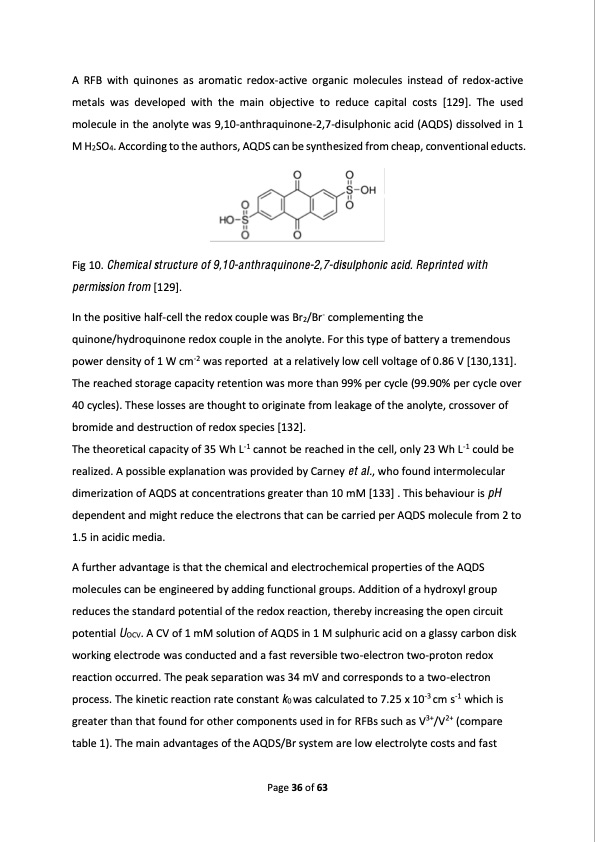
A RFB with quinones as aromatic redox-active organic molecules instead of redox-active metals was developed with the main objective to reduce capital costs [129]. The used molecule in the anolyte was 9,10-anthraquinone-2,7-disulphonic acid (AQDS) dissolved in 1 M H2SO4. According to the authors, AQDS can be synthesized from cheap, conventional educts. Fig 10. Chemical structure of 9,10-anthraquinone-2,7-disulphonic acid. Reprinted with permission from [129]. In the positive half-cell the redox couple was Br2/Br- complementing the quinone/hydroquinone redox couple in the anolyte. For this type of battery a tremendous power density of 1 W cm-2 was reported at a relatively low cell voltage of 0.86 V [130,131]. The reached storage capacity retention was more than 99% per cycle (99.90% per cycle over 40 cycles). These losses are thought to originate from leakage of the anolyte, crossover of bromide and destruction of redox species [132]. The theoretical capacity of 35 Wh L-1 cannot be reached in the cell, only 23 Wh L-1 could be realized. A possible explanation was provided by Carney et al., who found intermolecular dimerization of AQDS at concentrations greater than 10 mM [133] . This behaviour is pH dependent and might reduce the electrons that can be carried per AQDS molecule from 2 to 1.5 in acidic media. A further advantage is that the chemical and electrochemical properties of the AQDS molecules can be engineered by adding functional groups. Addition of a hydroxyl group reduces the standard potential of the redox reaction, thereby increasing the open circuit potential UOCV. A CV of 1 mM solution of AQDS in 1 M sulphuric acid on a glassy carbon disk working electrode was conducted and a fast reversible two-electron two-proton redox reaction occurred. The peak separation was 34 mV and corresponds to a two-electron process. The kinetic reaction rate constant k0 was calculated to 7.25 x 10⁻³ cm s-1 which is greater than that found for other components used in for RFBs such as V3+/V2+ (compare table 1). The main advantages of the AQDS/Br system are low electrolyte costs and fast Page 36 of 63PDF Image | Redox Flow Batteries Concepts Chemistries
PDF Search Title:
Redox Flow Batteries Concepts ChemistriesOriginal File Name Searched:
5870EAF5-2D70-44C8-A0A7-62D3A1462269.pdfDIY PDF Search: Google It | Yahoo | Bing
Salgenx Redox Flow Battery Technology: Salt water flow battery technology with low cost and great energy density that can be used for power storage and thermal storage. Let us de-risk your production using our license. Our aqueous flow battery is less cost than Tesla Megapack and available faster. Redox flow battery. No membrane needed like with Vanadium, or Bromine. Salgenx flow battery
| CONTACT TEL: 608-238-6001 Email: greg@salgenx.com | RSS | AMP |