
PDF Publication Title:
Text from PDF Page: 125
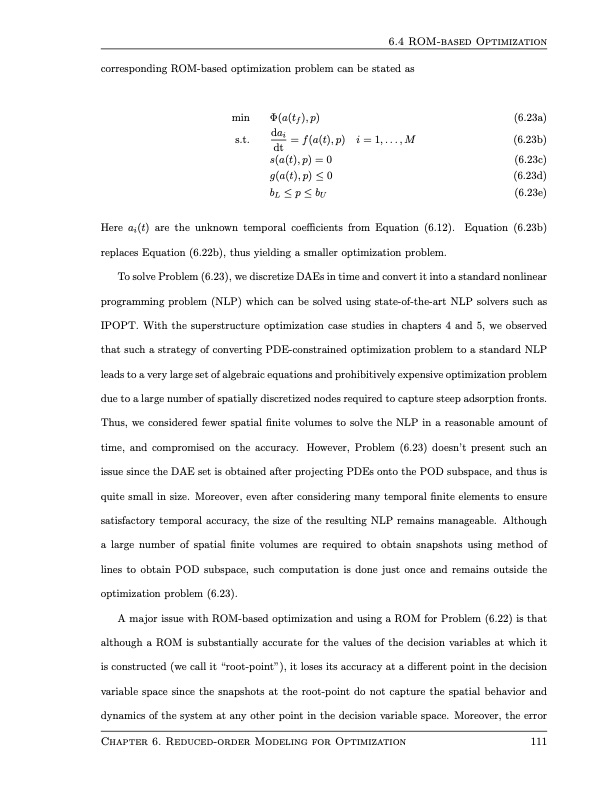
corresponding ROM-based optimization problem can be stated as min s.t. Φ(a(tf ), p) dai = f(a(t),p) i = 1,...,M (6.23a) (6.23b) (6.23c) (6.23d) (6.23e) dt s(a(t), p) = 0 g(a(t), p) ≤ 0 bL ≤ p ≤ bU Here ai(t) are the unknown temporal coefficients from Equation (6.12). Equation (6.23b) replaces Equation (6.22b), thus yielding a smaller optimization problem. To solve Problem (6.23), we discretize DAEs in time and convert it into a standard nonlinear programming problem (NLP) which can be solved using state-of-the-art NLP solvers such as IPOPT. With the superstructure optimization case studies in chapters 4 and 5, we observed that such a strategy of converting PDE-constrained optimization problem to a standard NLP leads to a very large set of algebraic equations and prohibitively expensive optimization problem due to a large number of spatially discretized nodes required to capture steep adsorption fronts. Thus, we considered fewer spatial finite volumes to solve the NLP in a reasonable amount of time, and compromised on the accuracy. However, Problem (6.23) doesn’t present such an issue since the DAE set is obtained after projecting PDEs onto the POD subspace, and thus is quite small in size. Moreover, even after considering many temporal finite elements to ensure satisfactory temporal accuracy, the size of the resulting NLP remains manageable. Although a large number of spatial finite volumes are required to obtain snapshots using method of lines to obtain POD subspace, such computation is done just once and remains outside the optimization problem (6.23). A major issue with ROM-based optimization and using a ROM for Problem (6.22) is that although a ROM is substantially accurate for the values of the decision variables at which it is constructed (we call it “root-point”), it loses its accuracy at a different point in the decision variable space since the snapshots at the root-point do not capture the spatial behavior and dynamics of the system at any other point in the decision variable space. Moreover, the error Chapter 6. Reduced-order Modeling for Optimization 111 6.4 ROM-based OptimizationPDF Image | Design and Operation of Pressure Swing Adsorption Processes
PDF Search Title:
Design and Operation of Pressure Swing Adsorption ProcessesOriginal File Name Searched:
anshul_thesis.pdfDIY PDF Search: Google It | Yahoo | Bing
CO2 Organic Rankine Cycle Experimenter Platform The supercritical CO2 phase change system is both a heat pump and organic rankine cycle which can be used for those purposes and as a supercritical extractor for advanced subcritical and supercritical extraction technology. Uses include producing nanoparticles, precious metal CO2 extraction, lithium battery recycling, and other applications... More Info
Heat Pumps CO2 ORC Heat Pump System Platform More Info
| CONTACT TEL: 608-238-6001 Email: greg@infinityturbine.com | RSS | AMP |