
PDF Publication Title:
Text from PDF Page: 142
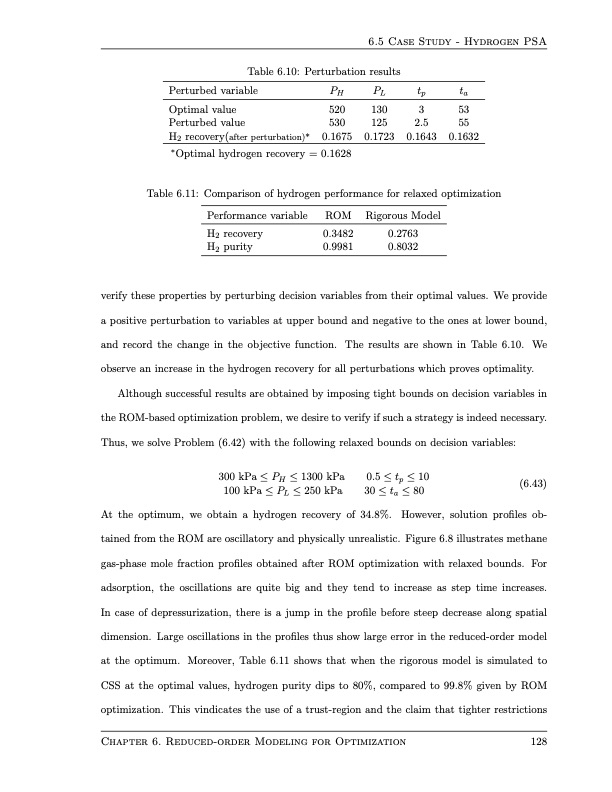
Table 6.10: Perturbation results Perturbed variable Optimal value Perturbed value H2 recovery(after perturbation)* Table 6.11: Comparison of hydrogen performance for relaxed optimization 6.5 Case Study - Hydrogen PSA PH PL tp ta 520 130 3 53 530 125 2.5 55 0.1632 0.1675 0.1723 0.1643 ∗Optimal hydrogen recovery = 0.1628 Performance variable H2 recovery H2 purity ROM 0.3482 0.9981 Rigorous Model 0.2763 0.8032 verify these properties by perturbing decision variables from their optimal values. We provide a positive perturbation to variables at upper bound and negative to the ones at lower bound, and record the change in the objective function. The results are shown in Table 6.10. We observe an increase in the hydrogen recovery for all perturbations which proves optimality. Although successful results are obtained by imposing tight bounds on decision variables in the ROM-based optimization problem, we desire to verify if such a strategy is indeed necessary. Thus, we solve Problem (6.42) with the following relaxed bounds on decision variables: 300kPa≤PH ≤1300kPa 0.5≤tp ≤10 100kPa≤PL ≤250kPa 30≤ta ≤80 (6.43) At the optimum, we obtain a hydrogen recovery of 34.8%. However, solution profiles ob- tained from the ROM are oscillatory and physically unrealistic. Figure 6.8 illustrates methane gas-phase mole fraction profiles obtained after ROM optimization with relaxed bounds. For adsorption, the oscillations are quite big and they tend to increase as step time increases. In case of depressurization, there is a jump in the profile before steep decrease along spatial dimension. Large oscillations in the profiles thus show large error in the reduced-order model at the optimum. Moreover, Table 6.11 shows that when the rigorous model is simulated to CSS at the optimal values, hydrogen purity dips to 80%, compared to 99.8% given by ROM optimization. This vindicates the use of a trust-region and the claim that tighter restrictions Chapter 6. Reduced-order Modeling for Optimization 128PDF Image | Design and Operation of Pressure Swing Adsorption Processes
PDF Search Title:
Design and Operation of Pressure Swing Adsorption ProcessesOriginal File Name Searched:
anshul_thesis.pdfDIY PDF Search: Google It | Yahoo | Bing
CO2 Organic Rankine Cycle Experimenter Platform The supercritical CO2 phase change system is both a heat pump and organic rankine cycle which can be used for those purposes and as a supercritical extractor for advanced subcritical and supercritical extraction technology. Uses include producing nanoparticles, precious metal CO2 extraction, lithium battery recycling, and other applications... More Info
Heat Pumps CO2 ORC Heat Pump System Platform More Info
| CONTACT TEL: 608-238-6001 Email: greg@infinityturbine.com | RSS | AMP |