
PDF Publication Title:
Text from PDF Page: 276
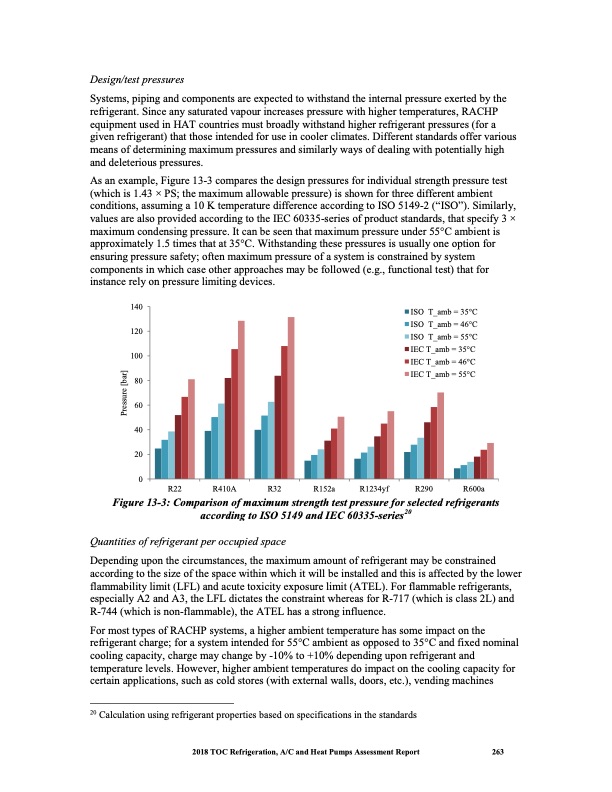
Design/test pressures Systems, piping and components are expected to withstand the internal pressure exerted by the refrigerant. Since any saturated vapour increases pressure with higher temperatures, RACHP equipment used in HAT countries must broadly withstand higher refrigerant pressures (for a given refrigerant) that those intended for use in cooler climates. Different standards offer various means of determining maximum pressures and similarly ways of dealing with potentially high and deleterious pressures. As an example, Figure 13-3 compares the design pressures for individual strength pressure test (which is 1.43 × PS; the maximum allowable pressure) is shown for three different ambient conditions, assuming a 10 K temperature difference according to ISO 5149-2 (“ISO”). Similarly, values are also provided according to the IEC 60335-series of product standards, that specify 3 × maximum condensing pressure. It can be seen that maximum pressure under 55°C ambient is approximately 1.5 times that at 35°C. Withstanding these pressures is usually one option for ensuring pressure safety; often maximum pressure of a system is constrained by system components in which case other approaches may be followed (e.g., functional test) that for instance rely on pressure limiting devices. 140 120 100 80 60 40 20 0 R22 R410A R32 R152a R1234yf ISO T_amb = 35°C ISO T_amb = 46°C ISO T_amb = 55°C IEC T_amb = 35°C IEC T_amb = 46°C IEC T_amb = 55°C R290 R600a Figure 13-3: Comparison of maximum strength test pressure for selected refrigerants according to ISO 5149 and IEC 60335-series20 Quantities of refrigerant per occupied space Depending upon the circumstances, the maximum amount of refrigerant may be constrained according to the size of the space within which it will be installed and this is affected by the lower flammability limit (LFL) and acute toxicity exposure limit (ATEL). For flammable refrigerants, especially A2 and A3, the LFL dictates the constraint whereas for R-717 (which is class 2L) and R-744 (which is non-flammable), the ATEL has a strong influence. For most types of RACHP systems, a higher ambient temperature has some impact on the refrigerant charge; for a system intended for 55°C ambient as opposed to 35°C and fixed nominal cooling capacity, charge may change by -10% to +10% depending upon refrigerant and temperature levels. However, higher ambient temperatures do impact on the cooling capacity for certain applications, such as cold stores (with external walls, doors, etc.), vending machines 20 Calculation using refrigerant properties based on specifications in the standards 2018 TOC Refrigeration, A/C and Heat Pumps Assessment Report 263 Pressure [bar]PDF Image | Heat Pumps Technical Options
PDF Search Title:
Heat Pumps Technical OptionsOriginal File Name Searched:
RTOC-assessment-report-2018_0.pdfDIY PDF Search: Google It | Yahoo | Bing
CO2 Organic Rankine Cycle Experimenter Platform The supercritical CO2 phase change system is both a heat pump and organic rankine cycle which can be used for those purposes and as a supercritical extractor for advanced subcritical and supercritical extraction technology. Uses include producing nanoparticles, precious metal CO2 extraction, lithium battery recycling, and other applications... More Info
Heat Pumps CO2 ORC Heat Pump System Platform More Info
| CONTACT TEL: 608-238-6001 Email: greg@infinityturbine.com | RSS | AMP |