
PDF Publication Title:
Text from PDF Page: 277
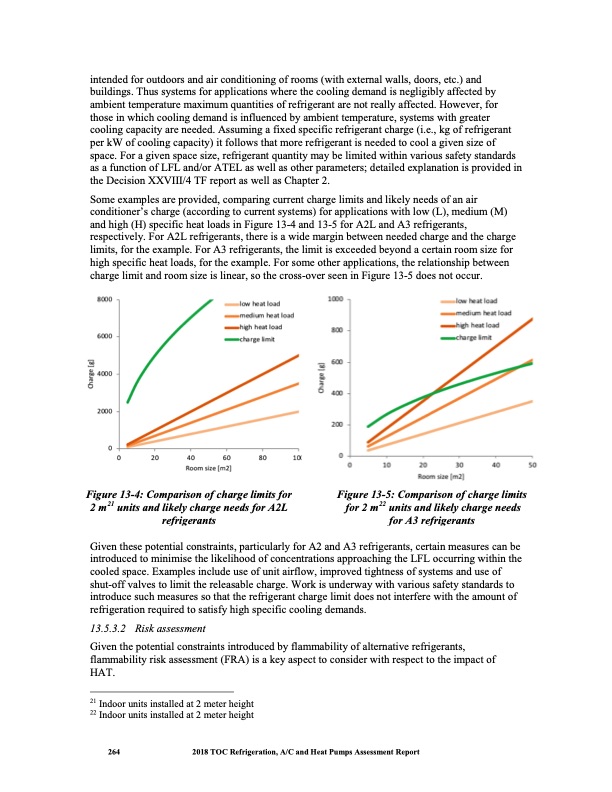
intended for outdoors and air conditioning of rooms (with external walls, doors, etc.) and buildings. Thus systems for applications where the cooling demand is negligibly affected by ambient temperature maximum quantities of refrigerant are not really affected. However, for those in which cooling demand is influenced by ambient temperature, systems with greater cooling capacity are needed. Assuming a fixed specific refrigerant charge (i.e., kg of refrigerant per kW of cooling capacity) it follows that more refrigerant is needed to cool a given size of space. For a given space size, refrigerant quantity may be limited within various safety standards as a function of LFL and/or ATEL as well as other parameters; detailed explanation is provided in the Decision XXVIII/4 TF report as well as Chapter 2. Some examples are provided, comparing current charge limits and likely needs of an air conditioner’s charge (according to current systems) for applications with low (L), medium (M) and high (H) specific heat loads in Figure 13-4 and 13-5 for A2L and A3 refrigerants, respectively. For A2L refrigerants, there is a wide margin between needed charge and the charge limits, for the example. For A3 refrigerants, the limit is exceeded beyond a certain room size for high specific heat loads, for the example. For some other applications, the relationship between charge limit and room size is linear, so the cross-over seen in Figure 13-5 does not occur. Figure 13-4: Comparison of charge limits for 2 m21 units and likely charge needs for A2L refrigerants Figure 13-5: Comparison of charge limits for 2 m22 units and likely charge needs for A3 refrigerants Given these potential constraints, particularly for A2 and A3 refrigerants, certain measures can be introduced to minimise the likelihood of concentrations approaching the LFL occurring within the cooled space. Examples include use of unit airflow, improved tightness of systems and use of shut-off valves to limit the releasable charge. Work is underway with various safety standards to introduce such measures so that the refrigerant charge limit does not interfere with the amount of refrigeration required to satisfy high specific cooling demands. 13.5.3.2 Risk assessment Given the potential constraints introduced by flammability of alternative refrigerants, flammability risk assessment (FRA) is a key aspect to consider with respect to the impact of HAT. 21 Indoor units installed at 2 meter height 22 Indoor units installed at 2 meter height 264 2018 TOC Refrigeration, A/C and Heat Pumps Assessment ReportPDF Image | Heat Pumps Technical Options
PDF Search Title:
Heat Pumps Technical OptionsOriginal File Name Searched:
RTOC-assessment-report-2018_0.pdfDIY PDF Search: Google It | Yahoo | Bing
CO2 Organic Rankine Cycle Experimenter Platform The supercritical CO2 phase change system is both a heat pump and organic rankine cycle which can be used for those purposes and as a supercritical extractor for advanced subcritical and supercritical extraction technology. Uses include producing nanoparticles, precious metal CO2 extraction, lithium battery recycling, and other applications... More Info
Heat Pumps CO2 ORC Heat Pump System Platform More Info
| CONTACT TEL: 608-238-6001 Email: greg@infinityturbine.com | RSS | AMP |