
PDF Publication Title:
Text from PDF Page: 278
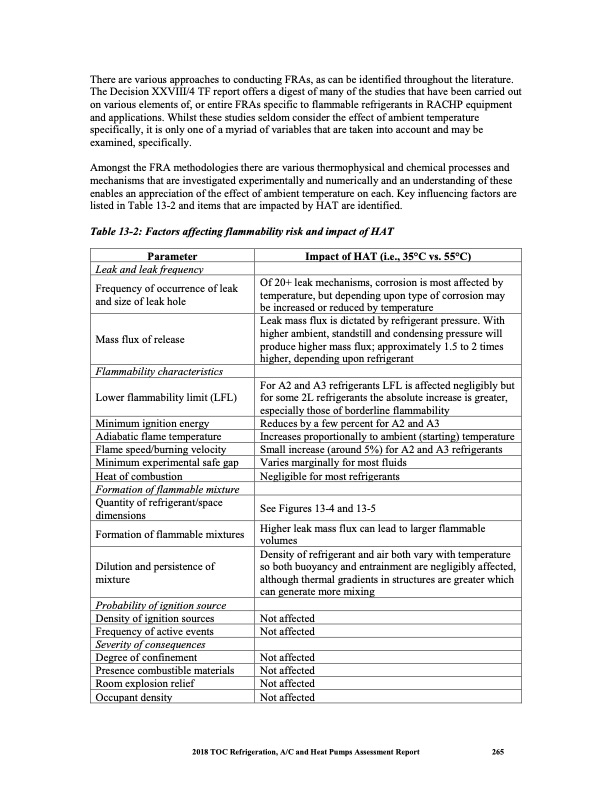
There are various approaches to conducting FRAs, as can be identified throughout the literature. The Decision XXVIII/4 TF report offers a digest of many of the studies that have been carried out on various elements of, or entire FRAs specific to flammable refrigerants in RACHP equipment and applications. Whilst these studies seldom consider the effect of ambient temperature specifically, it is only one of a myriad of variables that are taken into account and may be examined, specifically. Amongst the FRA methodologies there are various thermophysical and chemical processes and mechanisms that are investigated experimentally and numerically and an understanding of these enables an appreciation of the effect of ambient temperature on each. Key influencing factors are listed in Table 13-2 and items that are impacted by HAT are identified. Table 13-2: Factors affecting flammability risk and impact of HAT Parameter Leak and leak frequency Frequency of occurrence of leak and size of leak hole Flammability characteristics Lower flammability limit (LFL) Minimum ignition energy Adiabatic flame temperature Flame speed/burning velocity Minimum experimental safe gap Heat of combustion Formation of flammable mixture Quantity of refrigerant/space dimensions Formation of flammable mixtures Probability of ignition source Density of ignition sources Frequency of active events Severity of consequences Degree of confinement Presence combustible materials Room explosion relief Occupant density Impact of HAT (i.e., 35°C vs. 55°C) Of 20+ leak mechanisms, corrosion is most affected by temperature, but depending upon type of corrosion may be increased or reduced by temperature For A2 and A3 refrigerants LFL is affected negligibly but for some 2L refrigerants the absolute increase is greater, especially those of borderline flammability Reduces by a few percent for A2 and A3 Increases proportionally to ambient (starting) temperature Small increase (around 5%) for A2 and A3 refrigerants Varies marginally for most fluids Negligible for most refrigerants See Figures 13-4 and 13-5 Higher leak mass flux can lead to larger flammable volumes Not affected Not affected Not affected Not affected Not affected Not affected Mass flux of release Leak mass flux is dictated by refrigerant pressure. With higher ambient, standstill and condensing pressure will produce higher mass flux; approximately 1.5 to 2 times higher, depending upon refrigerant Dilution and persistence of mixture Density of refrigerant and air both vary with temperature so both buoyancy and entrainment are negligibly affected, although thermal gradients in structures are greater which can generate more mixing 2018 TOC Refrigeration, A/C and Heat Pumps Assessment Report 265PDF Image | Heat Pumps Technical Options
PDF Search Title:
Heat Pumps Technical OptionsOriginal File Name Searched:
RTOC-assessment-report-2018_0.pdfDIY PDF Search: Google It | Yahoo | Bing
CO2 Organic Rankine Cycle Experimenter Platform The supercritical CO2 phase change system is both a heat pump and organic rankine cycle which can be used for those purposes and as a supercritical extractor for advanced subcritical and supercritical extraction technology. Uses include producing nanoparticles, precious metal CO2 extraction, lithium battery recycling, and other applications... More Info
Heat Pumps CO2 ORC Heat Pump System Platform More Info
| CONTACT TEL: 608-238-6001 Email: greg@infinityturbine.com | RSS | AMP |