
|
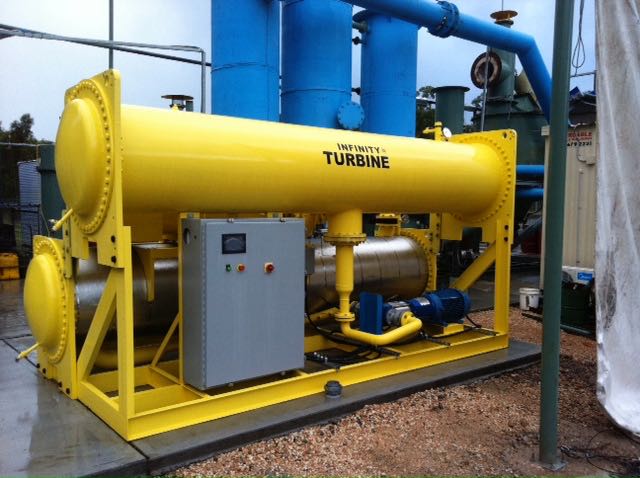
About Infinity Turbine LLC Waste Heat Power: For years we've been hearing requests from customers who would like to use their waste heat to generate power, both on land and marine applications. To meet that demand, we formed Infinity Turbine LLC in 2008 and developed the IT10, the worlds first production 10 kw ORC (Organic Rankine Cycle) waste heat to power generator. The roots of Infinity Turbine go back to 1986 selling biomass energy burners and steam engines.New developments in CO2 Brayton Cycle may allow efficiencies to reach 30-50 percent. This is a huge increase from the legacy ORC process which has a system efficiency (bottoming cycle) of 5-15 percent). We now offer a CO2 Turbine Development Platform for educators and energy developers.
|
|
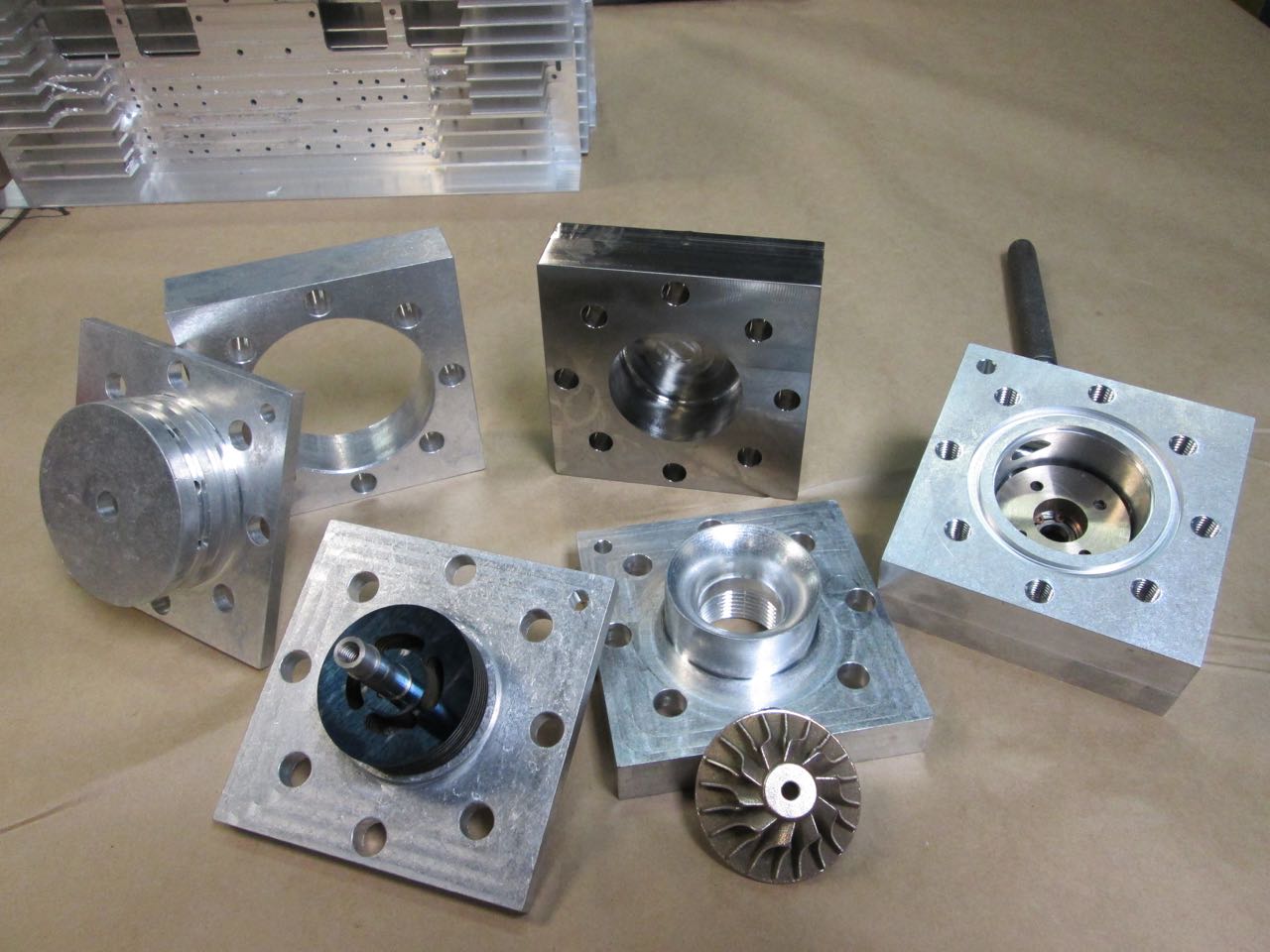
Status As of 27 June 2026 Offering: Design, plans, licensing, consulting, and some leftover surplus parts, carts, modular blocks, and more.Manufacturing: We no longer offer custom fabrication or small production line manufacturing, since we had to sell all of our equipment and close our shop in 2020 during the pandemic.Turbines and CO2 System: Since 2008 we have design, build, and tested hundreds of turbines and since 2015 over 100 supercritical CO2 extraction systems. We build the first sCO2 miniature turbine in 2013 (see YouTube video page or CO2 pages for more information). After we design a turbine, it is drawn up in Cad, then machined and tested on compressed air. From there we may test on actual working fluid (R245fa, CO2, or other refrigerants). We build a load bank center which had lights to indicate the amount of power being generated with our smaller (10 kW or smaller) turbine generators. |
|
Waste Heat to Energy: In 2008 I started Infinity Turbine LLC to discover, promote, develop, and build waste heat to power (renewable energy) systems. For a number of years, owned and operated a machine shop in Ferndale, Washington (near Bellingham, Washington) with a large Omax waterjet, laser engraver/cutter, Haas vertical milling machine, lathe, welders, shop tools and lots of custom test equipment. We experimented with most forms of prime movers, including the Tesla Disc Turbine, Sterling Engine, Axial Turbine, Scroll Compressors, Scroll Expanders/Compressors, and finally settled on the Radial Outflow Turbine. We employed the services of Henry Technologies in Canada to build the heat exchangers for our Organic Rankine Cycle systems, and then paired with our turbine generator builds. The predominant challenges were pressure seals, rotational speed, and moving parts. Basically, if you have more than one moving part, the system will fail. With the interest in CO2 as the working fluid (to reduce equipment footprint by increasing efficiency and pressure to produce rotational mechanical energy), we starting experimenting with liquid CO2 and phase change. Ultimately, the Holy Grail of power production is to reduce the number of moving parts and seals to a minimum.We build over 100 CO2 closed loop botanical extractors, and have lots of experience with Carbon Dioxide.
|
|
Value of Waste Heat: The value in waste heat to power is that it's a free energy source. The advantages are fuel, or electrical savings, but also displaces fossil fuel electrical production, and hence, reduces CO2 emissions. If you have to pay for your heat source, then ORC doesn’t make economic sense. If you have high-grade heat, consider a topping cycle (Brayton Cycle using CO2). |
|
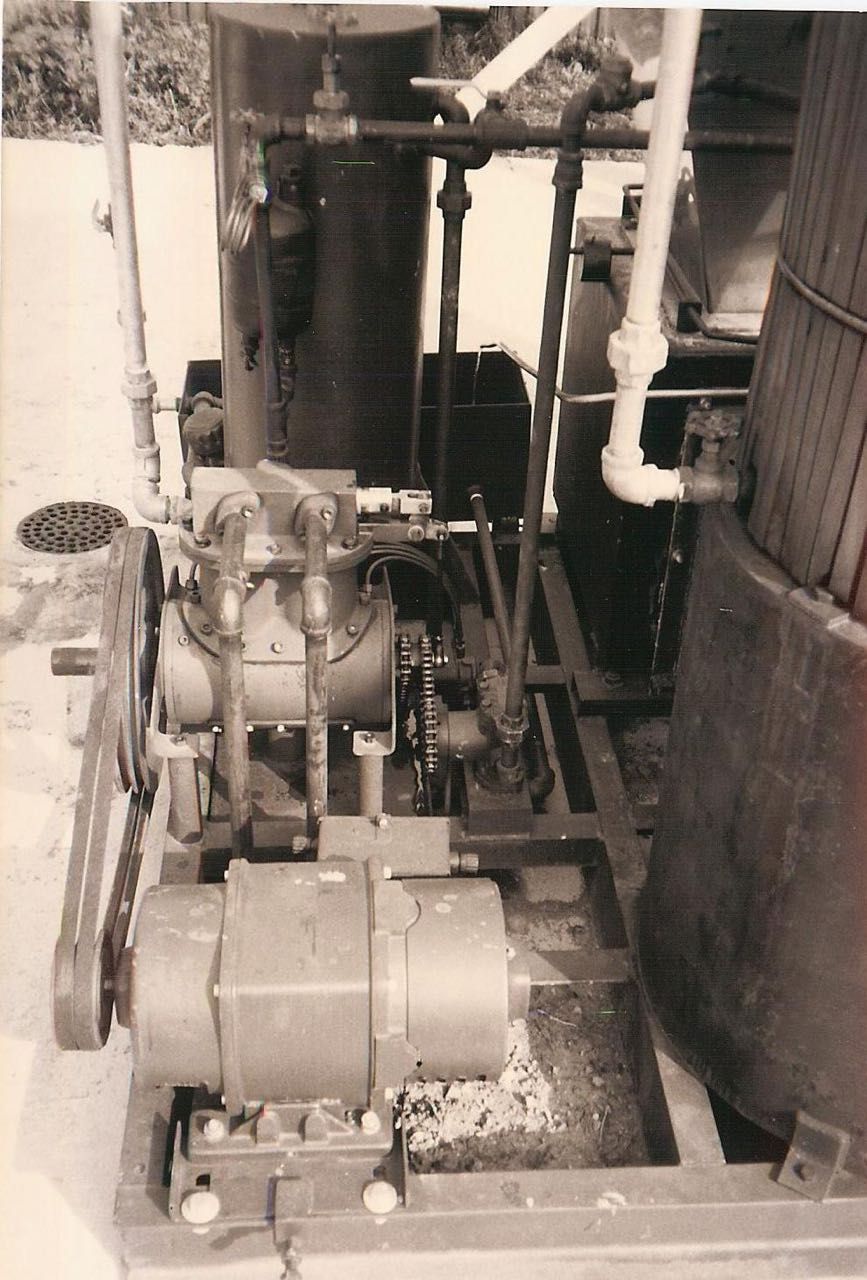
History Wood Energy: From 1985 until 2008: Doing business as Global Energy, developed and sold wood energy (biomass) systems. First with selling Waterwide Gasifiers from New Zealand in 1986, and then branching off into developing and selling my own systems, including steam turbines and steam engines. Container Kiln (Lumber and Firewood drying): In the mid 1990s, developed and marketed a shipping container lumber/firewood dry kiln system (Container Kiln), which is modular and portable. NonConventional Fuel Tax Credit: Adapted Section 29 credits for sawmills and wood processors that use wood fired boilers. Biomass is not burned, but oxidized and the gas is burned. Saved customers millions of tax dollars.Capstone Turbine: Bought and sold Capstone microturbine systems. Experimented with vegetable oil and other combustible liquids in the diesel (liquid fueled) versions. |
|
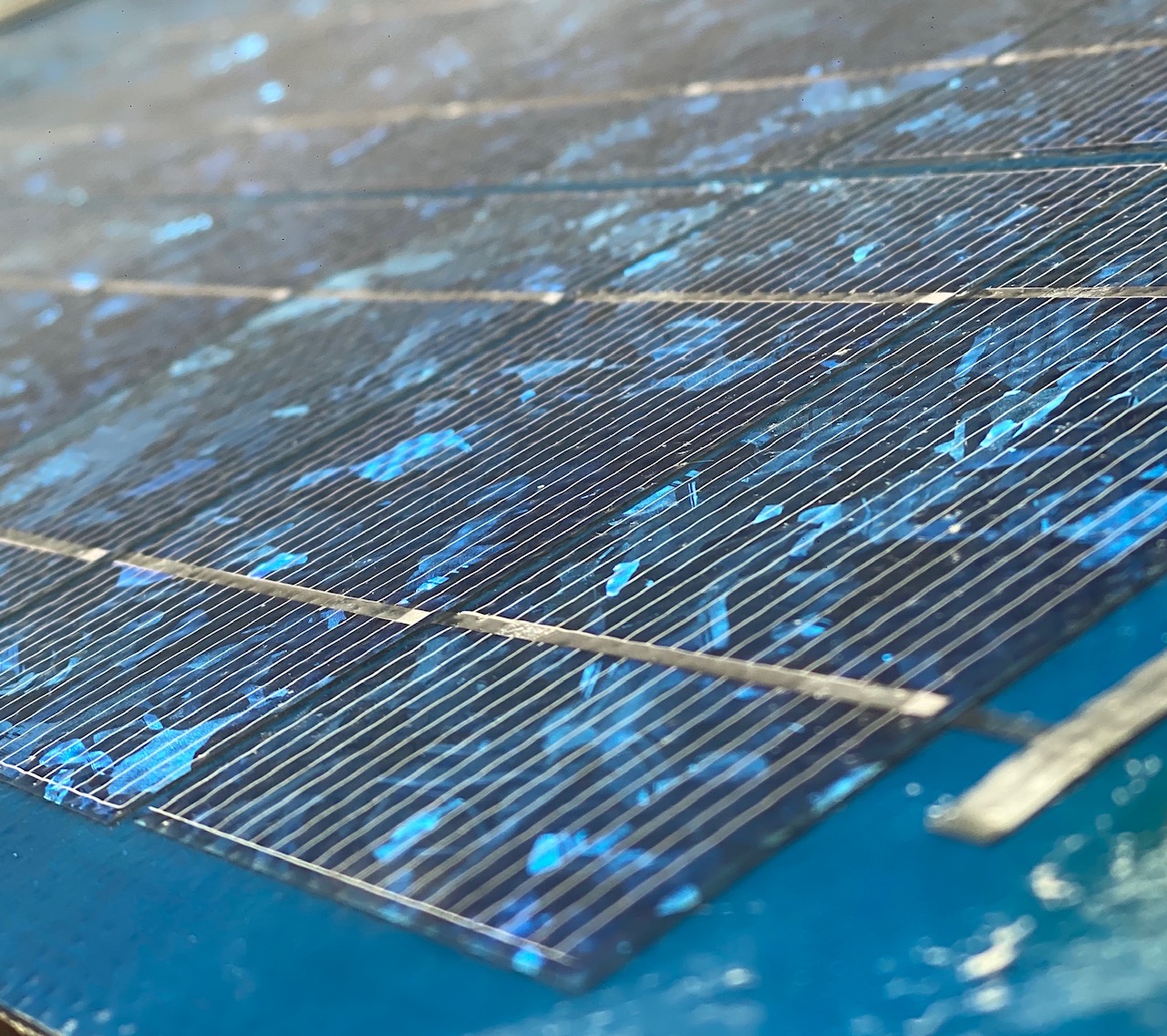
ORC Versus Solar PV: If your goal is inexpensive power with no moving parts, then please consider solar PV with a battery bank. This provides with fast power and relatively no maintenance. Typical payback is 6 months to a year.On the other hand, if you have consistent heat source and want a system with moving parts and complexity, then ORC or sCO2 may be a good choice. Typical paybacks are more than 3 years.If you pay more than $.10 per kWh, then either of the above may be a good choice.If you pay more than $.50 per kWh, then solar PV pays for itself very fast, and ORC may have a payback less than 3 years.We provide Preliminary Assessment studies to show you the best option and paybacks.Most groups emphasis a fast return on investment, which is why we suggest solar PV. Please visit the link below... |
|
Advantages: The advantages go much further than cost savings. Waste heat can now be used to produce rotary shaft horsepower, to spin a generator, a pump, or without any moving parts, to generate static electricity. Waste (thermal) heat can now be stored in our sand salt battery to be used by chillers, hydraulics, and power generation.The heat can be used many times, including CHP applications such as chillers, desalination, CO2 harvesting from the ocean (via off-the-shelf membranes), and CO2 Fluid Extraction machines (which can be used for extracting oil from botanicals, regenerating catalysts, and methanol or other alcohol production via the use of catalysts). |
|
Supercritical CO2: Infinity Turbine LLC already develops ORC green energy systems and is developing CO2 energy modules (in high temperatures can be over 40 percent efficient in the Brayton Cycle). Infinity is seeking funding to further this development. Until we get funding, we’ll continue to develop the CO2 Rankine cycle.This includes converting traditional high temperature and pressure pumps into sCO2 expanders to drive hydraulic pumps for Reverse Osmosis, Construction, or Powerheads. |
|
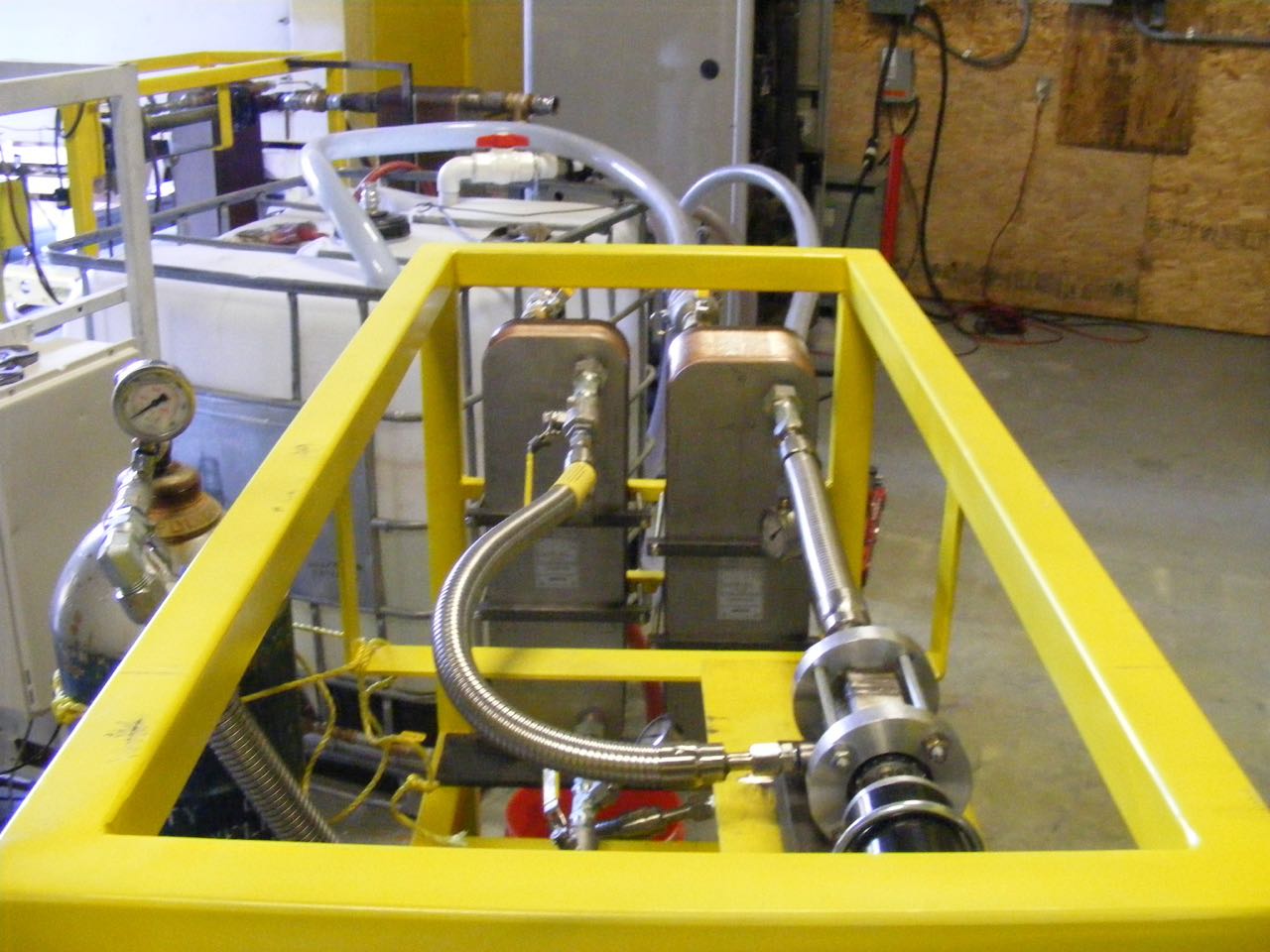
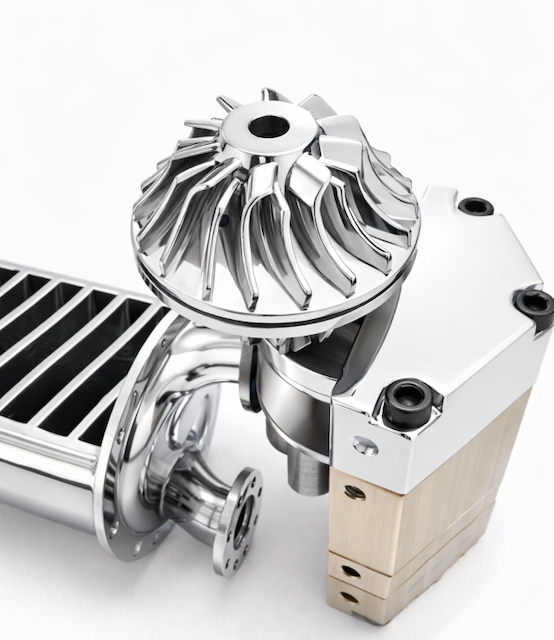
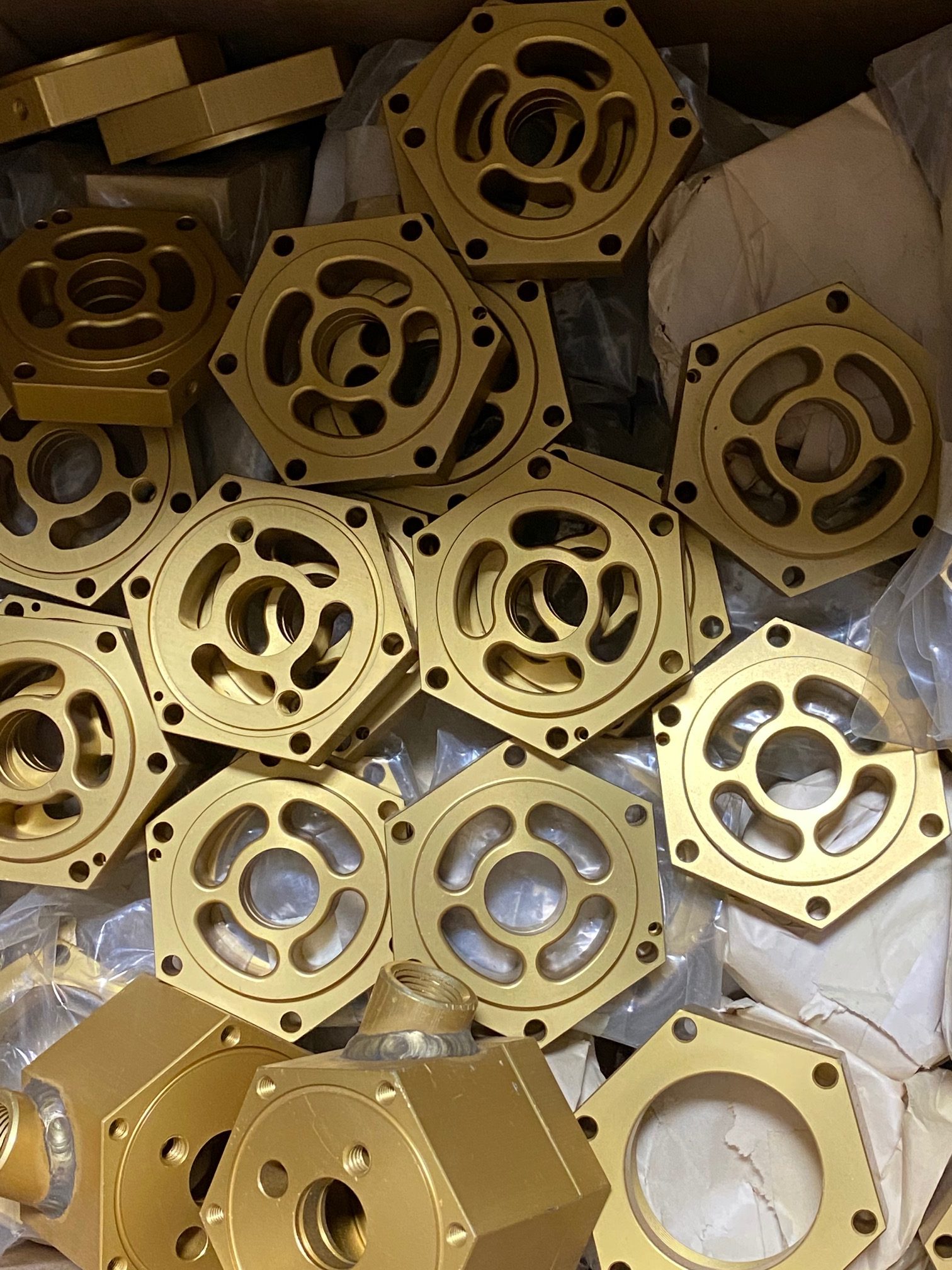
Modular Fluid Handling Device: Infinity Turbine uses rapid prototyping and development using the patented Modular Block (National Science Foundation quoted as saying it's an Industrial LEGO) allows fast deployment into the market. This fluidic block eliminates the need for hoses and pipes. |
|
Solid State Turbine Using Tribo Effect and Electrostatic Precipitation In our CO2 experiments, we studied the Colorado Springs notes from Nikola Tesla. I found some interesting characteristics of CO2 as it undergoes phase changes, including a tremendous production of static (DC) electricity. To that end, we started to develop a Solid State Turbine using Tribo Effect. I found that by using a hybrid polymer material, we could generate static electricity simply by pressure reduction of CO2 gas. Similar electrostatic effects were seen all the way back to the origins of steam power (coined the Armstrong Effect). The electrodynamic gas two phase system not only pertains to water-steam relations but any gaseous liquid two phase components. It can also cause explosions when using CO2 fire extinguishers, as seen in a silo explosion in Norway in 2010 and in multiple accidents when the static discharge seeded an explosion, as presented in this article. Using phase change to our advantage may be able to be the next Holy Grail of energy production. Why ? No moving parts. Plus CO2 goes supercritical at 89F or 30C, which allows utilization of low grade heat (as in the cloud server farms or even solar thermal parking lots). A Solid State Turbine scales up and down easily, and could even be used by Elon Musk for his Solar City or on Tesla cars to power the thermal management system by simply putting up black colored tubes on the roof to capture solar thermal energy. A new wave of HVAC strategy could combine low temperature solar thermal, along with ground geothermal for cooling (Organic Rankine Cycle needs both heat and cold sink). The ultimate Solid State Turbine deployment would be with a cavitation CO2 pump, for the least amount of moving parts (one). This is the system which will power us into the next few decades. |
|
Some Projects Since 1985 Include: - Large Steam Engine Sales and Support- Waterwide Biomass Burner Sales, Installation and Support- Containerized Modular Dry Kilns for Lumber, Pallets and Firewood- Capstone Microturbine Sales, Service and Support- Biomass Energy Systems Sales and Support- Cavitation On Demand Heating- ORC Turbine Design, Sales and Support- Waste Heat to Energy Systems- Conversion of Marine and Transportation Diesel Engines to Vegetable Oil- Design of Solar Thermal Panels- Non-conventional Fuel Tax Credits (old IRS Section 29 USA Federal Tax Credits)- Design of Compact Corn Pellet Burner/Boiler and Steam Engine Generator for Farms- ORC Publications On CD Rom and Download- Gas and Liquid Processing Blocks- CO2 Catalysts For Direct Conversion from Gas to Liquid Methanol and Butanol- SDR - Spinning Disc Reactors Technology- CO2 Energy Systems- CO2 Fuild Extraction Technology- Vortex Tubes Design and Technology- Peltier Cell Solid State Chiller- Modular Beam Frame Building System- 3D Plastic Printer Technology- 3D Metal Printer Technology- Fast Prototyping and Design- Smart Fluids 3D Printer and Valves- Waste (thermal) heat storage in sand salt battery to be used by chillers, hydraulics, and power generation- Conversion of pumps into sCO2 expanders- Solar thermal and waste heat storage in sand and salt- Flow battery development for electricity storage- Electrolyzer design for converting limestone into lime for cement and on-demand concrete processors for the 3D printing industry |
|
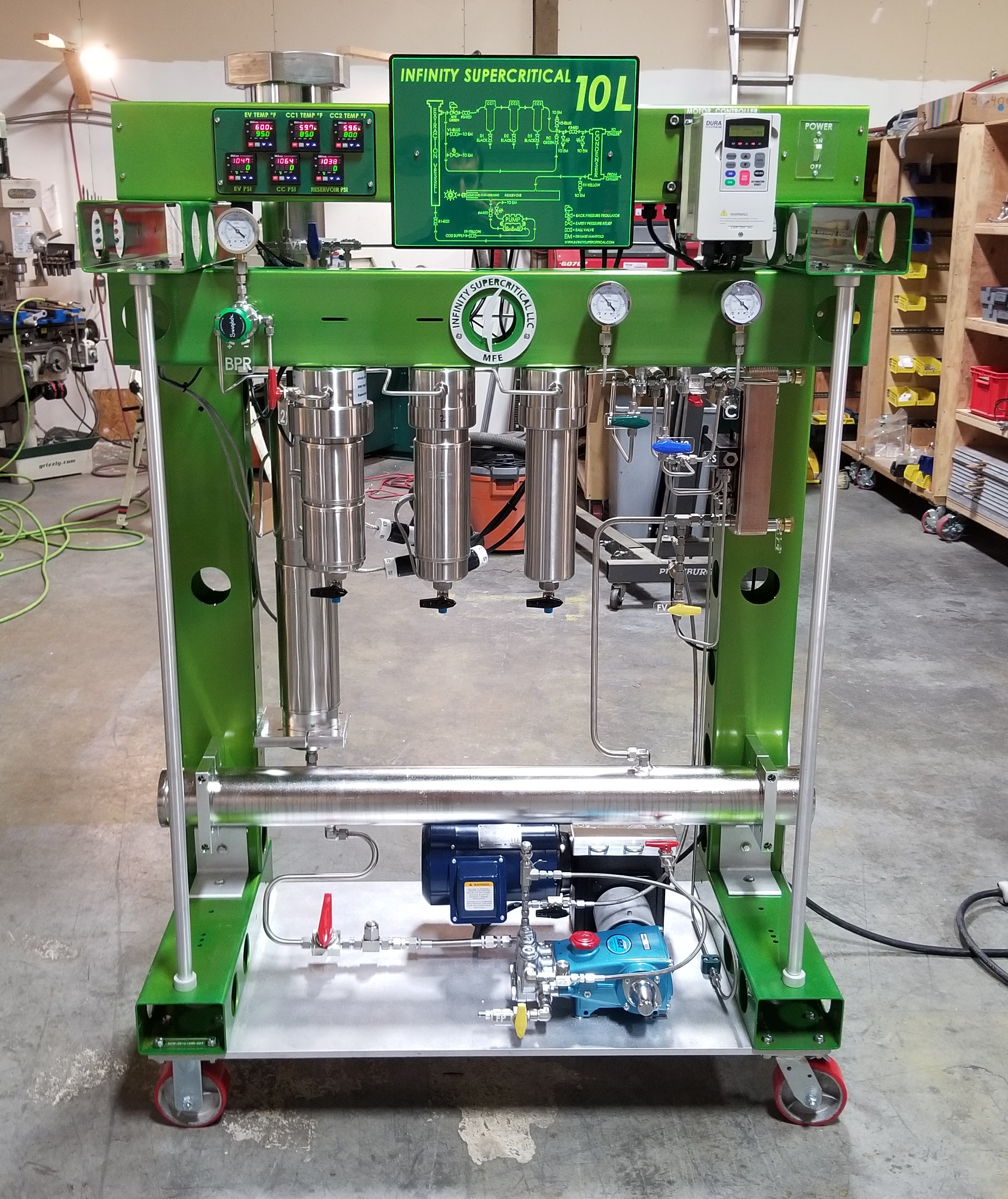
Supercritical CO2 and Water Botanical Extraction Systems: Starting in 2015, I started Infinity Supercritical, which uses the CO2 phase change process to extract oil from plants. It turns out that the same ORC system, can be used for plant oil extraction. It was in the past five years with this process development that we perfected CO2 phase change, and actually discovered the corona discharge for ourselves (shop workers were getting shocked while venting CO2). The CO2 phase change systems can also be used to sterilize PPE, and recycling precious metals from lithum ion batteries (LIB), and some have even proposed it is more valuable than Gold Mining.
|
|
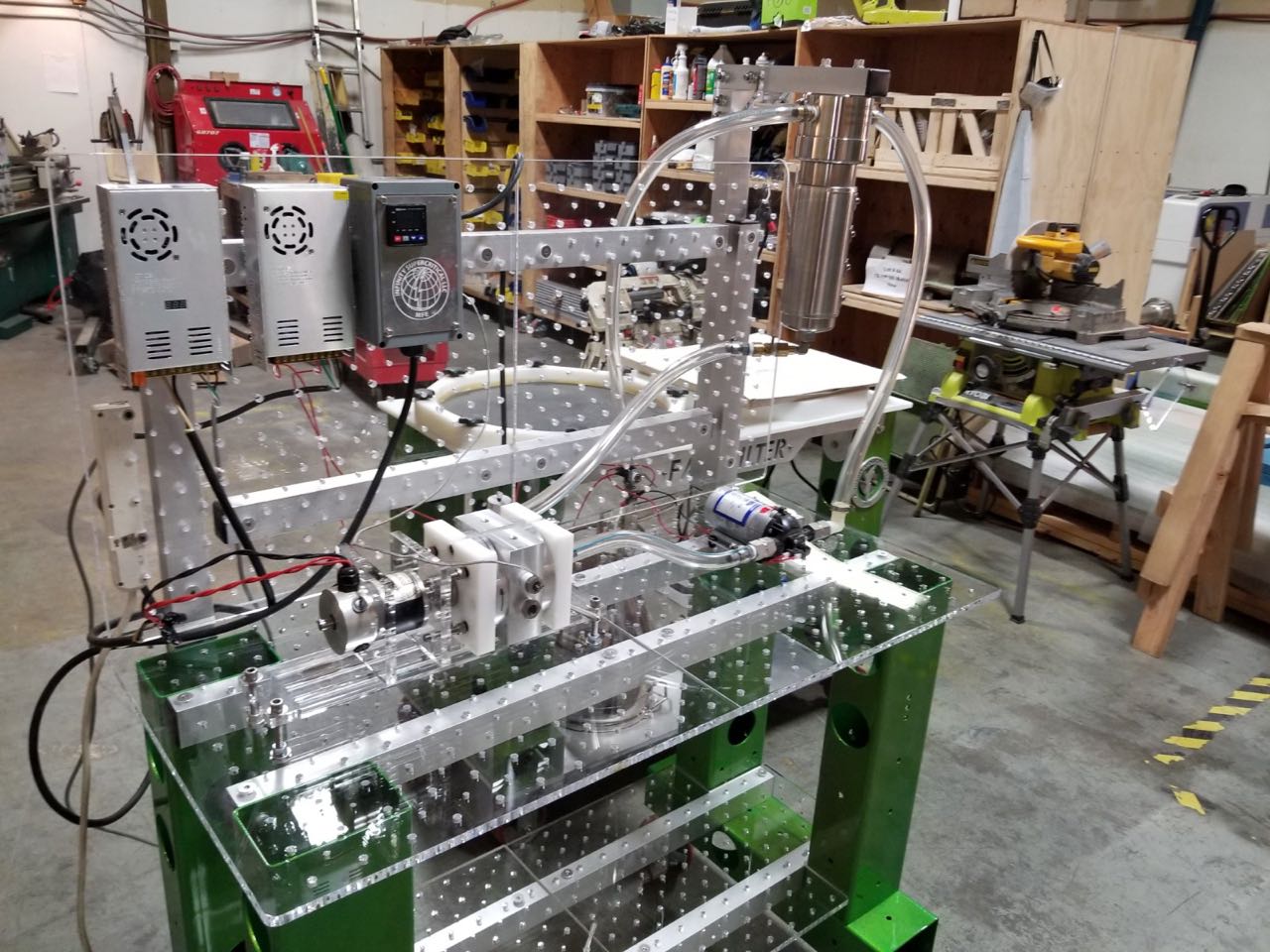
Hydrodynamic Cavitation Processing Systems: Concurrent with the Modular Blocks and Extraction Systems, I developed a Spinning Disc Reactor for process intensification. Termed the Sonic Extractor, this device uses spinning discs to hydrodynamically cavitate water. It turns out that you can also cavitation CO2 (quite easily) which allows us to use a spinning disc to phase change CO2 from a liquid to gas, and act as a pump. This methodology is perfect for Silver Nanoparticle production, and other continuous push-button manufacturing.
|
|
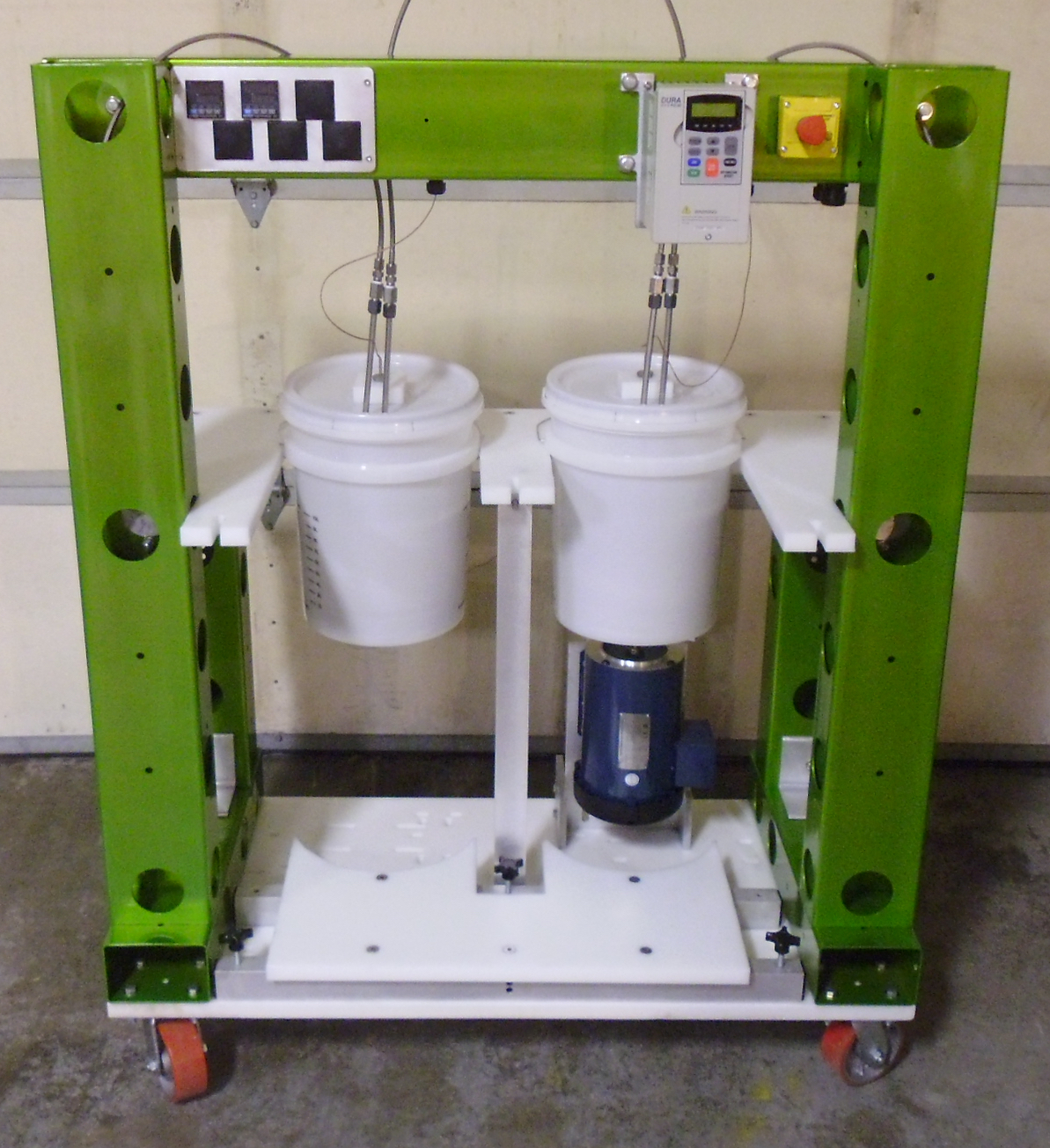
Induction Magnetics and MagnetoCaloric Cooling: In my quest for better and faster processing of botanicals, I have also developed a induction (touchless) mixing system based on a micro version of the Bitter Plate Magnet. This fun little project allows DIY at-home making and formulation of cosmetics and skin creams.
|
|
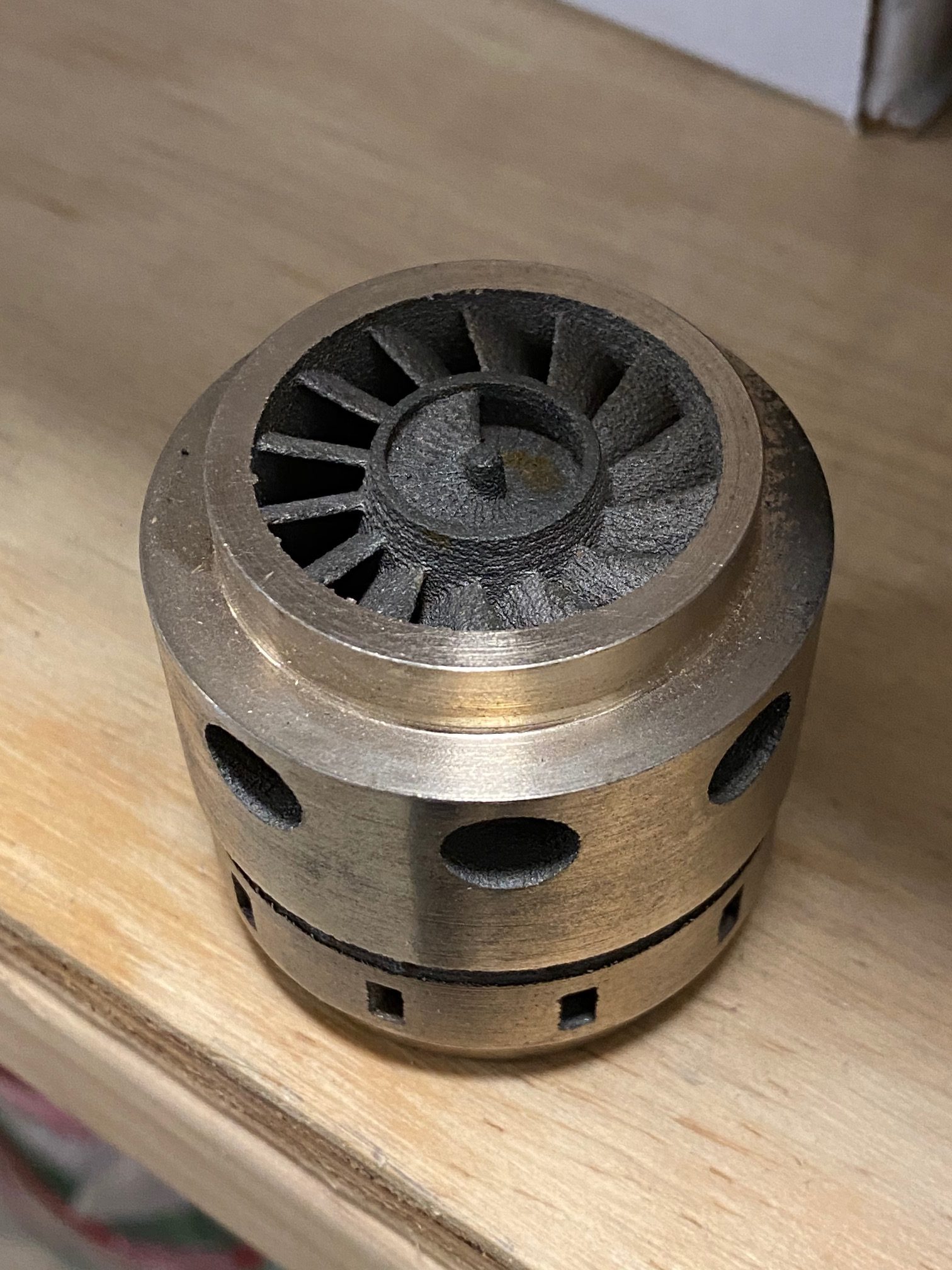
Counter-Rotating Compressor and Turbine with One Moving Part: Years ago I designed and 3-D printed (in metal) a one part assembly which acted as both a turbine, and a turbo-pump. This counter-rotating design takes the best of what 3-D printing has to offer, while simultaneously mitigating the inherencies of modern turbine design (seal, temperature, and moving part issues). While this design was primarily for energy production in the ORC process, it could easily be ported to a turbofan design for drones. This design can also be used as a compressor precooler and turbine post cooler, reducing temperatures as much as 1,000 F.
|

|
Phase Change Battery: Using CO2 (which is a energy dense working fluid) leveraging the phase change would essentially make pressure the electrolyte. This battery concept can accept multiple charging inputs including heat, electricity, and friction to store energy.
|
|
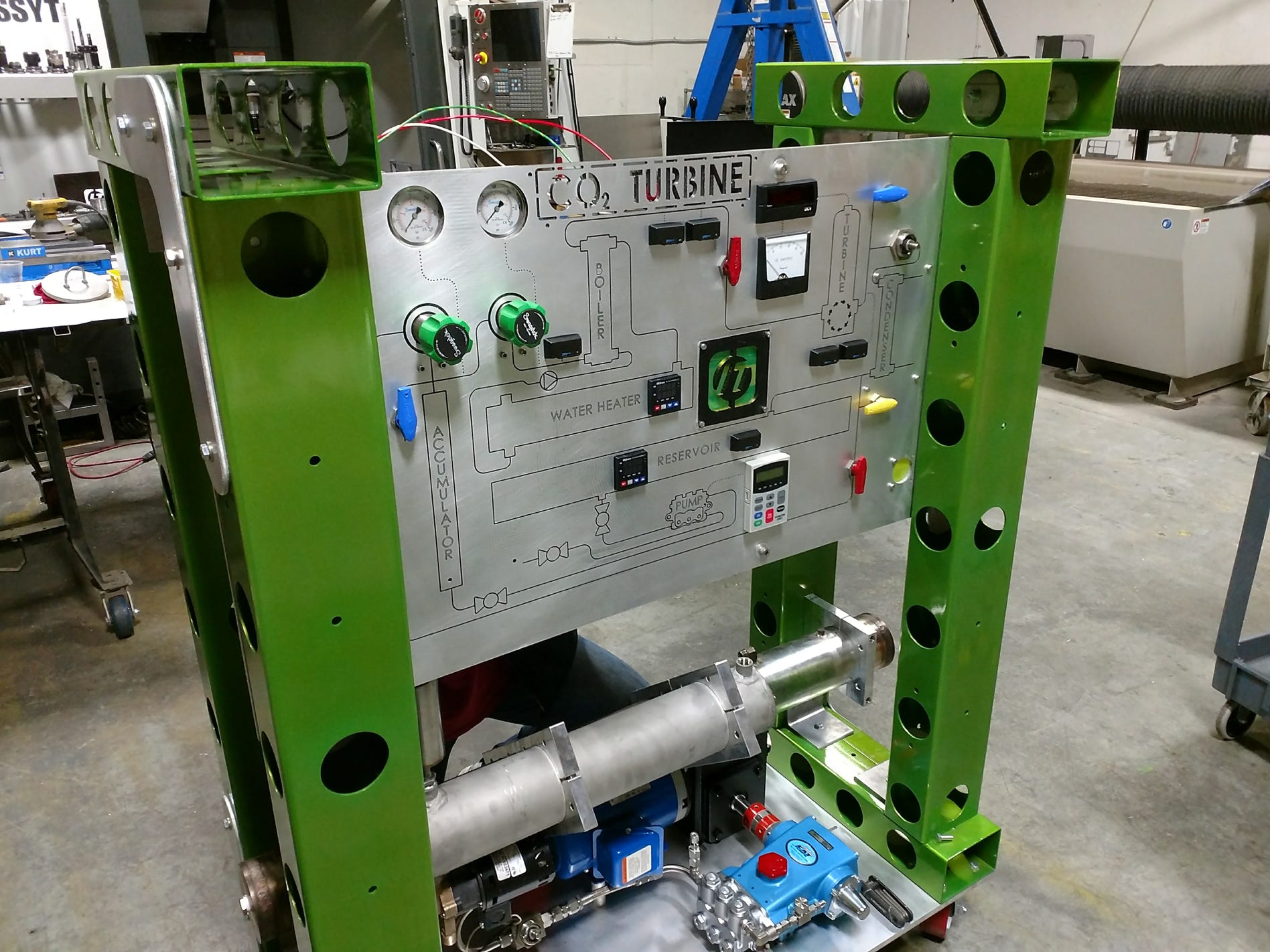
CO2 Gas Turbine: With a cavitating disc compressor, CO2 (instead of air) would make a very interesting high altitude gas turbine, which leverages the cold temperatures of high altitude for condensing, while making a closed-loop, energy efficient power unit, which could power electric turbofans for commercial aircraft.
|
|
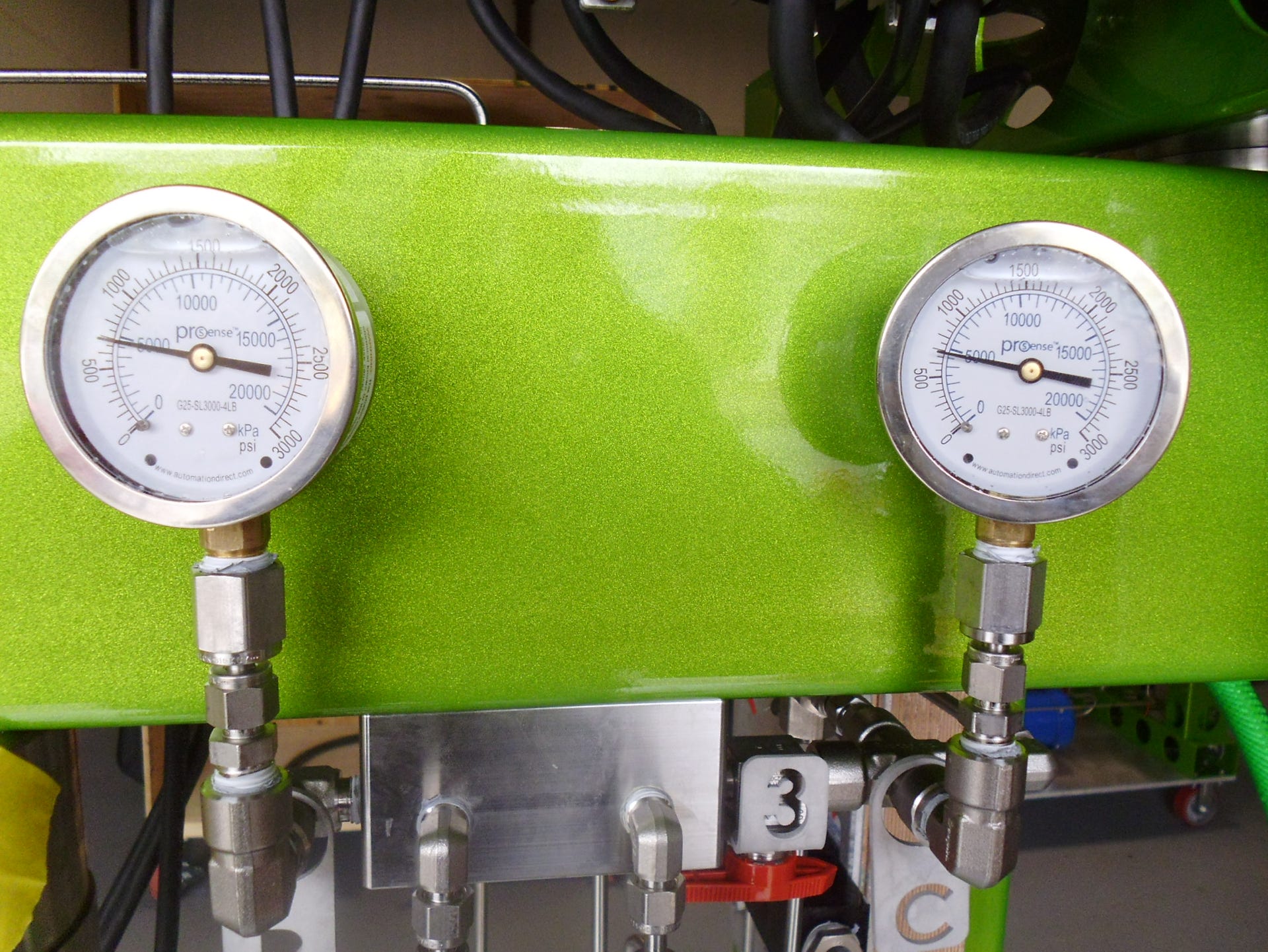
Gas Leverage Turbine: Extending CO2 Gas Turbine concept, a industrial version could be used in harmony with CO2 and its sonichemistry reactions to make industrial goods, such as gas-to-liquids, chemicals, and other industrial raw goods.
|
|
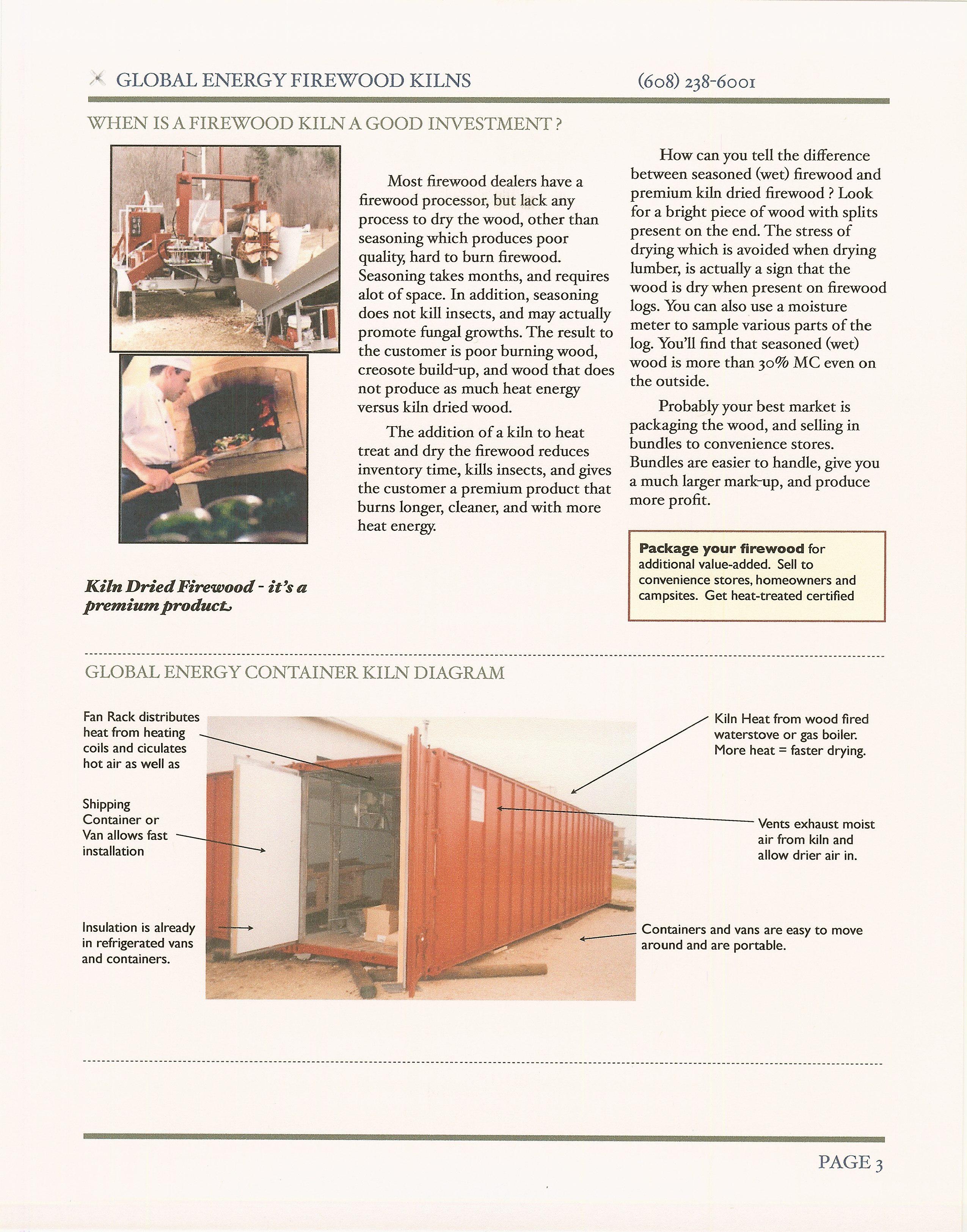
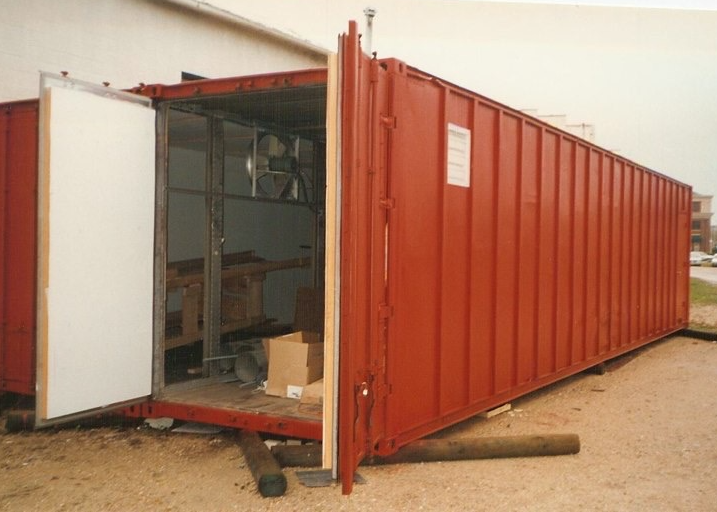
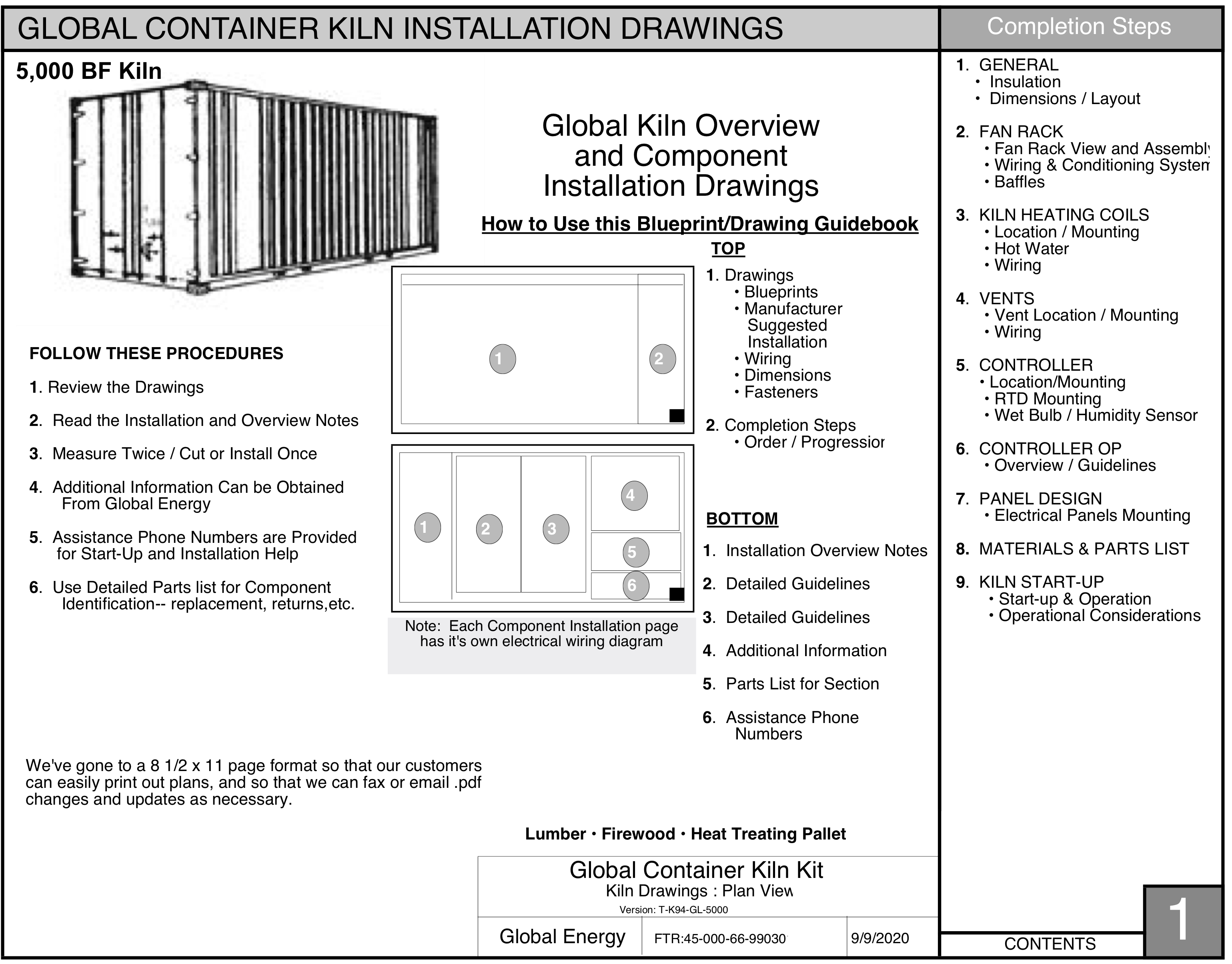
Global Container Kiln for Drying using Shipping Containers In the early 1990's I developed the container kiln system, which uses standard shipping containers converted into conventional lumber dry kilns for the portable sawmill market, and DIY network.The container kiln can be used for dimensional lumber, poles, timber, blocks, pallets, firewood, hemp, and heat treating wood. |
|
|
Fuel Sources Include Natural Gas, SMR, Hot Geothermal, Industrial Waste Heat, Concentrated Solar Thermal and more... |
Quantum Super Turbine for 2026 Key Features of the Infinity Super CO2 Turbine:• High Performance: Maintains full power output in temperatures over 43°C (110°F).• Water-Free Operation: Operates without water, a significant advantage for arid regions.• Compact Design: Delivered in a shipping-container-sized package for modular deployment.• Technology Link: Uses the same core technology as the Infinity Cluster Mesh CO2 Turbine, allowing for shared development and testing.• Target Market: Specifically designed for AI and high-performance computing (HPC) data centers facing power shortages.Quantum Super Turbine for 2026 Data Center Build-outs GE Vernova Hyperscale Gas Turbine Generator Systems Licensing Starting at $10 Million USD Including IP |
|
Gas to Liquids (alcohol fuels) with Ocean Ethanol LLC In 2004 formed Ocean Ethanol LLC with an investor (John Stevens in Kona, Hawaii) to develop my invention of converting CO2 into fuel grade ethanol, methanol, and butanol. With a short development window, we proved we could make alcohol fuel cheaper than existing fuel prices, but investor pulled out within 6 months, since he did not see an immediate return (even though it was projected to take at least 12 months to market). We were able to produce methanol and butanol from reversing a fuel cell (i.e. input was liquid CO2, water, and electricity, and output was alcohol). Catalysts were developed at PNL (Pacific Northwest Labs).Research was also done simultaneously in Italy, and a lab was able to show we could produce butanol and methanol from liquid CO2 by reversing a fuel cell.As a result I was issued two patents for my Modular Fluid Handling Device I and II in my name, and I have sole ownership of patents. It was this initial research and development into liquid CO2, that gives us the advantage in the CO2 extraction field. |
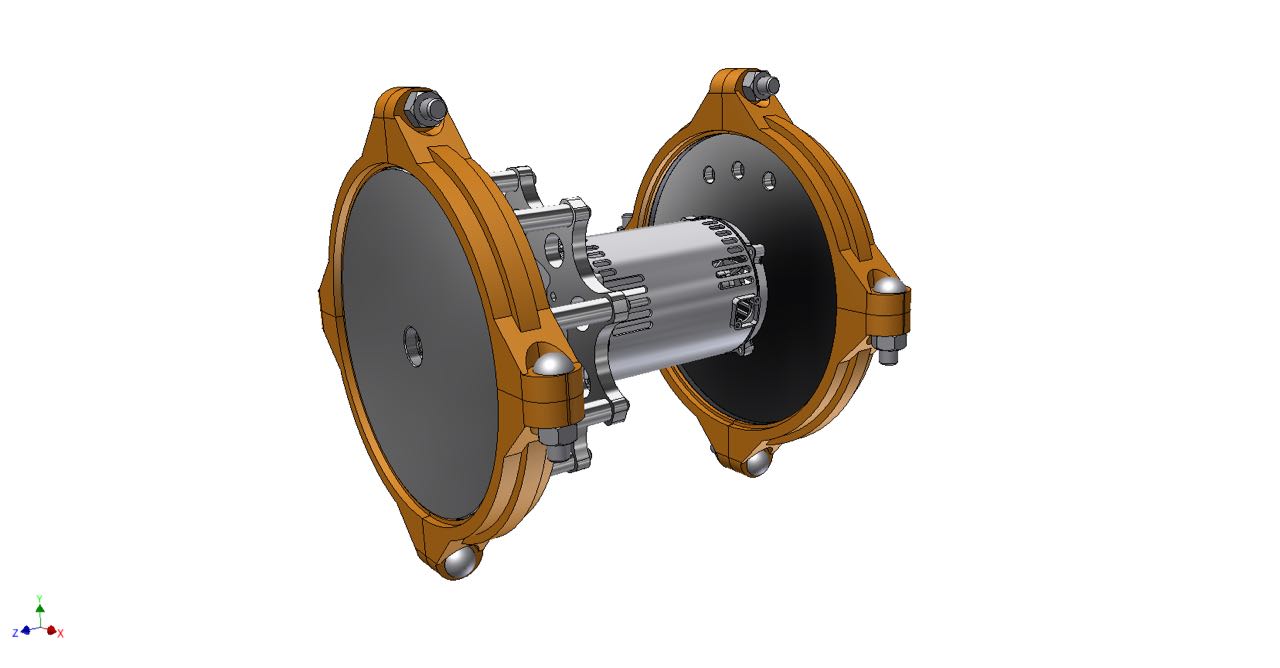
|
Plasma Wing: Some of the research for Corona Discharge also led to studying plasma generated by a static field. This may be applied to aircraft wings for wing deicing (mitigation) and even some interesting methods of increase lift, which may impact applications for silent drone propellers. You will notice static mitigation on wings by the use of static whips (on the tailing edge of most aircraft wings).
|
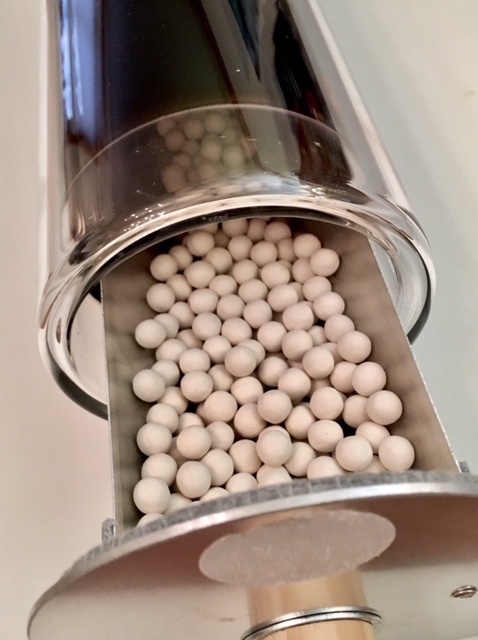
The solar thermal vacuum tube can efficiently heat to recharge Zeolite pellets. Without a reflector it can heat up to 212 F or 100 C. With reflectors up to 400 F or 204 C. |
Zeolites for Heating: Just add water A few pellets can heat an entire cup of coffee or tea. This provides a very simple way to deliver heat to your cup of morning beverage. They can also be used for soups, double boilers, and with some ingenuity, they can be used as a low to medium temperature burner heat source. Used with boiling water, you can make steamed vegetables, rice, and pasta.
|
|
Triboelectric Effect for Static DC: Infinity Turbine is also working on some new remarkable technology called TriboElectric Effect. Currently we have a patent-pending oil separation device that is used in the CO2 Fluid Extraction industry. Commonly referred to as electrostatic precipitation ESP, Infinity discovered a way to passively generate static charge using CO2. This helps to apply a static charge to entrained oil in a gas, which allows it to adhere to the first thing it comes in contact with (collection/filter vessel). |
|
Full Service Shop - Closed in 2020 During the Pandemic: We had a full machine shop with a VSS Mill, Waterjet, Vertical Manual Mill, 3D printers, laser cutter, high pressure stainless steel tubing system fabrication center, welders, and a small production line. We could build prototypes and production turbines, housings, rotors, stators, pumps, CO2 systems, full ORC systems, and bolt together modular frame systems. We also have a partner contractor in Toronto, Canada that builds commercial (and ASME rated) skid mounted heat exchangers for our larger IT50 and IT250 systems.During the pandemic, we had to close our shop in Ferndale, Washington.We continue to have our sub-contractor relationships, so we can still build systems when needed (just not in-house). |
|
Flow Battery Technology With the advent of huge tax credits ($35/kW) available to manufacturers and sellers of batteries in the USA, we sought out the best unknown grid-scale battery technology. After months of research, we settled on the CFB (Chlorine Flow Battery) using salt water (NaCl) as one of the electrolytes.Salgenx: The flow battery. Store electrical and thermal energy simultaneously with Salgenx . We first hired a chemical engineer to vet out the technology, and went from there. We have been applying our 40 years of knowledge base in everything from CO2 flows, tribo effect, turbines, phase change, magnetics, and other specialities to put together our version of the Salt Water Battery. |

|
Solar Thermal Battery Drives High-Capacity Chilling for Off-Grid Cooling Discover how a 40-foot sand-salt thermal battery with concentrated solar input can power thermally or electrically driven chillers, delivering over 1,500 tons of cooling-hours—ideal for off-grid or industrial cooling.A single thermal battery using sand-salt storage and rooftop solar collectors can provide over 1,500 tons of cooling, delivering up to 127 tons per hour using high-efficiency chillers. This scalable system offers renewable-driven cooling for industrial or remote applications.Solar Thermal Battery as a Renewable Cooling SourceA 40-foot shipping container filled with a 50/50 sand and salt mixture, equipped with concentrated solar panels and internal thermal oil piping, becomes a robust off-grid thermal battery. When paired with a chiller system—either thermally or electrically driven—it delivers substantial and sustained cooling capacity.Two Approaches to CoolingAbsorption Chiller (Thermal-Driven)Uses thermal energy directly via lithium bromide absorption systemCOP: ~0.7Cooling output: ~989 tons of cooling-hoursIdeal for locations where electricity is limitedElectric Chiller (Power-Driven)Uses power generated from heated supercritical CO₂ driving a turbineCOP: ~6.0Cooling output: ~1,525 tons of cooling-hoursDelivers up to 127 tons/hour over 12 hoursCooling Delivery ProfilesSystem Type 1-Hour Burst 12-Hour Avg 24-Hour AvgAbsorption Chiller 989 tons 82.4 tons/hr 41.2 tons/hrElectric Chiller 1,525 tons 127.1 tons/hr 63.5 tons/hrUse CasesData center coolingCold storage in agricultureEmergency or disaster zone chillingIndustrial HVAC in off-grid regionsConclusionThis integrated solar-thermal battery system delivers flexible, scalable cooling power using stored heat and smart conversion technology. Whether you need high-power bursts or round-the-clock chilling, this solution bridges renewable thermal storage with practical cooling demands.
|
|
Certifications Certifications: Only our CO2 extraction system is certified by an engineer. While our turbine systems were mainly designed by a turbine/refrigeration/compressor engineer, our designs and product are considered experiment.USA / European / German Certifications: None of our turbines, expanders, or energy systems or Salgenx saltwater battery have UL, CE, CSA, or TUV certification. They are available for certification, if you are willing to pay the approximately $150,000 - $2 million USD certification costs.USA / European / Worldwide Pressure Vessels: Some of our systems are rated for ASME BPVC. All systems are built to ASME standards. Only the CO2 extraction systems are stamped ASME and certified.What are the various agencies and codes ?1. Pressure Equipment Directives and CodesBecause ORC systems use organic fluids (which are often flammable or volatile) and sCO₂ operates at extreme pressures, pressure vessel safety is a mandatory baseline worldwide:• ASME BPVC (USA/Global): The ASME Boiler and Pressure Vessel Code ensures the structural integrity of high-pressure sCO₂ turbine casings, recuperators, and piping.• PED (Europe): The Pressure Equipment Directive governs the design, manufacturing, and conformity assessment of pressure assemblies in ORC loops.2. Machinery and Electrical Safety CertificationsTo ensure the turbine itself is safe to operate, connect to the grid, and control:• CE Marking (Europe): Mandates compliance with the Machinery Directive and Low Voltage Directive, ensuring rotating parts and electrical controls are safe.• ISO 9001 / ISO 14001: Standard global quality and environmental management certifications held by major manufacturers (like Turboden or Atlas Copco) during turbine fabrication.3. Power Generation and Grid IntegrationOnce the turbine turns a generator, it must comply with power distribution and grid connection standards:• IEEE Standards (Global): IEEE Power & Energy Society standards cover generator design, excitation systems, and protective relaying.• Grid Codes: Turbines must meet specific regional or country-level regulations for frequency control, voltage ride-through, and power quality (e.g., European Network of Transmission System Operators for Electricity or local utility rules in Madison, WI).4. Third-Party Global VerificationBecause sCO₂ and ORC cycles operate in highly specialized commercial sectors (like geothermal, waste heat, and nuclear), manufacturers often bypass mass certification in favor of independent third-party verification:• Bureau Veritas: Conducts global testing, independent inspections, and Factory Acceptance Testing (FAT) for ORC/sCO₂ speed, vibration, and performance validation.•DNV: Provides independent assessment, performance verification, and risk management standards tailored to energy transition machinery, akin to their wind turbine Type Certification services. |

The unique latent heat storage capabilities of the Zeolite pellets allow them to release heat by just adding water. They can be recharged with solar vacuum tube heat. |
Review of the Zeolite heat storage pellets. Just add water. Just Add Water: A revolutionary heat storage product has been around for some time now, but this is one of the first applications for solar cooking and hot water heating use off-grid. The product is called a Zeolite, which is a high surface area substance, which when exposed to water, releases heat. The structure is unique, in that it can be recharged with heat, and retain that latent heat virtually indefinitely if kept dry, until it comes in contact with water. Instant Heat: The remarkable feature of this substance in pellet or ball form, is that it can boil water almost instantly. So it is perfect for emergency water purification, and cooking. Heat Recharge: Because the Zeolites need to be heated to be recharged, it is a perfect application for the solar vacuum tube. The recharge temperature is 130 to 250 C.Charge Now Use Later: The unique qualities of the heat storage (at room temperature), allow you to use the Zeolite at any time of the day, just add water. After cool down of the pellets, dry off and recharge in your solar thermal vacuum tube. The pellets store at ambient temperature.
|

Infinity Solar Thermal Collectors |
Solar Thermal Back in 2008 Infinity designed helical solar collectors, which now have updated in 2025, including: • supercritical CO2 working fluid• laser etched Fresnel lens (allow higher temperatures) option• vacuum sealed collector option• graphene coated sand as the solar heat absorber option• sand-salt thermal storage as part of collector optionCollectors are hexagonal or rectangular for modular manufacturing, shipping, and deployment. |
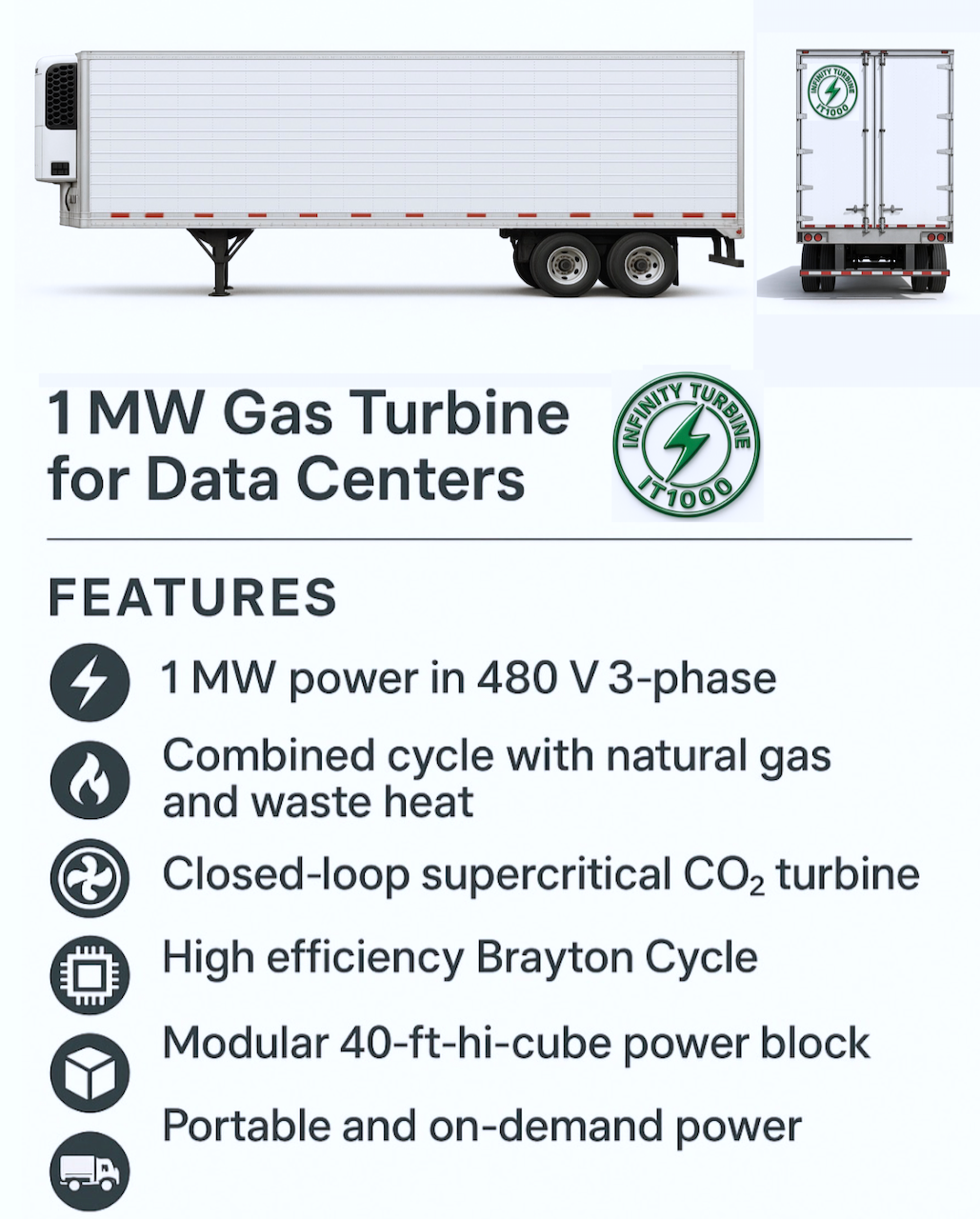
1 MW to 10 MW Portable Power for Data Centers fired by natural gas, waste heat, or solar thermal IT1000 Natural Gas 1 MW Power Block (also available IT250 and IT10 MW) |
|
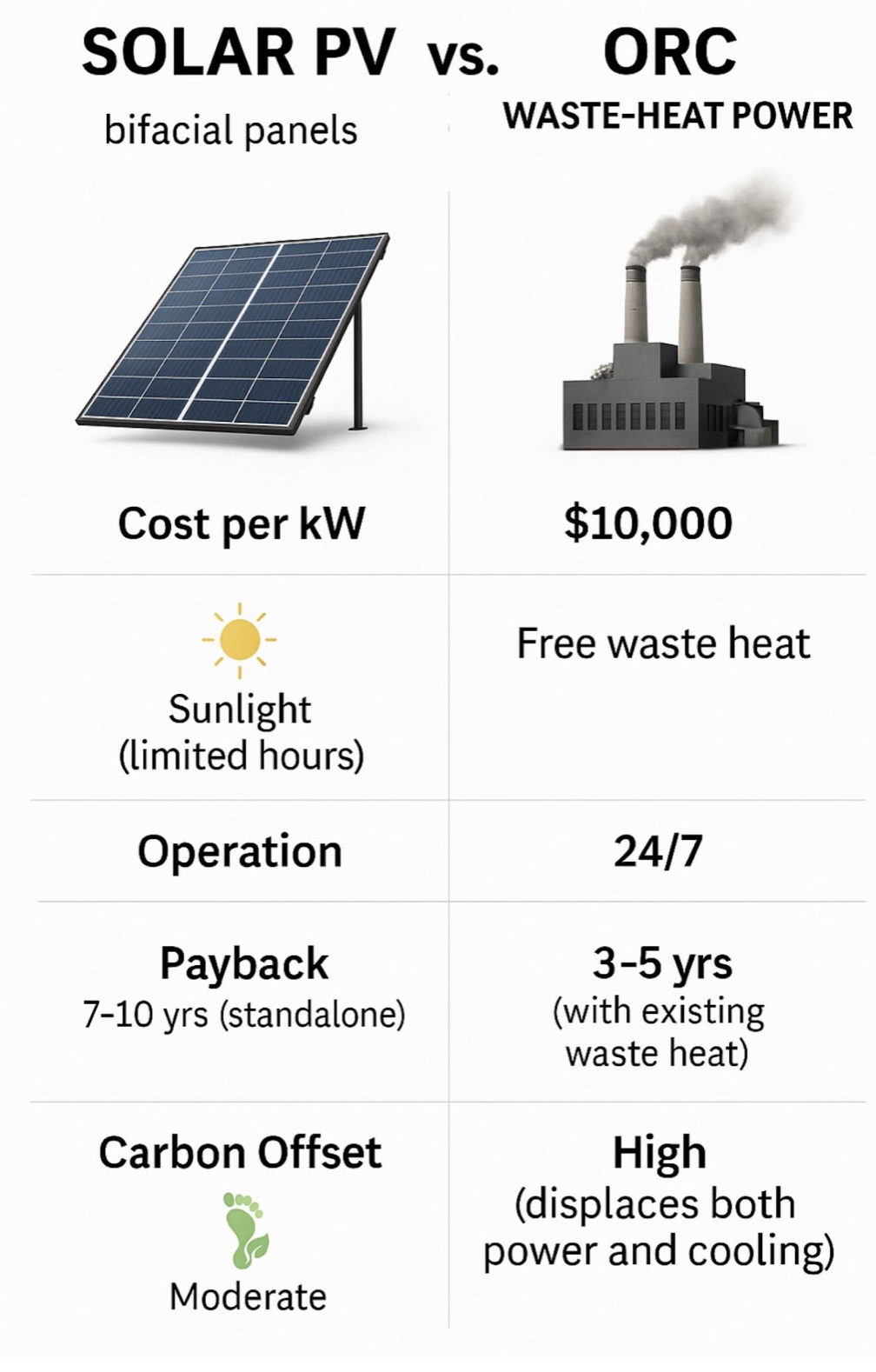
The Power of Waste Heat: Why ORC Systems Outperform Solar PV in Industrial Applications In the clean energy landscape, solar PV panels often take the spotlight for renewable electricity generation. However, in industrial and data center settings where waste heat is abundant, the Organic Rankine Cycle (ORC) system delivers a compelling alternative. While the upfront cost per kilowatt for ORC is higher, its ability to generate power continuously from waste heat makes it an exceptional technology for 24/7 operations.1. Understanding the Cost DifferenceAt first glance, the price difference between solar PV and ORC appears dramatic. Bifacial solar panels typically cost around 300 dollars per kilowatt, while ORC systems cost about 10,000 dollars per kilowatt. However, the key distinction lies in the fuel source. Solar panels rely on sunlight, which is intermittent and available only during daytime hours. In contrast, an ORC system utilizes free waste heat that would otherwise be lost to the atmosphere. This transforms what was once an expense into a revenue-generating asset.2. Continuous Operation AdvantageSolar PV systems generate electricity only during daylight hours and are subject to weather fluctuations. ORC systems, on the other hand, run continuously. They convert waste heat from industrial processes, power plants, or data centers into clean electricity 24 hours a day. This constant operation increases overall energy efficiency and reduces the need for backup systems or grid dependency.3. Payback and Financial ReturnWhen evaluating any power system, payback period is critical. Solar PV installations typically take 7 to 10 years to achieve full payback when operating as standalone systems. ORC systems, by contrast, can reach payback in just 3 to 5 years when installed in facilities with existing waste heat streams. This accelerated return is due to the fact that the energy source is free and already available, and the system operates without consuming additional fuel.4. Carbon Reduction and ESG ImpactRecovering waste heat through ORC technology contributes directly to carbon reduction goals. Every kilowatt of electricity generated through waste heat recovery offsets the need for additional fuel combustion. This results in a higher carbon offset compared to solar PV, which only displaces grid power during daytime hours. ORC systems also reduce the thermal pollution from vented heat, enhancing both environmental and operational sustainability.5. Complementary TechnologiesRather than viewing solar PV and ORC as competitors, many facilities are now combining them. Solar panels can provide daytime generation while ORC systems supply base-load power from thermal sources. When paired with energy storage, such as a saltwater battery system, the combined configuration delivers a balanced renewable solution that reduces energy costs and emissions around the clock.6. Key Comparison Summary| Feature | Solar PV | ORC Waste-Heat Power || ----------------| -----------------------| ------------------------------------- || Cost per kW | 300 dollars | 10,000 dollars || Fuel Source | Sunlight (limited hours) | Free waste heat || Operation | Daytime only | 24/7 continuous || Payback | 7–10 years | 3–5 years || Carbon Offset | Moderate | High (displaces both power and cooling) |7. The Circular Energy MindsetThe concept behind ORC waste-heat power fits perfectly within the emerging circular energy economy. Every industrial process generates heat, and traditionally that heat is vented or cooled at additional cost. ORC systems recover this energy, transforming it into power that can be reused or sold back to the grid. This closed-loop principle creates efficiency, reduces operating costs, and aligns with corporate sustainability and ESG goals.ConclusionSolar PV panels remain an excellent option for renewable power generation, especially in distributed applications. However, for industries or facilities already producing significant waste heat, ORC systems unlock a hidden source of clean, continuous energy. The higher initial cost is offset by 24-hour operation, faster payback, and greater environmental impact.Every BTU deserves a second life.
|
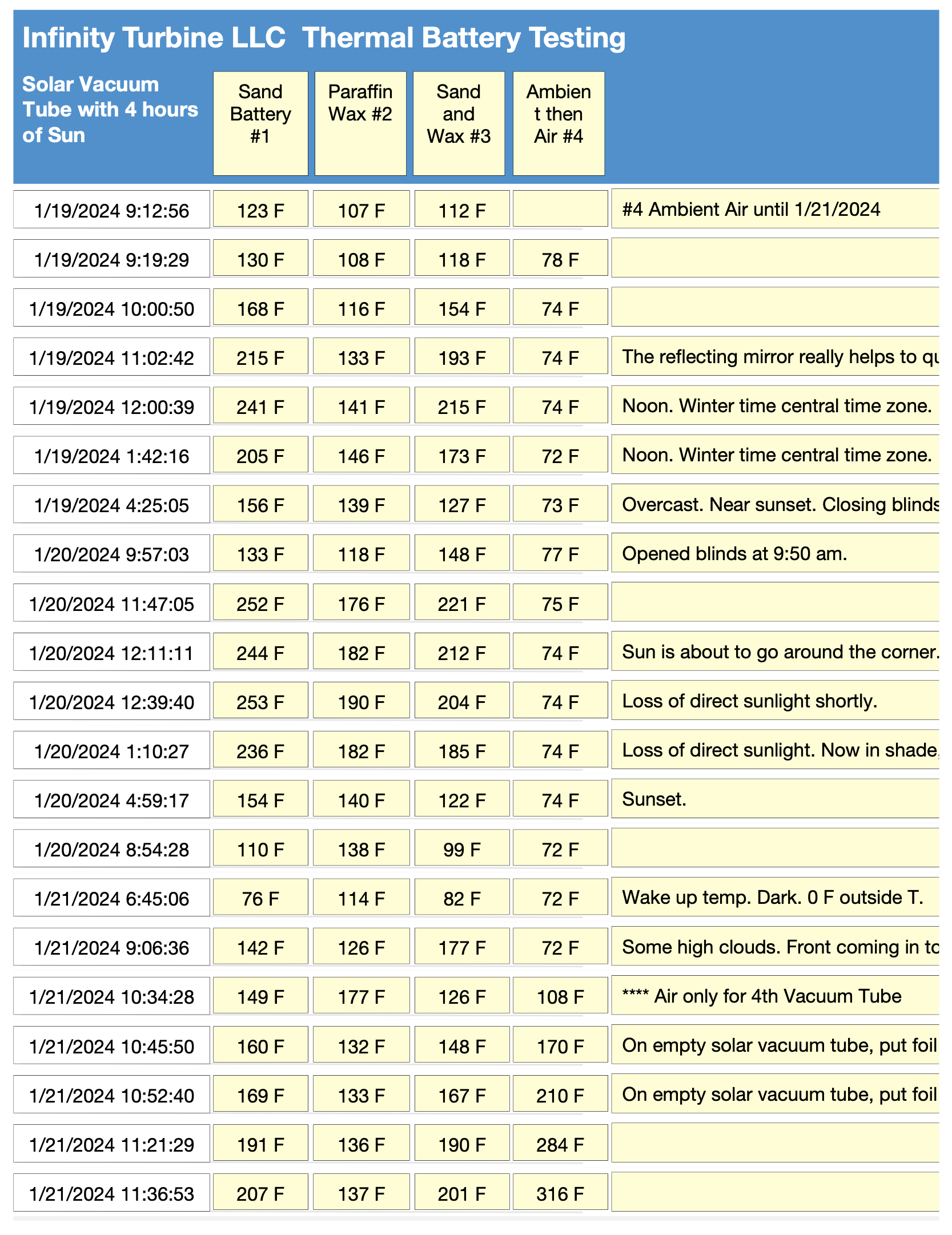
Solar Vacuum Tube Thermal Testing |
Solar Vacuum Tube Sand Battery Testing Experiments testing various media in solar vacuum tube.Sand Battery: Higher temperatures than wax, but cools down faster.Paraffin Wax: Lower temperatures than Sand to heat up (appears to reach a maxium), but stays hotter all night long.Sand and Paraffin Wax: Temperature between sand and wax, but stays longer.Air in Tube Only: Fast to heat up well above 300 F, but also fast to cool down.Salt Only: Pending.Sand and Salt: Pending.
|
| CONTACT Email: greg@infinityturbine.com | AMP | PDF |