
INFINITY TURBINE LLC We specialize in designs, plans, licensing, consulting, design services, and surplus spare parts. We no longer manufacture turbines or CO2 systems. More Info...
Please email for first contact with request for more information
Email: greg@infinityturbine.com
CO2 Ejectors for Data Center Waste Heat Cooling: A Technical Review Hyperscalers are racing to deploy gigawatts of AI compute, but the grid can't keep up and large gas turbines are backordered half a decade out. Infinity Turbine's Cluster Mesh Supercritical CO₂ system offers a radical alternative: modular, silent, trailer-deployable prime power that scales the way software does... More Info
From the Feher Cycle to the Cluster Mesh: A History of Supercritical CO₂ Power... More Info
Cooling a Data Center Pod with Its Own Waste Heat: A 100 kW Ejector Design Study More Info
Portable Gas Turbine Prime Power More Info
Cluster Mesh Supercritical CO2 Power System for Data Centers and AI Pairing Cluster Mesh Supercritical CO2 Power System with Small Modular Reactors enables hyperscalers to convert high-grade nuclear heat into ultra-efficient, dispatchable power with a compact, modular footprint tailored for AI-scale demand. More Info
ORC and Products Index Infinity Turbine ORC Index... More Info
AMD Helios Cooling Strategy Using Transcritical CO2 and a Cluster Mesh sCO2 Turbine Generator Cell More Info
|
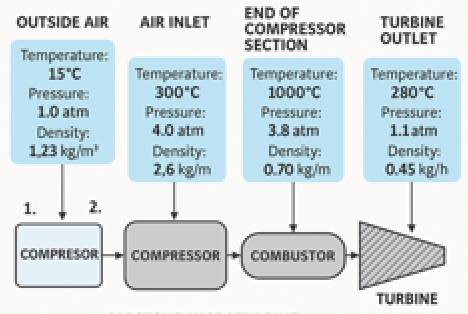
Air Density and Temperature Changes in a Capstone Microturbine Cycle IntroductionThe Capstone Microturbine operates on a simple Brayton cycle: air is compressed, mixed with fuel and burned, and the hot gas expands through a turbine to produce power. Each stage in this process dramatically changes the air’s pressure, temperature, and density. This article analyzes those changes using approximate thermodynamic conditions for a typical Capstone C65 or C200 microturbine, starting with an outside air temperature of 60°F (15°C).1. Ambient Inlet ConditionsTemperature: 15°C (288 K)Pressure: 1 atm (14.7 psi or 101 kPa)Density: ~1.225 kg/m³At the inlet, the air is drawn through a filter and enters the compressor at atmospheric conditions. The air is relatively cool and dense, which helps improve the turbine’s mass flow rate and power output.2. End of Compressor SectionThe compressor in a Capstone microturbine typically operates with a pressure ratio of 3.5:1 to 4:1.Assuming an outlet pressure of about 4 atm (≈400 kPa or 58 psi) and an adiabatic efficiency of around 80%, the air experiences significant compression heating.Pressure: ~4 atm (400 kPa or 58 psi)Temperature: ~300°C (573 K)Density: ~2.4–2.8 kg/m³Effect: The air becomes much hotter and about twice as dense as at inlet, but because of the large temperature rise, it does not become as dense as a simple pressure ratio would suggest. The high energy content in this compressed air is essential for efficient combustion.3. Combustion SectionIn the combustion chamber, fuel (typically natural gas or biogas) is mixed with the compressed air and burned under nearly constant pressure. The Capstone turbine uses lean premixed combustion for low emissions.Pressure: ~3.8–4.0 atm (slight drop from compressor discharge)Temperature: ~950–1000°C (1223–1273 K)Density: ~0.6–0.8 kg/m³Effect: The density drops dramatically because the temperature rises to nearly 1000°C, even though pressure stays roughly constant. The hot gases expand rapidly, increasing volume and velocity, which drives the turbine.4. Turbine Outlet (Exhaust Section)The turbine extracts energy from the expanding hot gases to drive both the compressor and the generator. After expansion, the exhaust gases have cooled and dropped in pressure.Pressure: ~1.1 atm (110 kPa or 16 psi absolute)Temperature: ~260–300°C (533–573 K)Density: ~0.4–0.5 kg/m³Effect: After expansion, the pressure returns near atmospheric levels, while the gas remains warm. Much of the waste heat can be recovered in a recuperator to preheat the incoming compressed air, improving the system’s overall efficiency to 28–33 percent (for electrical generation alone).Summary of Conditions| Stage | Temperature (°C) | Pressure (atm) | Density (kg/m³) | Process Description || --• | • | -• | --• | --• || 1. Inlet (Ambient) | 15 | 1.0 | 1.23 | Outside filtered air enters the compressor || 2. Compressor Exit | 300 | 4.0 | 2.6 | Air compressed and heated by compression || 3. Combustion | 1000 | 3.8 | 0.7 | Fuel added, major temperature rise || 4. Turbine Exhaust | 280 | 1.1 | 0.45 | Hot gases expand and exit to recuperator |ConclusionIn a Capstone Microturbine, air undergoes dramatic changes in pressure, temperature, and density across each stage of the Brayton cycle.Compression raises pressure and temperature while modestly increasing density.Combustion maintains nearly constant pressure but increases temperature, sharply lowering density.Expansion through the turbine converts this thermal energy into mechanical power while reducing both temperature and pressure.These transformations highlight the delicate balance of thermodynamics that allows microturbines to deliver reliable, efficient power using a compact, low-maintenance design.
|
|
|
| CONTACT Email: greg@infinityturbine.com | AMP | PDF |