
INFINITY TURBINE LLC We specialize in designs, plans, licensing, consulting, design services, and surplus spare parts. We no longer manufacture turbines or CO2 systems. More Info...
Please email for first contact with request for more information
Email: greg@infinityturbine.com
CO2 Ejectors for Data Center Waste Heat Cooling: A Technical Review Hyperscalers are racing to deploy gigawatts of AI compute, but the grid can't keep up and large gas turbines are backordered half a decade out. Infinity Turbine's Cluster Mesh Supercritical CO₂ system offers a radical alternative: modular, silent, trailer-deployable prime power that scales the way software does... More Info
From the Feher Cycle to the Cluster Mesh: A History of Supercritical CO₂ Power... More Info
Cooling a Data Center Pod with Its Own Waste Heat: A 100 kW Ejector Design Study More Info
Portable Gas Turbine Prime Power More Info
Cluster Mesh Supercritical CO2 Power System for Data Centers and AI Pairing Cluster Mesh Supercritical CO2 Power System with Small Modular Reactors enables hyperscalers to convert high-grade nuclear heat into ultra-efficient, dispatchable power with a compact, modular footprint tailored for AI-scale demand. More Info
ORC and Products Index Infinity Turbine ORC Index... More Info
AMD Helios Cooling Strategy Using Transcritical CO2 and a Cluster Mesh sCO2 Turbine Generator Cell More Info
|
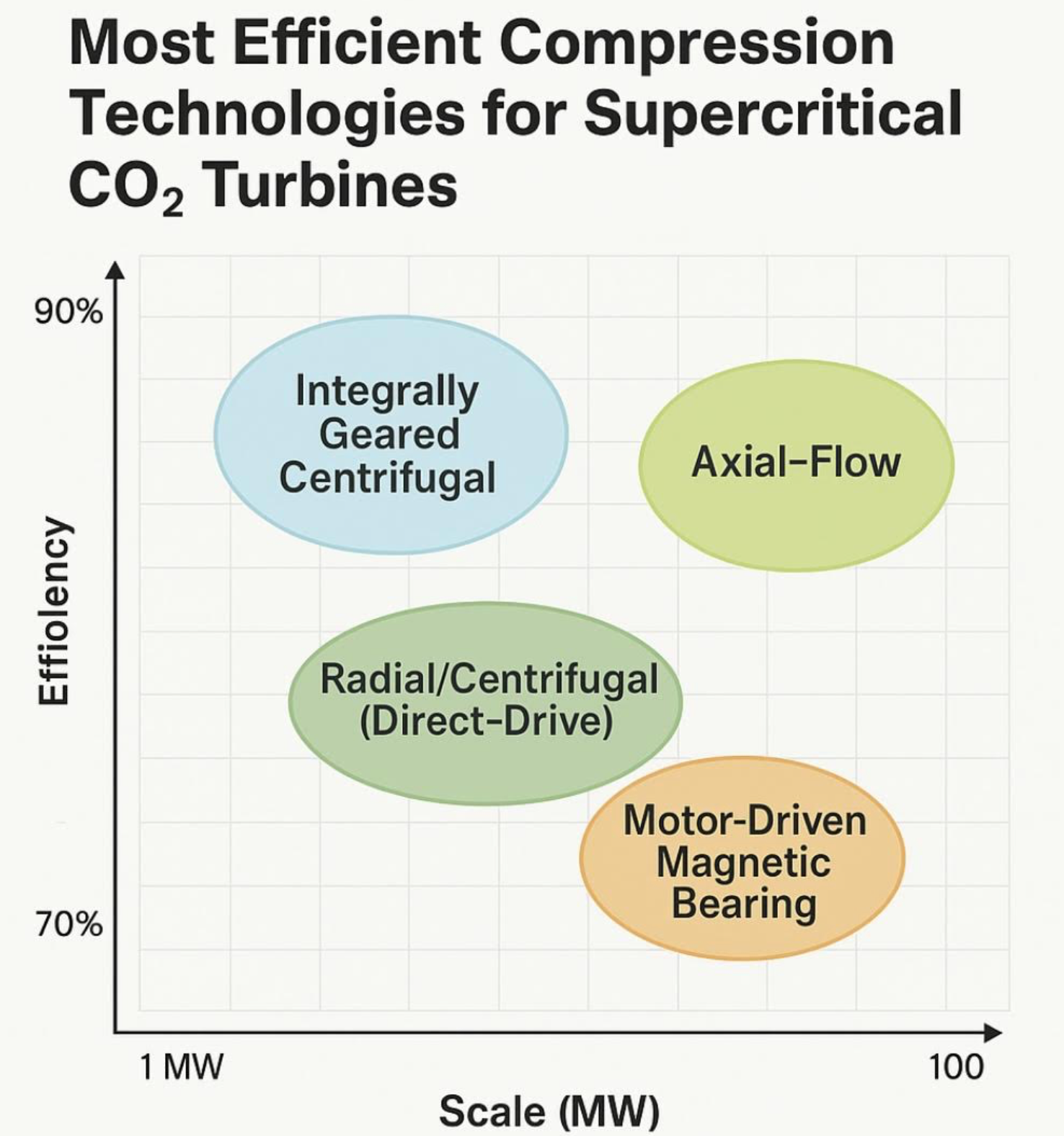
Most Efficient Compression Technologies for Supercritical CO₂ Turbines IntroductionIn supercritical CO₂ (sCO₂) power cycles, the compressor is just as critical as the turbine. Efficiency at this stage directly impacts overall cycle performance, since compression consumes a significant portion of the turbine’s work output. Selecting the right compression technology is therefore essential to achieving high cycle efficiency, compact size, and reliable operation. This article examines the most efficient compression technologies available for sCO₂ turbines, whether shaft-driven or motor-driven.The Challenge of CO₂ CompressionCompressing CO₂ is unique compared to air or steam due to its thermophysical properties:Near the critical point (31 °C and 7.38 MPa), CO₂ density changes rapidly with pressure and temperature.Small temperature variations can drastically impact compression power requirements.To minimize parasitic losses, cycle designs often place the compressor inlet temperature just above the critical point.These characteristics demand compressors with high efficiency, tight tolerances, and excellent control of leakage and cooling.Leading Compression Technologies1. Integrally Geared Centrifugal CompressorsHow They Work: Multiple impellers mounted on pinions connected to a central bull gear, each stage optimized for specific pressure ratios.Advantages:High isothermal efficiency (up to 85–90%).Compact, modular design.Excellent controllability over a wide operating range.Application: Already in use in pilot-scale sCO₂ systems due to their proven efficiency and ability to handle CO₂’s high density.2. Axial-Flow CompressorsHow They Work: Rows of rotating and stationary blades compress gas continuously along the shaft.Advantages:Extremely efficient for large mass flow rates.Well-suited for systems where the turbine and compressor are on the same shaft.Application: Effective in large-scale sCO₂ cycles (tens of MW and above), but less flexible for part-load or modular systems.3. Radial/Centrifugal Compressors (Direct-Drive)How They Work: Single or multi-stage impellers accelerate and diffuse gas to increase pressure.Advantages:Compact and robust.Suitable for moderate flow ranges.Can be integrated directly onto the turbine shaft for mechanical simplicity.Application: Widely considered for mid-size sCO₂ cycles (1–10 MW).4. Motor-Driven Magnetic Bearing CompressorsHow They Work: Compressors are decoupled from the turbine shaft and powered by high-speed electric motors with magnetic bearings.Advantages:Near-frictionless operation reduces parasitic losses.Independent speed control allows optimization for varying conditions.Easier integration into hybrid systems (e.g., grid-interactive sCO₂ blocks).Application: Emerging as a flexible option where modularity and variable load-following are required.Efficiency ConsiderationsIsothermal Efficiency: Integrally geared and axial compressors lead the field, achieving 85–90% efficiency in optimized designs.Parasitic Losses: Magnetic bearing systems reduce oil and seal-related inefficiencies, improving long-term performance.Integration: A direct shaft-coupled compressor minimizes moving parts, while motor-driven units offer superior flexibility for hybrid power plants.ConclusionThe most efficient compression technologies for supercritical CO₂ turbines are integrally geared centrifugal compressors and axial-flow compressors, depending on plant scale. For smaller or modular systems, motor-driven magnetic bearing compressors offer unmatched flexibility and reliability.Ultimately, the best choice depends on system size, operational goals, and whether the turbine is designed as a tightly integrated shaft-driven system or a modular power block. By optimizing the compressor stage, developers can unlock the full efficiency potential of supercritical CO₂ turbine systems.
|
|
|
| CONTACT Email: greg@infinityturbine.com | AMP | PDF |