
INFINITY TURBINE LLC We specialize in designs, plans, licensing, consulting, design services, and surplus spare parts. We no longer manufacture turbines or CO2 systems. More Info...
Please email for first contact with request for more information
Email: greg@infinityturbine.com
CO2 Ejectors for Data Center Waste Heat Cooling: A Technical Review Hyperscalers are racing to deploy gigawatts of AI compute, but the grid can't keep up and large gas turbines are backordered half a decade out. Infinity Turbine's Cluster Mesh Supercritical CO₂ system offers a radical alternative: modular, silent, trailer-deployable prime power that scales the way software does... More Info
From the Feher Cycle to the Cluster Mesh: A History of Supercritical CO₂ Power... More Info
Cooling a Data Center Pod with Its Own Waste Heat: A 100 kW Ejector Design Study More Info
Portable Gas Turbine Prime Power More Info
Cluster Mesh Supercritical CO2 Power System for Data Centers and AI Pairing Cluster Mesh Supercritical CO2 Power System with Small Modular Reactors enables hyperscalers to convert high-grade nuclear heat into ultra-efficient, dispatchable power with a compact, modular footprint tailored for AI-scale demand. More Info
ORC and Products Index Infinity Turbine ORC Index... More Info
AMD Helios Cooling Strategy Using Transcritical CO2 and a Cluster Mesh sCO2 Turbine Generator Cell More Info
|
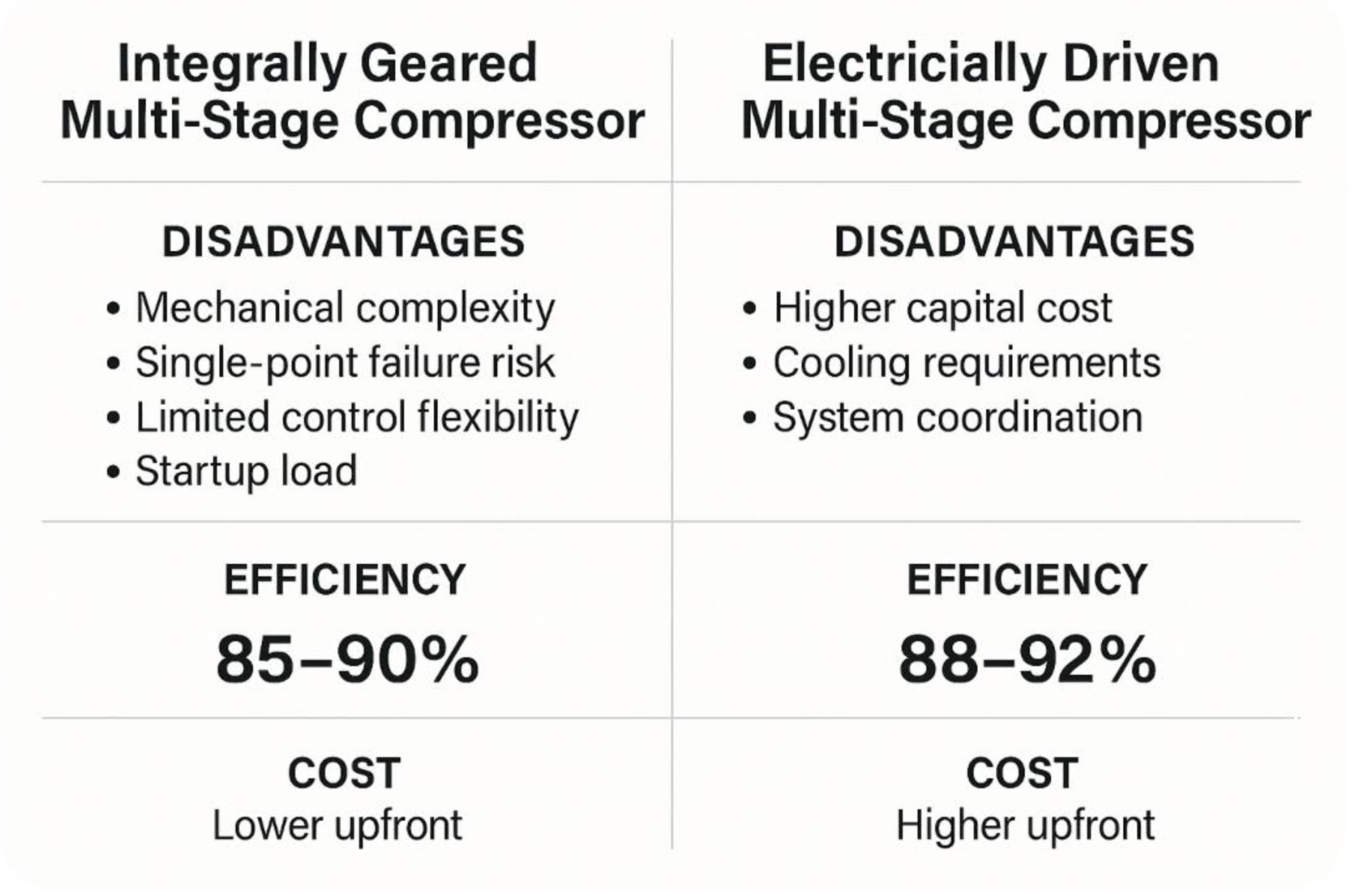
Comparing Integrally Geared CO₂ Compressors and Electrically Driven Multi-Stage Designs IntroductionIn CO₂ compression systems—especially those used in supercritical power cycles, refrigeration, and carbon capture—efficiency and flexibility of compression are critical. Two primary configurations dominate advanced compressor design:1. Integrally geared multi-stage compressors, powered by a single shaft and central drive source.2. Electrically driven multi-stage compressors, where each stage has its own motor.This article compares both approaches in terms of mechanical complexity, efficiency, controllability, and cost, to determine which architecture best suits modern CO₂ systems.1. Integrally Geared Multi-Stage Compressor SystemDescriptionAn integrally geared compressor (IGC) uses a single main drive shaft connected to a central bull gear. Multiple pinions, each attached to an impeller, rotate at optimized speeds for different compression stages. These stages are often cooled between impellers to maintain efficiency and prevent gas overheating.AdvantagesHigh overall efficiency: The gearing allows each impeller to operate at its most efficient speed.Compact configuration: One common gearbox and drive motor or turbine reduce footprint and complexity.Proven reliability: Decades of industrial use in air separation, CO₂, and gas pipeline service.Centralized maintenance: A single lubrication and bearing system supports all stages.DisadvantagesMechanical complexity: Requires precise alignment, lubrication, and gear synchronization.Single-point failure risk: If the main drive or gear system fails, all compression stages stop.Limited control flexibility: All stages run together—independent speed control is not possible.Startup load: High torque required at startup, which can demand large electric drives or soft-start systems.Efficiency and CostIsothermal efficiency: 85–90% typical.Gear losses: Around 1–2% per stage, depending on configuration.Cost: Lower capital cost per stage due to shared components, but higher maintenance costs over time due to wear in gears and bearings.2. Electrically Driven Multi-Stage Compressor SystemDescriptionIn this setup, each CO₂ compression stage is individually driven by a dedicated high-speed electric motor. Instead of mechanical gears, variable-frequency drives (VFDs) precisely control impeller speed for each compressor.AdvantagesIndependent control: Each stage can be optimized for flow, pressure, and temperature.No mechanical gears: Reduced frictional losses and maintenance.High operational flexibility: Easy to modulate for part-load operation or dynamic system balancing.Improved reliability: Failure of one stage does not disable the entire compression system.DisadvantagesHigher capital cost: Each motor and VFD adds cost and complexity.Cooling requirements: Multiple motor drives generate additional heat that must be managed.System coordination: Requires precise digital control to synchronize stages and prevent surge conditions.Physical footprint: May require more space for distributed motor and drive electronics.Efficiency and CostElectrical drive efficiency: 95–97% per motor and VFD combination.Overall compression efficiency: 85–92% depending on control optimization and heat recovery.Cost: Higher initial investment but lower lifetime mechanical maintenance costs.3. Comparison: Mechanical Gear vs. Electric Direct Drive| Parameter | Integrally Geared System | Electrically Driven Multi-Stage System || --• | • | -• || Drive Type | Single shaft with pinions | Individual electric motors || Efficiency | 85–90% overall | 88–92% overall || Control Flexibility | Fixed speed per stage | Variable speed per stage || Maintenance | Centralized but gear-intensive | Decentralized, minimal mechanical wear || Startup Characteristics | High torque, gear dependent | Soft start via VFDs || Reliability | Single-point failure possible | Modular; partial operation possible || Cost (CapEx) | Lower upfront | Higher upfront || Cost (OpEx) | Higher long-term maintenance | Lower long-term maintenance || Footprint | Compact and centralized | Larger, distributed components || Best Use Case | Continuous industrial base load | Modular or variable-load CO₂ systems |4. Efficiency SummaryMechanically geared systems are inherently efficient and compact for large, steady-load industrial processes where variable operation is not critical. However, electrically driven compressors gain an advantage in dynamic or modular systems (such as CO₂ refrigeration, energy recovery, or data center cooling) where load flexibility and control precision matter more than minimal footprint.5. Cost and Lifecycle AnalysisInitial Cost: Integrally geared systems are typically 20–30% cheaper to install, since they share a single drive source and housing.Operating Cost: Electric direct-drive systems generally have 15–20% lower lifetime maintenance costs due to fewer mechanical wear parts and easier component replacement.Energy Use: Electrical drives may be slightly more efficient overall, especially under variable load conditions where part-speed operation reduces power draw.ConclusionBoth integrally geared and electrically driven CO₂ compressor systems have distinct advantages.The integrally geared compressor excels in centralized, continuous-duty applications, offering high power density and proven reliability.The electrically driven multi-stage system offers modularity, energy flexibility, and superior control, making it ideal for next-generation CO₂ refrigeration, heat pumps, and supercritical power cycles.When considering overall lifecycle cost and system adaptability, electrically driven compressors are the future direction—particularly as high-speed, high-efficiency motor technologies continue to advance.
|
|
|
| CONTACT Email: greg@infinityturbine.com | AMP | PDF |