
INFINITY TURBINE LLC We specialize in designs, plans, licensing, consulting, design services, and surplus spare parts. We no longer manufacture turbines or CO2 systems. More Info...
Please email for first contact with request for more information
Email: greg@infinityturbine.com
CO2 Ejectors for Data Center Waste Heat Cooling: A Technical Review Hyperscalers are racing to deploy gigawatts of AI compute, but the grid can't keep up and large gas turbines are backordered half a decade out. Infinity Turbine's Cluster Mesh Supercritical CO₂ system offers a radical alternative: modular, silent, trailer-deployable prime power that scales the way software does... More Info
From the Feher Cycle to the Cluster Mesh: A History of Supercritical CO₂ Power... More Info
Cooling a Data Center Pod with Its Own Waste Heat: A 100 kW Ejector Design Study More Info
Portable Gas Turbine Prime Power More Info
Cluster Mesh Supercritical CO2 Power System for Data Centers and AI Pairing Cluster Mesh Supercritical CO2 Power System with Small Modular Reactors enables hyperscalers to convert high-grade nuclear heat into ultra-efficient, dispatchable power with a compact, modular footprint tailored for AI-scale demand. More Info
ORC and Products Index Infinity Turbine ORC Index... More Info
AMD Helios Cooling Strategy Using Transcritical CO2 and a Cluster Mesh sCO2 Turbine Generator Cell More Info
|
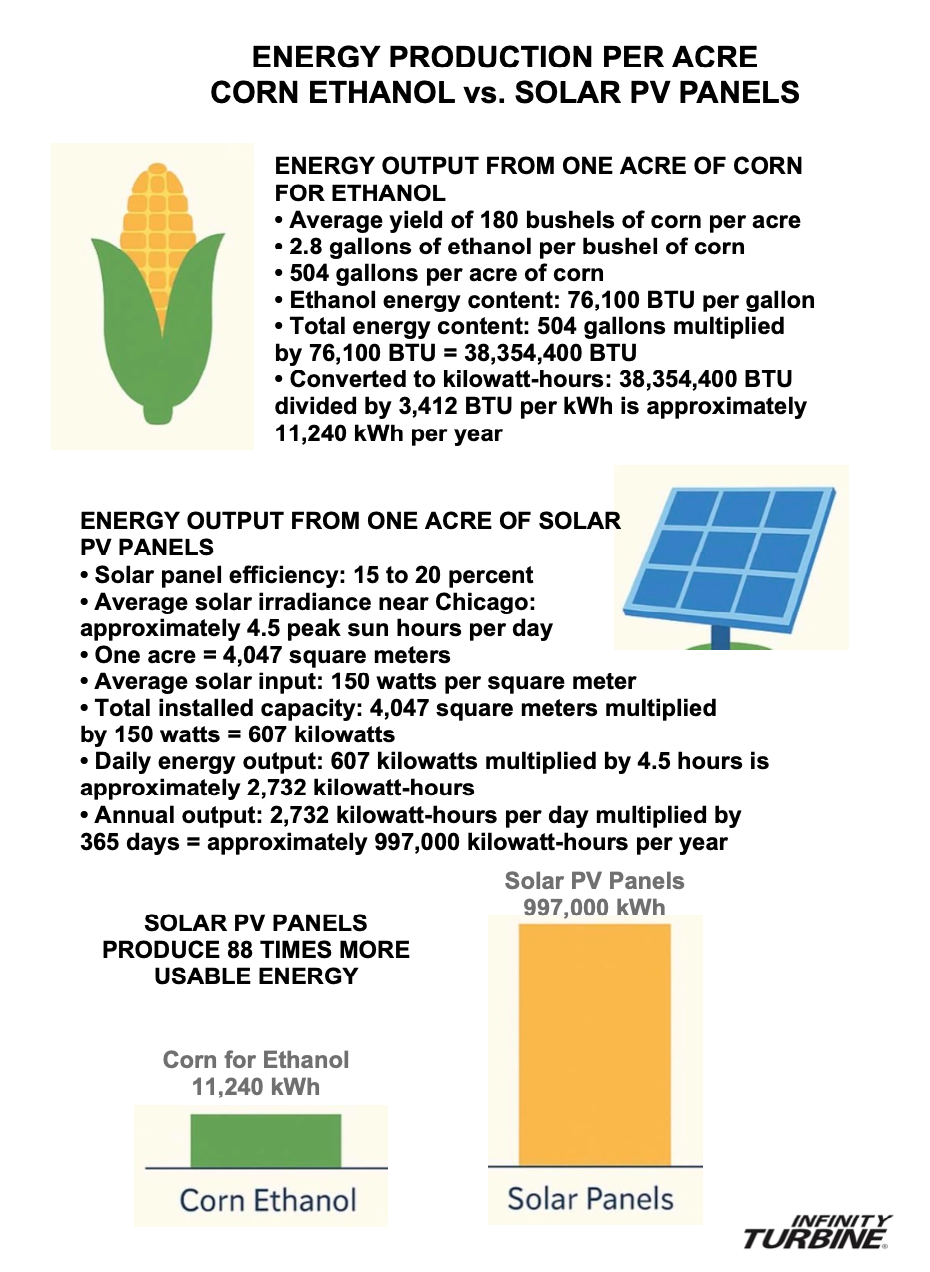
Energy Production per Acre: Corn Ethanol vs Solar Panels How much energy does one acre of corn really produce when turned into ethanol? And how does that compare to the same acre covered in solar panels? Explore the numbers and find out which solution is more energy efficient.---Comparing Energy Output: Corn for Ethanol vs Solar PV PanelsOverviewIn the American Midwest, many farmers grow corn destined for ethanol production. At the same time, solar photovoltaic (PV) technology offers an alternative way to harvest energy from the same land. This article compares the annual energy yield from one acre of corn grown for ethanol to the output of one acre of solar panels, using realistic data for a location near Chicago, Illinois.---Energy Output from One Acre of Corn for EthanolAverage corn yield: 180 bushels per acre per yearEthanol yield per bushel: 2.8 gallonsTotal ethanol yield per acre: 180 bushels multiplied by 2.8 gallons = 504 gallonsEnergy content of ethanol: 76,100 BTU per gallonTotal energy content: 504 gallons multiplied by 76,100 BTU = 38,354,400 BTUConverted to kilowatt-hours: 38,354,400 BTU divided by 3,412 BTU per kWh = approximately 11,240 kWh per yearAnnual energy output from one acre of corn for ethanol: approximately 11,240 kilowatt-hoursNote: This is a gross value and does not account for fossil fuel inputs such as fertilizer, harvesting equipment, or ethanol refining.---Energy Output from One Acre of Solar PanelsUsable land area: 43,560 square feet (1 acre)Solar panel efficiency: 15 to 20 percentAverage solar irradiance near Chicago: approximately 4.5 peak sun hours per dayOne acre = 4,047 square metersAverage solar input: 150 watts per square meterTotal installed capacity: 4,047 square meters multiplied by 150 watts = 607 kilowattsDaily energy output: 607 kilowatts multiplied by 4.5 hours = approximately 2,732 kilowatt-hoursAnnual output: 2,732 kilowatt-hours per day multiplied by 365 days = approximately 997,000 kilowatt-hours per yearAnnual energy output from one acre of solar panels: approximately 997,000 kilowatt-hours---Energy Comparison Table| Energy Source | Annual Output per Acre (kWh) | Corn for Ethanol | 11,240 | Gross energy, significant fossil inputs || Solar PV Panels | 997,000 | Clean, renewable, continuous output |Solar panels produce nearly 90 times more usable energy per acre per year than corn grown for ethanol.---ConclusionIn terms of raw energy output, one acre of solar panels provides a dramatically higher yield than one acre of corn used for ethanol. While corn-based ethanol is renewable, it requires substantial energy input to grow, harvest, and refine. Solar panels, by contrast, convert sunlight directly into electricity and operate with minimal maintenance.For policymakers, landowners, and farmers seeking to maximize energy efficiency and sustainability, the case for solar energy over biofuel crops is clear.
|
|
Energy Production per Acre: Corn Ethanol vs Solar Panels How much energy does one acre of corn really produce when turned into ethanol? And how does that compare to the same acre covered in solar panels? Explore the numbers and find out which solution is more energy efficient.Comparing Energy Output: Corn for Ethanol vs Solar PV PanelsOverviewIn the American Midwest, many farmers grow corn destined for ethanol production. At the same time, solar photovoltaic (PV) technology offers an alternative way to harvest energy from the same land. This article compares the annual energy yield from one acre of corn grown for ethanol to the output of one acre of solar panels, using realistic data for a location near Chicago, Illinois.Energy Output from One Acre of Corn for EthanolAverage corn yield: 180 bushels per acre per yearEthanol yield per bushel: 2.8 gallonsTotal ethanol yield per acre: 180 bushels multiplied by 2.8 gallons = 504 gallonsEnergy content of ethanol: 76,100 BTU per gallonTotal energy content: 504 gallons multiplied by 76,100 BTU = 38,354,400 BTUConverted to kilowatt-hours: 38,354,400 BTU divided by 3,412 BTU per kWh = approximately 11,240 kWh per yearAnnual energy output from one acre of corn for ethanol: approximately 11,240 kilowatt-hoursNote: This is a gross value and does not account for fossil fuel inputs such as fertilizer, harvesting equipment, or ethanol refining.Energy Output from One Acre of Solar PanelsUsable land area: 43,560 square feet (1 acre)Solar panel efficiency: 15 to 20 percentAverage solar irradiance near Chicago: approximately 4.5 peak sun hours per dayOne acre = 4,047 square metersAverage solar input: 150 watts per square meterTotal installed capacity: 4,047 square meters multiplied by 150 watts = 607 kilowattsDaily energy output: 607 kilowatts multiplied by 4.5 hours = approximately 2,732 kilowatt-hoursAnnual output: 2,732 kilowatt-hours per day multiplied by 365 days = approximately 997,000 kilowatt-hours per yearAnnual energy output from one acre of solar panels: approximately 997,000 kilowatt-hoursEnergy Comparison Table| Energy Source | Annual Output per Acre (kWh) | Notes || Corn for Ethanol | 11,240 | Gross energy, significant fossil inputs || Solar PV Panels | 997,000 | Clean, renewable, continuous output |Solar panels produce nearly 90 times more usable energy per acre per year than corn grown for ethanol.ConclusionIn terms of raw energy output, one acre of solar panels provides a dramatically higher yield than one acre of corn used for ethanol. While corn-based ethanol is renewable, it requires substantial energy input to grow, harvest, and refine. Solar panels, by contrast, convert sunlight directly into electricity and operate with minimal maintenance.For policymakers, landowners, and farmers seeking to maximize energy efficiency and sustainability, the case for solar energy over biofuel crops is clear. |

|
Corn for Ethanol (1 acre near Chicago) Corn for Ethanol (1 acre near Chicago)Average yield: \~177 bushels per acre in the U.S. ([Reddit][1], [Wikipedia][2])Farm‐gate corn price: \$4.64 per bushel (May 2025 avg) ([YCharts][3])Gross revenue: 177 bu × \$4.64 = \$821 per acreNet profit will depend on input costs (seed, fertilizer, labor, transport, ethanol plant differential), but gross revenue is about \$820/acre.---⚡ Solar PV Farm (1 acre near Chicago)Annual electricity output: \~400 MWh ≈ 400,000 kWh per acre ([YCharts][3], [sungoldsolar.us][4])Export value to grid: \$0.10 per kWh (given)Gross revenue: 400,000 kWh × \$0.10 = \$40,000 per acre-yearNet profit depends on costs (panel installation, maintenance, financing, tax credits), but gross revenue is \~\$40k per acre—roughly 50× the corn revenue.---📊 Comparison Summary| Use of 1 Acre | Annual Gross Revenue || ------------• | -------------------• || Corn–ethanol | \~\$820 || Solar PV | \~\$40,000 |Solar PV farming yields about 50× higher gross revenue per acre compared to growing corn for ethanol—before accounting for capital and operational costs.---Wehbe‑Style ArticlePage: 1Title: Corn Versus Solar: Acre‑by‑Acre Revenue ShowdownMeta: This article compares annual per‑acre revenues from corn grown for ethanol versus electricity produced by solar PV near Chicago. Corn yields roughly \$820 per acre, while solar commands about \$40,000 per acre, highlighting the dramatic economic advantage of solar farming in that region.Description: A detailed comparison of two land‑use strategies—corn for ethanol versus utility‑scale solar PV—on a per‑acre basis near Chicago. Includes current corn pricing, solar yield data, and implications for farmers and policymakers.Teaser: An acre of solar panels can generate approximately fifty times more revenue per year than an acre of corn destined for ethanol. This stark disparity reveals major opportunities and trade‑offs for agricultural land in the Midwest.---Let me know if you want a deeper dive into costs, financing, policy incentives, or a broader regional analysis![1]: https://www.reddit.com/r/solar/comments/oebpcr/solar_farm_economics/?utm_source=chatgpt.com Solar farm economics? : r/solar • Reddit[2]: https://en.wikipedia.org/wiki/Corn_production_in_the_United_States?utm_source=chatgpt.com Corn production in the United States[3]: https://ycharts.com/indicators/us_corn_price?utm_source=chatgpt.com US Corn Farm Price Received • Real-Time & Historical Trends[4]: https://www.sungoldsolar.us/how-many-homes-would-an-acre-of-solar-panels-provide/?utm_source=chatgpt.com How Many Homes Would An Acre Of Solar Panels Provide
|
|
Corn (Ethanol Feedstock) Corn (Ethanol Feedstock)Total production cost per bushel in Illinois (2023 avg): \$5.82 ([Purdue Agriculture][1], [farmdoc daily][2])Based on yield of 177 bushels/acre, total cost per acre = 177 × \$5.82 ≈ \$1,030/acreCost per bushel: \$5.82 (as above)---⚡ Solar PV FarmOvernight installation cost (utility-scale): \~\$1.06 per watt ([MarketWatch][3])1 acre ≈ 43.56 kW AC capacity → upfront cost ≈ 43.56 kW × \$1,060/kW = \$46,174Amortized over 20 years (straight-line): \$46,174 / 20 = \$2,309/yearAnnual output: \~400,000 kWh ([Reddit][4])Capital cost per kWh: \$2,309 / 400,000 = \$0.0058/kWhO\&M & fixed costs (typical): \~\$0.010/kWh&x20;All-in cost: \~\$0.016/kWhCapital cost per year: \$2,309Total cost per kW installed: \$1,060---📊 Summary Table| Use | Yield Equivalent | Annual Cost | Unit Cost || -------• | ---------------• | ----------• | --------------------------------------------• || Corn | 177 bu/acre | \$1,030 | \$5.82 per bushel || Solar PV | 400,000 kWh | \$2,309 | \$0.0058 (cap) + \$0.010 (O\&M) = \$0.016/kWh |---🚜 Web ArticlePage TitleComparing Production Costs: Corn Ethanol vs Solar PV on One AcreMetaThis article examines the cost structure of producing corn for ethanol versus generating electricity with solar PV on one acre near Chicago, with per-bushel and per-kilowatt-hour breakdowns based on current data.DescriptionA detailed cost comparison of two land-use strategies: corn for ethanol production and utility-scale solar PV, including amortized equipment costs and per-unit production cost analysis.TeaserOn one acre of Illinois farmland, corn production costs average \$5.82 per bushel (\$1,030 per acre), while a solar PV installation costs roughly \$46,000 upfront (\$2,309/year amortized), yielding electricity at just \$0.016 per kilowatt-hour.---Let me know if you’d like a breakdown including financing, tax credits, or net profit after revenue is included![1]: https://ag.purdue.edu/commercialag/home/paer-article/2025-purdue-crop-cost-and-return-guide/?utm_source=chatgpt.com 2025 Purdue Crop Cost and Return Guide • Center for Commercial ...[2]: https://farmdocdaily.illinois.edu/2024/04/cost-to-produce-corn-and-soybeans-in-illinois-2023.html?utm_source=chatgpt.com Cost to Produce Corn and Soybeans in Illinois—2023 • farmdoc daily[3]: https://www.marketwatch.com/guides/solar/solar-farm-cost/?utm_source=chatgpt.com How Much Does a Solar Farm Cost in July 2025? • MarketWatch[4]: https://www.reddit.com/r/solar/comments/1194hcm/how_do_people_actually_know_when_they_break_even/?utm_source=chatgpt.com How do people actually know when they “break even” after an install? |

|
comparison of energy outputs Here is a comparison of energy outputs for three solar technologies based on 1 square meter of surface area under typical conditions (assumed irradiance: 1,000 W/m² peak, average 5.5 sun-hours/day, near Chicago or similar climate):---1. Bifacial Solar PV Panel (1 m²)Conversion efficiency: \~20% front-side, \~5–10% rear-side (bifacial gain \~10–15% total)Total effective efficiency: \~22%Daily energy output:1,000 W/m² × 5.5 hrs/day × 22% = 1.21 kWh/dayAnnual energy output:\~441 kWh/year---2. Concentrated Solar Thermal (1 m² aperture)Thermal collection efficiency: \~60% (varies with design, mirrors, and temperature)Peak solar irradiance: 1,000 W/m²Daily thermal energy output:1,000 W/m² × 5.5 hrs × 60% = 3,300 Wh = 11,262 BTU/dayAnnual output:\~1,204,000 BTU/year\~353 kWh (thermal)---3. Solar Thermal Vacuum Tubes (1 m²)Efficiency: \~70% at mid-range temperatures (\~60–80°C)Daily thermal energy output:1,000 W/m² × 5.5 hrs × 70% = 3,850 Wh = 13,142 BTU/dayAnnual output:\~1,430,000 BTU/year\~419 kWh (thermal)---🔍 Summary Table| Technology | Daily Output (kWh) | Daily Output (BTU) | Annual Output (kWh) | Annual Output (BTU) || ------------------------• | -----------------• | -----------------• | ------------------• | ------------------• || Bifacial Solar PV (1 m²) | 1.21 | 4,130 | 441 | 1,505,000 || Concentrated Solar (1 m²) | 3.30 (thermal) | 11,262 | 353 | 1,204,000 || Vacuum Tube Solar (1 m²) | 3.85 (thermal) | 13,142 | 419 | 1,430,000 |
|
| Here is a comparison of energy outputs for three solar technologies based on 1 square meter of surface area under typical conditions (assumed irradiance: 1,000 W/m² peak, average 5.5 sun-hours/day, near Chicago or similar climate):---1. Bifacial Solar PV Panel (1 m²)Conversion efficiency: \~20% front-side, \~5–10% rear-side (bifacial gain \~10–15% total)Total effective efficiency: \~22%Daily energy output:1,000 W/m² × 5.5 hrs/day × 22% = 1.21 kWh/dayAnnual energy output:\~441 kWh/year---2. Concentrated Solar Thermal (1 m² aperture)Thermal collection efficiency: \~60% (varies with design, mirrors, and temperature)Peak solar irradiance: 1,000 W/m²Daily thermal energy output:1,000 W/m² × 5.5 hrs × 60% = 3,300 Wh = 11,262 BTU/dayAnnual output:\~1,204,000 BTU/year\~353 kWh (thermal)---3. Solar Thermal Vacuum Tubes (1 m²)Efficiency: \~70% at mid-range temperatures (\~60–80°C)Daily thermal energy output:1,000 W/m² × 5.5 hrs × 70% = 3,850 Wh = 13,142 BTU/dayAnnual output:\~1,430,000 BTU/year\~419 kWh (thermal)---🔍 Summary Table| Technology | Daily Output (kWh) | Daily Output (BTU) | Annual Output (kWh) | Annual Output (BTU) || ------------------------• | -----------------• | -----------------• | ------------------• | ------------------• || Bifacial Solar PV (1 m²) | 1.21 | 4,130 | 441 | 1,505,000 || Concentrated Solar (1 m²) | 3.30 (thermal) | 11,262 | 353 | 1,204,000 || Vacuum Tube Solar (1 m²) | 3.85 (thermal) | 13,142 | 419 | 1,430,000 | |
|
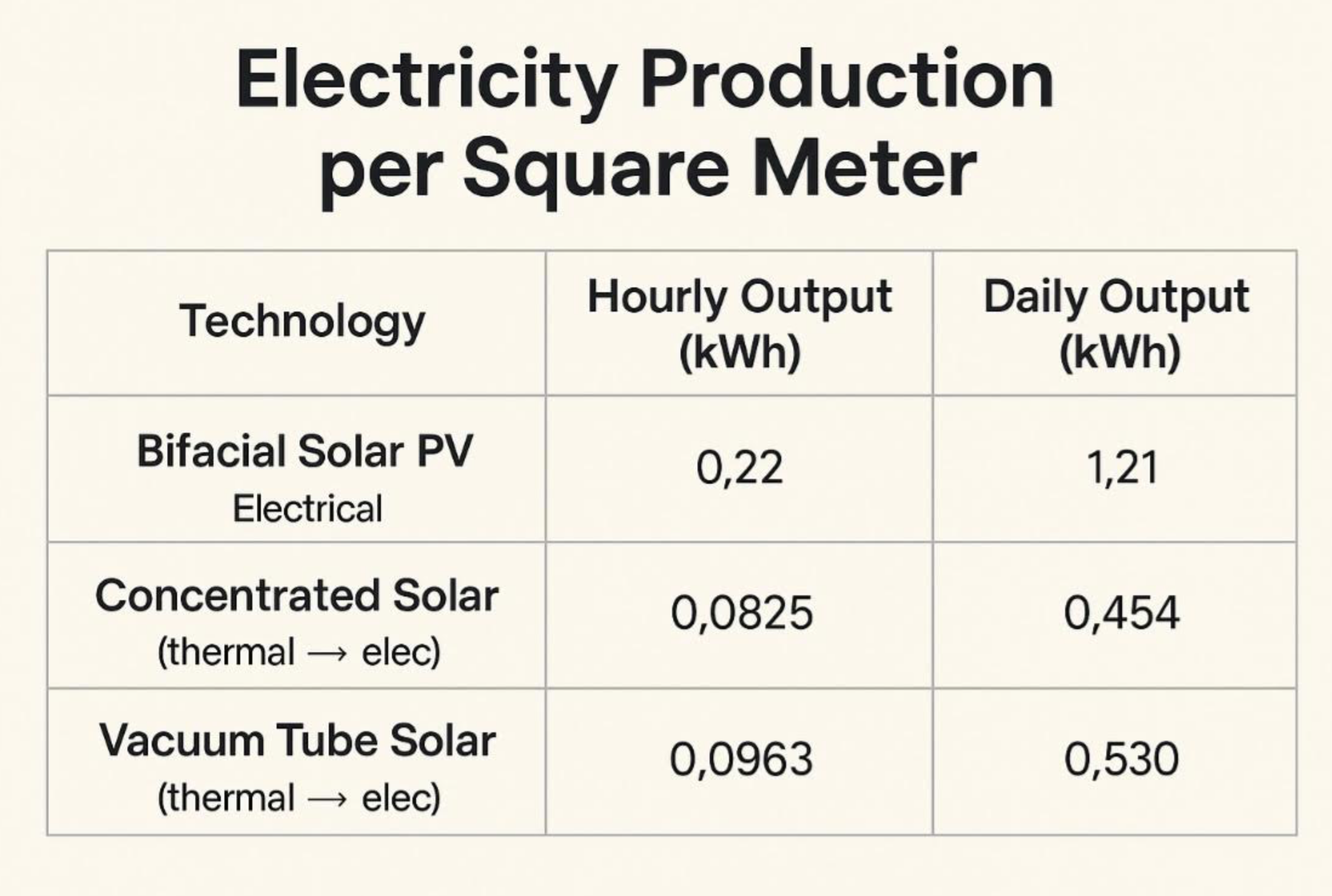
| Here is a written comparison chart showing the hourly and daily electricity production per square meter for each solar technology, assuming:5.5 solar hours/dayBifacial Solar PV produces electricity directlyConcentrated Solar and Vacuum Tube Solar produce thermal energy, converted to electricity using supercritical CO₂ at a heat rate of 40,000 BTU/kWh---Electricity Production per Square Meter| Technology | Type | Hourly Output (kWh) | Daily Output (kWh) || ----------------------------------• | ---------• | ------------------• | -----------------• || Bifacial Solar PV | Electrical | 0.22 | 1.21 || Concentrated Solar (thermal → elec) | Thermal | 0.0825 | 0.454 || Vacuum Tube Solar Thermal (→ elec) | Thermal | 0.0963 | 0.530 |---Notes:Hourly Output is calculated as daily output divided by 5.5 sun-hours.Thermal conversion assumes 1 kWh of electricity requires 40,000 BTU of heat.This chart helps quantify usable electricity output, not just thermal potential, for fair comparison across technologies. |

|
Typical Operating Temperatures Typical Operating Temperatures| System Type | Working Fluid | Temperature Range (°C) | Temperature Range (°F) || ----------------------------• | --------------------------------• | ---------------------• | ---------------------• || Concentrated Solar Thermal | Thermal Oil | 300–400 °C | 572–752 °F || Vacuum Tube Solar Thermal | Thermal Oil | 100–200 °C | 212–392 °F || Concentrated Solar (advanced) | Supercritical CO₂ (sCO₂) | 500–700 °C | 932–1,292 °F || Advanced CSP or ORC | Salt–CO₂ mix (sCO₂ + molten salt) | 550–750 °C | 1,022–1,382 °F |---Comparison of Heat Transfer Fluids| Fluid | Max Temp (°C) | Cost (USD/ton) | Pressure Required | Advantages | Drawbacks || --------------------• | ------------• | --------------• | ----------------• | -----------------------------------------------------------------------• | ----------------------------------------------------------------------• || Thermal Oil | \~400 | \$1,000–\$3,000 | Low (1–3 bar) | Stable, non-corrosive, simple system | Fire risk, degrades at high temp, limited to \~400°C || Supercritical CO₂ | \~700 | \$100–\$300 | High (≥7.38 MPa) | High efficiency, compact system, non-toxic, abundant | Needs high pressure equipment, corrosion issues at high temps || Salt–CO₂ Mixture | \~750 | \~\$300–\$500 | High (10–20 MPa) | Enhanced heat transfer, thermal storage, higher temp = better cycle eff. | Corrosion, complex material compatibility, experimental in some systems |---Key AdvantagesThermal Oil is ideal for mid-temperature systems like vacuum tubes or parabolic troughs. Easy to maintain.sCO₂ is used in high-efficiency Brayton cycles, offering smaller footprint and high energy density.Salt-mixed sCO₂ can push performance even higher, combining the thermal inertia of molten salt with sCO₂’s efficiency.---Web-Based ArticlePage TitleComparing Solar Heat Transfer Media: Thermal Oil, Supercritical CO₂, and Salt-CO₂ HybridsMeta DescriptionExplore the advantages, temperature ranges, costs, and energy efficiencies of thermal oil, supercritical CO₂, and salt-CO₂ blends as heat transfer fluids in solar thermal systems.Page DescriptionFrom traditional vacuum tube collectors to cutting-edge concentrated solar power systems, the choice of heat transfer fluid impacts efficiency, cost, and scalability. Learn how thermal oil, supercritical CO₂, and hybrid salt-CO₂ mixtures compare in real-world applications.TeaserThermal oil is simple and reliable, but supercritical CO₂ brings higher efficiency and power density to advanced solar systems. Add molten salt, and performance jumps even further. See how these heat transfer fluids stack up in modern energy systems.
|

|
Page Title:Choosing the Best Working Fluid for Solar Thermal Systems: Thermal Oil vs Supercritical CO2 vs Enhanced CO2 with Salt or SandMeta Description:Explore the pros, cons, temperatures, and costs of using thermal oil, supercritical CO2, and enhanced CO2 with salt or sand in solar thermal and concentrated solar power (CSP) systems. Identify the best solution for performance, cost, and scalability.Page Description:Selecting the right working fluid is critical in designing efficient and cost-effective solar thermal systems. This article compares thermal oil, supercritical CO2, and enhanced CO2 mixtures using salt or sand. We evaluate each option for temperature range, efficiency, cost, and suitability for small-scale and utility-scale applications, guiding engineers and developers toward optimal fluid selection.Teaser:Thermal oil is simple and proven, supercritical CO2 delivers high efficiency, and enhanced CO2 mixed with salt or sand offers next-level performance and storage. Which working fluid is right for your solar thermal system? Discover the best match by application, cost, and energy yield.---Choosing the Best Working Fluid for Solar Thermal and CSP SystemsWhen it comes to converting solar heat into usable energy, the choice of working fluid can significantly impact system performance, cost, and scalability. Here we compare three major options used in solar thermal and concentrated solar power (CSP) systems:---1. Thermal OilTemperature Range: Up to 400 °C (752 °F)Pressure: Low (1–3 bar)Cost: \$1,000–\$3,000 per tonAdvantages:Well-established in commercial CSP and vacuum tube systemsSimple plumbing and low-pressure operationCompatible with low• to mid-temperature solar collectorsDrawbacks:Flammable, with degradation risk at high temperaturesLimited thermal storage unless paired with molten salt tanksLower overall conversion efficiencyBest Use:Small• to medium-scale solar thermal systems or retrofits of existing infrastructure.---2. Supercritical CO2 (sCO2)Temperature Range: 500–700 °C (932–1292 °F)Pressure: Very high (≥7.38 MPa or 1070 psi)Cost: \$100–\$300 per ton (CO2 cost; hardware cost higher)Advantages:Enables compact, highly efficient Brayton cycle turbinesExcellent heat-to-power conversion efficiencyNon-toxic and non-flammableDrawbacks:Requires high-pressure components and advanced materialsSusceptible to corrosion in high-temp systems without coating or additivesNo inherent thermal storageBest Use:High-efficiency, closed-loop CSP systems prioritizing power density and thermal conversion.---3. Enhanced sCO2 with Salt or SandTemperature Range: 600–750 °C (1112–1382 °F)Pressure: High (10–20 MPa or 1450–2900 psi)Cost: \$300–\$500 per ton for salt; sand is cheaperAdvantages:Combines sCO2 performance with thermal storage capabilitiesEnables high-temperature operations for maximum conversion efficiencyModular and scalable with potential packed-bed storageDrawbacks:Still emerging; limited field testingHigh material compatibility and corrosion challengesMore complex engineering and system integrationBest Use:Next-generation CSP with integrated heat storage and large-scale deployment potential.---Final Recommendation| System Type | Best Working Fluid || -------------------------• | -----------------------• || Small/Medium CSP | Thermal Oil || High-Efficiency CSP | Supercritical CO2 || Utility-Scale with Storage | Enhanced CO2 + Salt/Sand |If simplicity and low startup cost are key, thermal oil is the most accessible choice. If long-term efficiency, high energy density, and integration with turbine systems matter more, supercritical CO2 is the preferred option. For the best of both worlds—efficiency and thermal storage—enhanced CO2 mixtures using sand or salt represent the future of CSP technology.
|
|
Technical Assessment: Heat-Storing Composite Fiber Cable Technical Assessment: Heat-Storing Composite Fiber CableConcept SummaryThe proposal introduces a novel composite fiber heat storage system as an alternative to traditional heat transfer fluids like thermal oil or supercritical CO₂. Instead of relying on pressurized, flammable, or corrosive media, this system uses a flexible composite fiber cable—made from sand, salt, and fiberglass—drawn through a solar-heated pipe and coiled into a thermally insulated spool. This cable absorbs and stores thermal energy, which can later be transferred to a supercritical CO₂ heat exchanger operating in a Brayton cycle to generate electricity.---Key FeaturesNo pressure containment required: Eliminates complex pressure vessels and safety hazards.Passive thermal absorption: Cable is heated via direct conduction and/or radiation within a receiver pipe.Spool-based storage: Offers a modular, mobile, and scalable solution.Materials:Sand: High thermal mass and stabilitySalt: Phase change and thermal retentionFiberglass: Structural integrity and thermal insulation---AdvantagesSafety: No fire risk, no high-pressure systems.Thermal Stability: Composite materials withstand high temperatures (600–750°C).Decoupled Operation: Heat storage is separated from the power cycle, allowing delayed or on-demand energy extraction.Cost-Effectiveness: Use of abundant, inexpensive materials like sand and salt.Modularity: Cable length and storage container size can be customized for applications from microgrids to utility-scale plants.---ChallengesThermal Conductivity: Efficiency of heat absorption and release depends on composite structure and winding density.Heat Transfer to sCO₂: Requires highly efficient interface to exchange stored heat with a Brayton-cycle CO₂ turbine.Mechanical Durability: Repeated thermal cycling and winding may impact long-term integrity of the fiber.Design Validation: Limited field data; proof-of-concept prototyping needed.---Ideal ApplicationsOff-grid or modular CSP systemsRemote or mobile thermal storageEnvironments where pressure safety regulations limit CO₂ or oil systemsHybrid solar-thermal systems integrating storage with on-demand conversion---Web-Based ArticlePage TitleComposite Fiber Heat Storage: A Safe, Pressure-Free Alternative to Thermal FluidsMeta DescriptionExplore a new approach to solar thermal energy storage using a flexible composite fiber cable made from sand, salt, and fiberglass. This pressure-free system offers high-temperature storage and safety without using thermal oil or supercritical CO₂.Page DescriptionThis article introduces an innovative thermal storage concept that replaces traditional working fluids with a composite cable made from sand, salt, and fiberglass. The heat-absorbing fiber is wound into insulated spools and later used to drive a supercritical CO₂ Brayton cycle, offering a safe and scalable solution for concentrated solar power systems.TeaserImagine a solar thermal system with no oil, no pressure, and no fire hazard—just heat stored in a flexible cable. Learn how this sand and salt-based composite fiber could reshape the future of solar energy storage.---Would you like an infographic or system diagram to illustrate this concept next?Composite Fiber Heat Storage: A Safe, Pressure-Free Alternative to Thermal FluidsIntroductionAs the demand for efficient, scalable, and safe thermal energy storage grows, traditional heat transfer fluids like thermal oil and supercritical CO₂ face increasing scrutiny. These conventional systems pose challenges related to high pressures, fire hazards, system complexity, and material degradation. In response, a new concept is emerging: composite fiber heat storage—a flexible, solid-state thermal medium made from sand, salt, and fiberglass.This system replaces fluid-based transfer with a drawn composite cable that can be heated by concentrated solar energy, then spooled into an insulated container for later use. When electricity is needed, the stored thermal energy is transferred through a heat exchanger to a supercritical CO₂ Brayton cycle for high-efficiency power generation.The ConceptAt the heart of this innovation is a composite fiber constructed from:Sand, for its high thermal mass and stabilitySalt, for its phase-change storage potential and heat retentionFiberglass, providing strength, flexibility, and insulationThis fiber is drawn through a solar receiver pipe where it absorbs heat, then wound into an insulated storage spool. Unlike liquid or gas systems, this approach requires no pressurization, no sealed expansion tanks, and no thermal oils—resulting in a lower-risk, lower-cost energy solution.Technical Advantages1. SafetyThere is no fire hazard or risk of explosion. The system avoids flammable fluids and high-pressure components.2. Thermal EfficiencyThe fiber can operate at 600 to 750°C, comparable to supercritical CO₂ systems and molten salts, making it suitable for modern high-efficiency CSP designs.3. Modular DesignSpools can be sized and swapped based on application needs. Systems can be scaled easily for off-grid or utility-scale deployments.4. Cost-EffectivenessCore materials—sand, salt, and fiberglass—are inexpensive, non-toxic, and widely available. The system’s simplicity reduces capital and maintenance costs.5. Decoupled OperationEnergy collection and conversion can be time-shifted. Heat is stored until electricity is needed, then transferred to a Brayton-cycle sCO₂ turbine.Engineering ConsiderationsWhile promising, several technical challenges must be addressed:Thermal Transfer EfficiencyHigh-efficiency contact with the sCO₂ heat exchanger is critical for minimizing losses.Mechanical IntegrityRepeated heating, spooling, and unspooling could degrade fiber performance over time.Material CompatibilityComposite consistency and bonding must withstand high temperatures and thermal cycling.Prototype ValidationLaboratory testing and modeling are necessary to confirm thermal absorption rates, durability, and practical deployment limits.Use CasesThis system could be a game-changer for:Remote or off-grid solar systems where pressure and safety codes restrict fluid-based solutionsModular CSP systems requiring scalable, containerized energy storageHybrid plants integrating both electricity generation and thermal demand (e.g., industrial heating)Disaster-resilient energy storage where rugged, passive systems outperform electronics-based batteriesConclusionComposite fiber heat storage represents a transformative step toward safe, efficient, and scalable solar thermal energy. By eliminating the need for hazardous fluids or pressurized systems, it simplifies deployment and reduces risk—without sacrificing temperature performance. If proven through prototyping and scaled manufacturing, it may provide a new foundation for next-generation renewable power systems.This innovation could decouple the complexity of heat transfer from the benefits of solar concentration, offering a practical solution for both developed and emerging energy markets. |
|
Commercial Pipe Types for Oilfield and HPHT Use For oilfield applications—especially in high-pressure, high-temperature (HPHT) environments—there are commercially available pipe materials that partially or fully satisfy the requirements for use with supercritical CO₂ embedded in a sand-salt thermal container. These environments are similar in stress profile, so several oilfield-grade pipes are suitable.---✅ Commercial Pipe Types for Oilfield and HPHT Use1. CRA (Corrosion-Resistant Alloy) Clad PipeBase Material: Carbon steel or low-alloy steel (e.g., API 5L X65 or X70)Cladding: Inconel 625, 825, or Alloy 316LPressure Rating: High (≥20 MPa)Temperature Limit: Up to \~700 °C (depending on cladding)Corrosion Resistance: Excellent with the right claddingAdvantages:Cost-effective compromise: strong base with corrosion-resistant linerWidely used in sour gas and CO₂ injection wellsAvailable in 2 NPS and custom diametersUse Case: Best option for economic high-pressure piping that will be exposed to sCO₂, especially if sand or salt is external (not internal to flow path).---2. Inconel 625 Solid Pipe (API Spec 6ACRA or ASTM B444)Pressure Rating: ExcellentTemperature Rating: 1000 °C+Corrosion Resistance: Best-in-class for CO₂, chlorides, H₂SAdvantages:Oil and gas certified for aggressive fluids and gas environmentsHigh thermal resistance and no risk of internal corrosionCommercially available in 2 schedule 80, 160, or XXSDrawbacks:High costLonger lead timesUse Case: Ideal for most critical applications where thermal and chemical conditions are extreme and cannot be compromised.---3. Super Duplex Stainless Steel (e.g., UNS S32750 or S32760)Pressure Rating: ExcellentTemperature Limit: \~300–600 °CCorrosion Resistance: Excellent in CO₂-rich and saline environmentsAdvantages:High strength and good weldabilityGood resistance to chloride stress corrosionOften used in CO₂ injection and subsea linesDrawbacks:Lower temperature threshold than InconelMay need internal coating at higher tempsUse Case: Suitable for moderate temperature applications (<600 °C) with high CO₂ partial pressure and salt exposure.---4. API 5CRA Pipe Series (CRA Tubular Goods)Standard: API 5CRA and ISO 13680Materials: 13Cr, 22Cr, Incoloy 825, etc.Availability: Commercially available in 2 NPS and custom sizesUse Case: Widely adopted in CO₂ injection, EOR, geothermal, and corrosive reservoir service.---🔩 Availability Summary (for 2 NPS Pipes)| Pipe Type | Suitable for sCO₂ | Temp Rating | Pressure | Available? || ---------------------------• | ----------------• | ----------• | --------• | -------------• || CRA-Clad Carbon Steel | Yes | \~700 °C | High | Yes (API/ASTM) || Inconel 625 (solid) | Yes | >900 °C | Very High | Yes (B444) || Super Duplex Stainless Steel | Partially | \~600 °C | High | Yes (S32750) || API 5CRA Tubulars | Yes | 300–600 °C | High | Yes |---✅ RecommendationFor commercial availability in oilfield supply chains and compatibility with sCO₂, high temp, and corrosive salt/sand environments, the CRA-clad pipe with Inconel 625 lining is the best trade-off between cost, performance, and accessibility.For maximum reliability (and if budget allows), go with solid Inconel 625 pipe (ASTM B444)—widely used in offshore, geothermal, and CCS (carbon capture and storage) applications. |
|
|
| CONTACT Email: greg@infinityturbine.com | AMP | PDF |