
INFINITY TURBINE LLC We specialize in designs, plans, licensing, consulting, design services, and surplus spare parts. We no longer manufacture turbines or CO2 systems. More Info...
Please email for first contact with request for more information
Email: greg@infinityturbine.com
CO2 Ejectors for Data Center Waste Heat Cooling: A Technical Review Hyperscalers are racing to deploy gigawatts of AI compute, but the grid can't keep up and large gas turbines are backordered half a decade out. Infinity Turbine's Cluster Mesh Supercritical CO₂ system offers a radical alternative: modular, silent, trailer-deployable prime power that scales the way software does... More Info
From the Feher Cycle to the Cluster Mesh: A History of Supercritical CO₂ Power... More Info
Cooling a Data Center Pod with Its Own Waste Heat: A 100 kW Ejector Design Study More Info
Portable Gas Turbine Prime Power More Info
Cluster Mesh Supercritical CO2 Power System for Data Centers and AI Pairing Cluster Mesh Supercritical CO2 Power System with Small Modular Reactors enables hyperscalers to convert high-grade nuclear heat into ultra-efficient, dispatchable power with a compact, modular footprint tailored for AI-scale demand. More Info
ORC and Products Index Infinity Turbine ORC Index... More Info
AMD Helios Cooling Strategy Using Transcritical CO2 and a Cluster Mesh sCO2 Turbine Generator Cell More Info
|
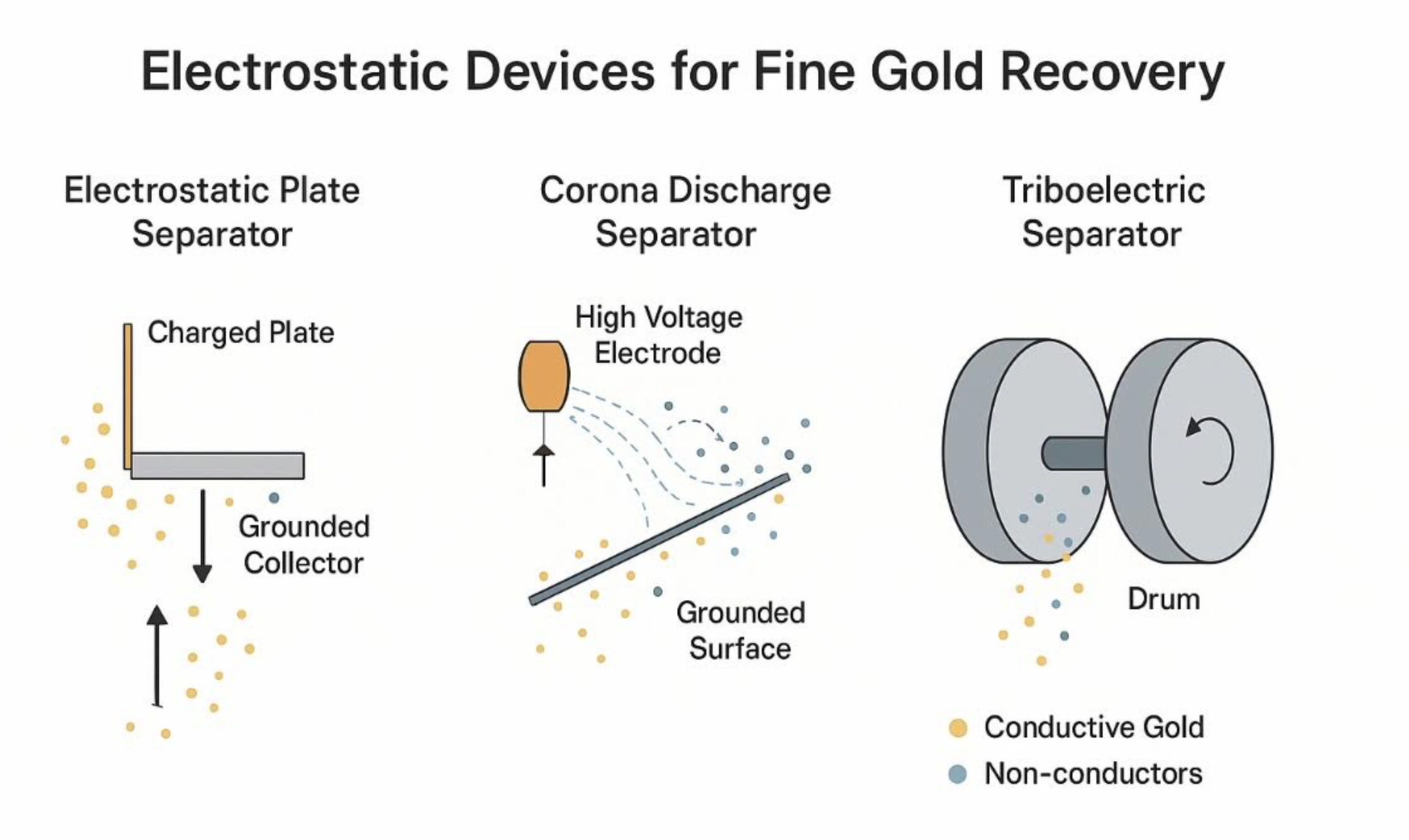
Using Static Electricity to Harvest Fine Gold Particles Recovering fine gold particles is one of the oldest challenges in mineral processing. Conventional methods such as sluice boxes, shaking tables, and flotation cells are effective for coarse or moderately fine particles, but they often lose the finest material to tailings. Static electricity, also known as electrostatics, offers an alternative mechanism to separate fine particles based on their surface charge and conductivity. This article explores how static forces can be harnessed to collect fine gold, the principles behind electrostatic attraction, and the type of device best suited for this task.How Static Electricity Interacts with Fine GoldGold itself is a highly conductive metal. When exposed to a charged surface or field, gold particles do not retain a static charge in the same way that non-conductors do. Instead, they can be influenced by induction: a static electric field can polarize a conductive particle, creating localized attraction to the charged surface.Meanwhile, lighter gangue materials such as quartz, mica, or silicates are insulators. These materials can either repel or adhere differently under static conditions. This contrast in behavior forms the basis of electrostatic separation, where conductive minerals (like gold) behave differently than non-conductive particles.Effectiveness of Static HarvestingParticle size sensitivity: Electrostatic collection works best for very fine particles where mechanical separation is less effective.Dry environment requirement: For static forces to dominate, material must be dry. Moisture reduces charge buildup and makes fine particles stick together, lowering separation efficiency.Selective attraction: Gold, being conductive, is not attracted by static charge in the same way as insulating dust. Instead, its movement is governed by induction and grounding effects in electrostatic separators. This means static electricity can assist in concentrating gold, but it is more indirect than with insulating particles.Devices for Collecting Gold with Static ElectricityElectrostatic separation is already used in the mining and recycling industries. The following device types are suitable for fine gold recovery:1. Electrostatic Plate SeparatorConsists of a charged plate or drum and a grounded collector.Conductive particles (gold) lose their charge quickly and fall differently from non-conductors.Effective for dry, finely ground ore.2. Corona Discharge SeparatorUses a high voltage discharge to ionize air near a surface.Gold particles are polarized and behave differently from lighter gangue.Allows continuous feed and separation on a conveyor belt or drum.3. Triboelectric SeparatorRelies on friction charging between particles.Different minerals acquire different charges after contact and can then be separated in an electric field.Works best with fine dry powders, including gold-bearing dust.Practical ConsiderationsFeed preparation: Ore must be very dry and finely milled for static processes to be effective.Safety: High voltage is required to generate sufficient electrostatic fields, necessitating shielding and proper controls.Scale: Electrostatic methods are often used in small to medium throughput operations or as finishing steps after gravity separation.ConclusionStatic electricity can play a role in recovering fine gold particles that are often lost in conventional methods. Through electrostatic induction, conductive gold behaves differently than surrounding gangue material, enabling selective separation. Devices such as electrostatic plate separators, corona discharge systems, and triboelectric separators can be adapted to concentrate gold from finely milled, dry ore. While not a universal solution, static electricity offers a complementary method to enhance gold recovery where conventional techniques face limitations. |
|
| CONTACT Email: greg@infinityturbine.com | AMP | PDF |