
INFINITY TURBINE LLC We specialize in designs, plans, licensing, consulting, design services, and surplus spare parts. We no longer manufacture turbines or CO2 systems. More Info...
Please email for first contact with request for more information
Email: greg@infinityturbine.com
CO2 Ejectors for Data Center Waste Heat Cooling: A Technical Review Hyperscalers are racing to deploy gigawatts of AI compute, but the grid can't keep up and large gas turbines are backordered half a decade out. Infinity Turbine's Cluster Mesh Supercritical CO₂ system offers a radical alternative: modular, silent, trailer-deployable prime power that scales the way software does... More Info
From the Feher Cycle to the Cluster Mesh: A History of Supercritical CO₂ Power... More Info
Cooling a Data Center Pod with Its Own Waste Heat: A 100 kW Ejector Design Study More Info
Portable Gas Turbine Prime Power More Info
Cluster Mesh Supercritical CO2 Power System for Data Centers and AI Pairing Cluster Mesh Supercritical CO2 Power System with Small Modular Reactors enables hyperscalers to convert high-grade nuclear heat into ultra-efficient, dispatchable power with a compact, modular footprint tailored for AI-scale demand. More Info
ORC and Products Index Infinity Turbine ORC Index... More Info
AMD Helios Cooling Strategy Using Transcritical CO2 and a Cluster Mesh sCO2 Turbine Generator Cell More Info
|
|
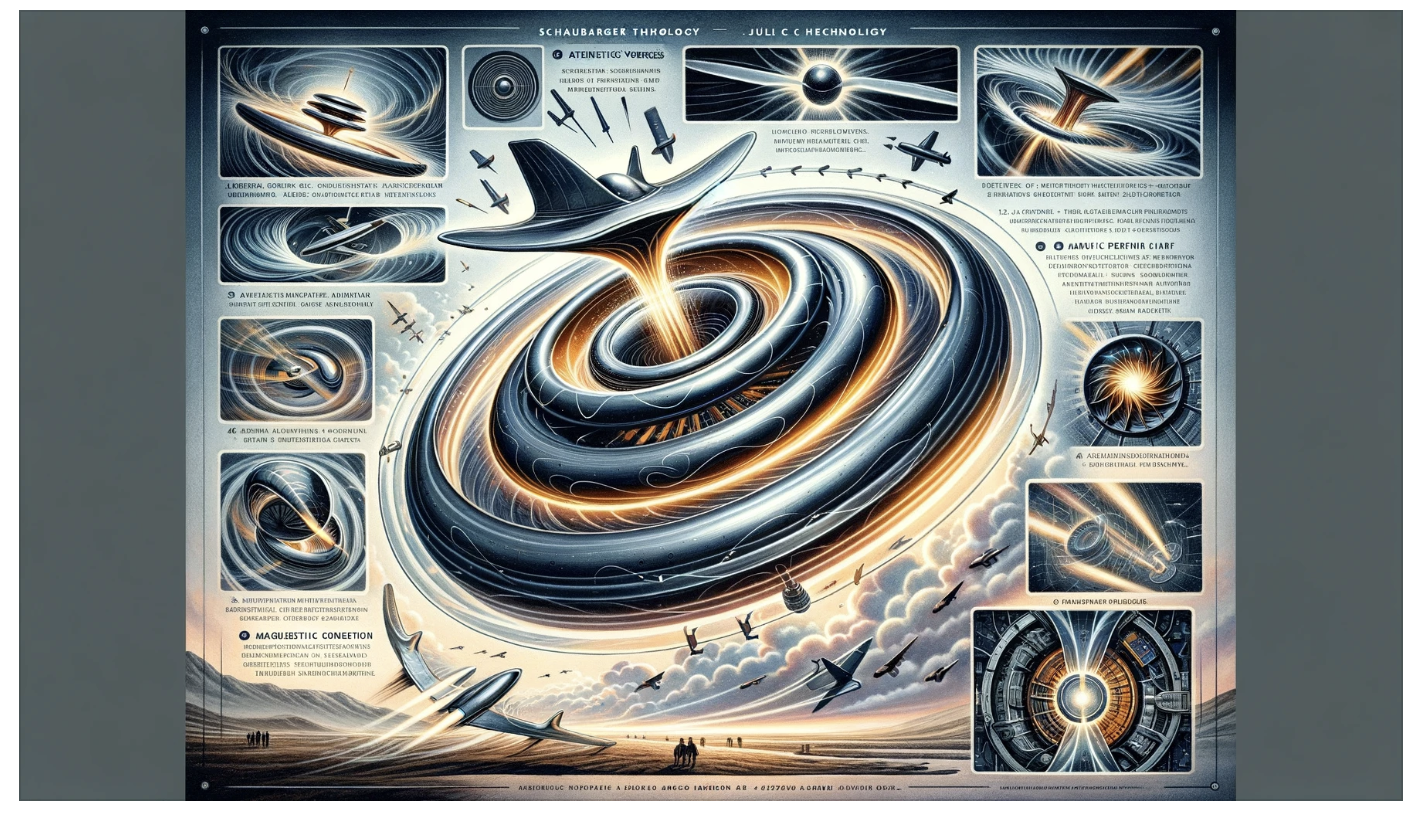
Schauberger Technology The paper titled Schauberger Technology by Julio C. Gobbi, published on January 30, 2021, explores the development of a mechanical system for atmospheric air ionization based on the work of Viktor Schauberger. Schauberger's studies on water flow led him to devise a method to accelerate air and create cyclonic vortexes, which, through ionization over rotating metallic surfaces, produce a low-pressure gradient that can be harnessed for propulsion and energy generation, notably in aircraft and discoid vehicles referred to as Repulsine.Key areas of focus in the paper include:• Introduction: The premise is based on Schauberger's philosophy that nature's processes are rhythmic and reciprocal, not bound by rigid laws. His innovations are rooted in observations of natural water movements, leading to the conception of devices that mimic these processes for energy generation and propulsion.• Vortexes of Viktor Schauberger: Schauberger's early work with water led to insights into creating powerful propulsion systems by manipulating flow dynamics, which he applied to both water and air. This section discusses the transition processes within vortexes, including the implosion effect and the transformation of matter into bio-magnetic force.• Magnetic Propulsion Systems: Two systems are described, both utilizing ionized air produced by the Repulsine's rotating chamber to create magnetic fields capable of propelling the device.• Mechanical Propulsion Systems: Three systems are elaborated, focusing on the creation of a low-pressure gradient through air ionization and manipulation of air flows over the device's surfaces to generate lift and propulsion.• Gravitoinertial Propulsion System: This section discusses how the Repulsine's high-speed rotation can potentially neutralize the gravitational force acting on the device, facilitating propulsion without direct lift mechanisms.The paper concludes by highlighting the innovative propulsion mechanisms Schauberger's technology presents, suggesting its significant potential for advancing propulsion technology. These systems range from magnetic and mechanical to gravitoinertial methods, each contributing to the thrust necessary for the levitation and movement of the discoid vehicles Schauberger envisioned.No mathematical equations are included in this summary, in accordance with your request. The document also contains several figures illustrating the principles and devices discussed, including discoid aircraft models, the inner guide fins on tubes, and representations of air flow within the Repulsine turbine. |
| CONTACT Email: greg@infinityturbine.com | AMP | PDF |