logo

INFINITY TURBINE LLC
CO₂ turbine-generator comparison

ROT-8-650 vs. CO2T-800

Two hermetic CO₂ turbine-generators for heat up to 650 °C, both with a high-speed permanent-magnet generator on the turbine shaft and oil-free foil bearings. They reach the same cycle efficiency. They differ in how they turn CO₂ into shaft power, and that changes the cost, the speed, the maintenance and the best use of each.

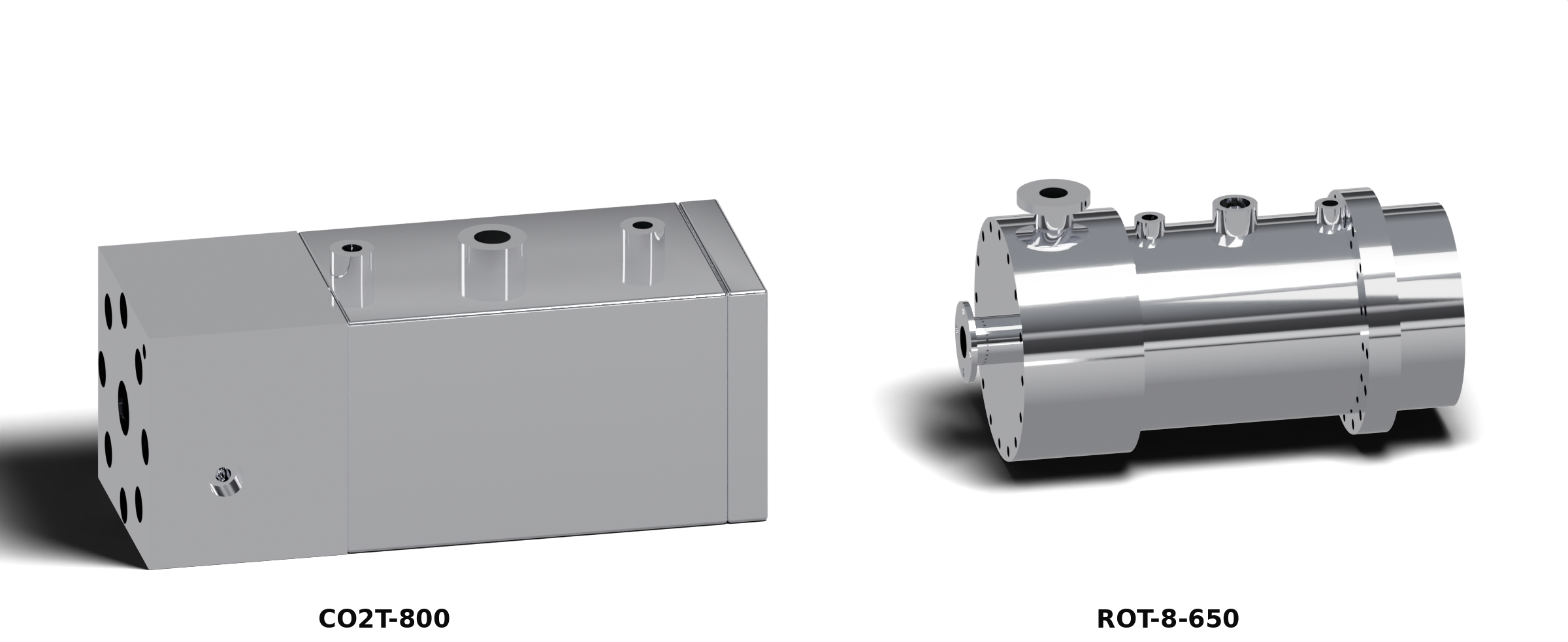
ROT-8-650 and CO2T-800 turbine-generators side by side in polished chrome, shown at the same scale
Shown at the same scale (orthographic view), turbine ends to the left. Left: CO2T-800, a two-stage bucket turbine in square bolted stainless blocks, about 620 mm long. Right: ROT-8-650, an eight-stage radial outflow turbine in round flanged blocks, 480 mm long.
Choose the ROT-8-650 if…

You want the most power per unit from steady heat

  • About 15 % more gross power per unit (51 kW vs. 45 kW at 650 °C)
  • Half the shaft speed (22,600 rpm), easier on bearings and the generator
  • The shortest package (480 mm) for a given output
  • Steady, base-load heat: engine and gas-turbine exhaust, furnaces, fuel cells
Choose the CO2T-800 if…

You want the lowest cost and the simplest machine

  • About 30 % lower cost per kW to manufacture ($136–187/kW vs. $199–270/kW)
  • Standard stainless steel and A286 instead of Inconel
  • Fewer, coarser flow parts and replaceable nozzle rings: lower expected maintenance
  • Variable heat: wood-fired boilers, batch kilns, solar; easy re-rating by nozzle ring

Side-by-side specifications

Performance for both machines comes from the same recuperated CO₂ cycle model with the same assumptions, so the numbers compare like for like. Outputs are gross, at the generator terminals.

ROT-8-650CO2T-800
Turbine type8-stage radial outflow turbine (ROT), full admission2-stage bucket (impulse) turbine, partial admission
RotorOne Ø175 mm disc with 8 blade rings, 563 bladesOne disc with 2 bucket rows, Ø123 / Ø86 mm, about 104 buckets
Stator / nozzlesStator plate with 8 vane rings, 528 vanes2 press-fit nozzle rings, 4 + 6 nozzles (replaceable)
Maximum inlet200 bar / 650 °C200 bar / 650 °C
Design speed22,600 rpm (15,000–25,000 via inverter)42,400 rpm at 650 °C (about 18,600–46,000)
Rotor tip speed at 650 °C207 m/s273 m/s
CO₂ flow at 650 °C0.37 kg/s0.31 kg/s
Shaft power at 650 °C54 kW47 kW
Gross output at 650 °C51 kW45 kW
Gross cycle efficiency at 650 °C31.1 %31.6 %
Heat input at 650 °C165 kWth (563,000 BTU/h)142 kWth (483,000 BTU/h)
GeneratorHSG-55R, 55 kW, 2-pole Sm₂Co₁₇, 377 Hz, 481 V; built to the drawing set58 kW frameless 2-pole Sm₂Co₁₇ kit, 707 Hz at 650 °C, about 440 V; bought in
Laminations0.20 mm silicon steel0.10 mm silicon steel
Bearings and sealingCO₂ foil journal ×2 + thrust; hermeticCO₂ foil journal ×2 + thrust; hermetic
Hot-section metalsInconel 625 / 718316H / 347H stainless, A286 rotor and shaft
ConstructionRound flanged blocks, Ø240 mm, 16 × M10Square bolted blocks, 244 mm, 8 bolts
Length480 mmAbout 620 mm
Part-load control3 nozzle-group valves plus speedSwitch nozzle groups plus speed; re-rate by swapping nozzle rings
Est. manufacturing cost, 1,000 / yr$13,900 ($270/kW)$8,400 ($187/kW)
Est. manufacturing cost, 10,000 / yr$10,200 ($199/kW)$6,100 ($136/kW)
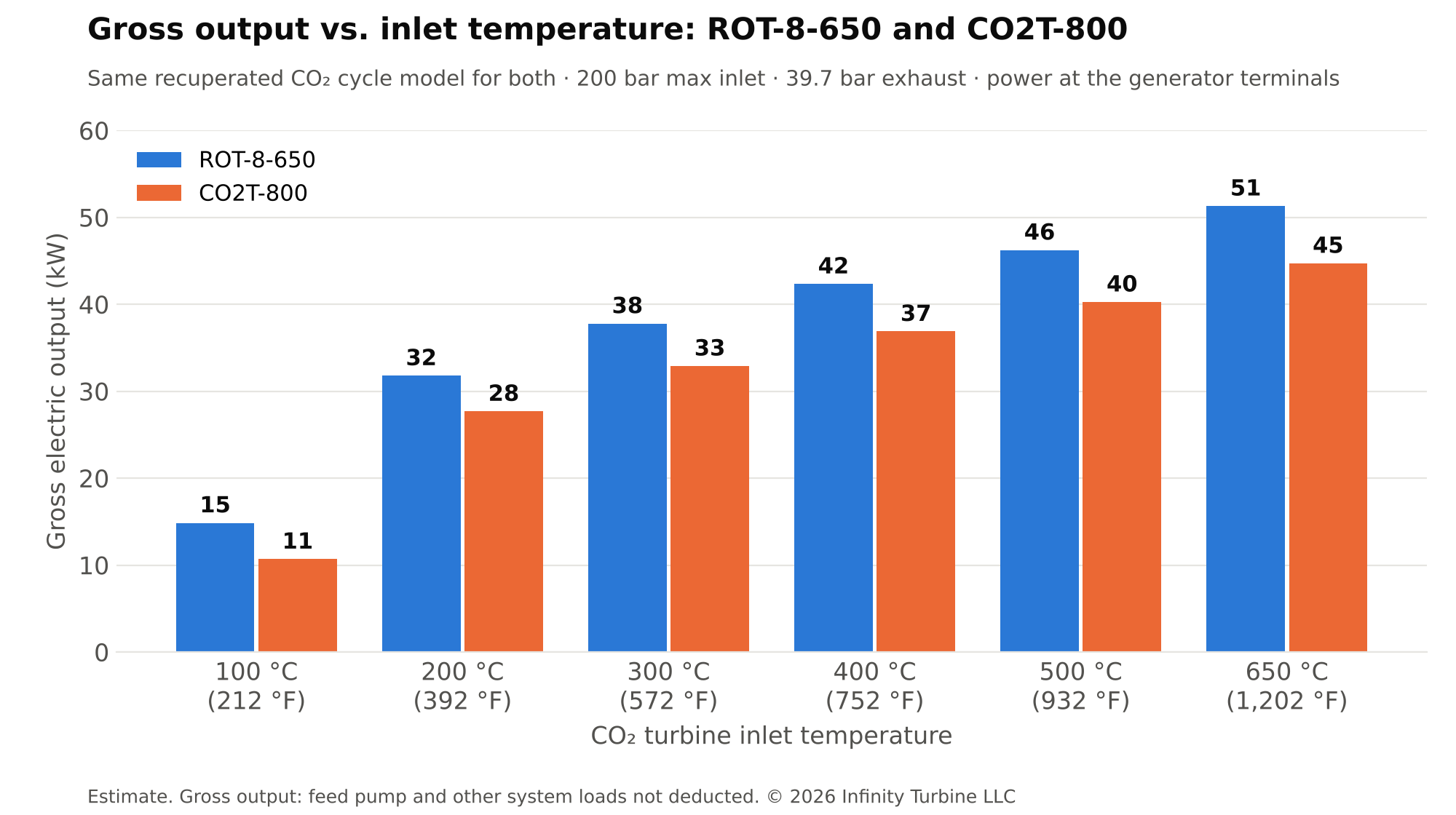
Grouped bar chart of gross output by inlet temperature. ROT-8-650: 15, 32, 38, 42, 46, 51 kW. CO2T-800: 11, 28, 33, 37, 40, 45 kW at 100, 200, 300, 400, 500 and 650 C

Same efficiency, different size. At every temperature the two machines convert heat to power at almost the same efficiency, within about half a percentage point, because the CO₂ cycle sets the efficiency more than the turbine type does. The ROT-8-650 makes more power per unit only because its blade passages are sized for about 17 % more CO₂ flow. Per kW of heat, the two are equal.

Which one for which application

The two designs suit different heat sources and operating patterns. In short: the ROT-8-650 for steady, clean, high-duty heat; the CO2T-800 for variable heat, remote sites and the lowest capital cost.

SituationBetter fitWhy
Steady base-load exhaust: gensets, gas turbines, fuel cells, continuous furnacesROT-8-650Full admission is most efficient at a fixed design flow. It gives more kW per unit, and the lower speed suits long continuous runs.
Variable or cyclic heat: wood-fired boilers, batch kilns, concentrated solarCO2T-800A partial-admission wheel handles changing flow by switching nozzles on and off, so each open nozzle stays at its design point. Swapping nozzle rings re-rates the machine for a new site.
Remote and off-grid sites with limited service supportCO2T-800Simpler flow path and stainless parts; nozzle rings are cheap spares that can be changed on site.
New or "dirty" CO₂ loops (scale or debris from a new heater coil)CO2T-800Debris that reaches the turbine wears replaceable nozzle rings. In the ROT it can foul or erode the 2 mm passages machined into the rotor itself.
Space-limited installations, highest output per unitROT-8-650480 mm long and 51 kW gross, versus about 620 mm and 45 kW.
Lowest capital cost per kWCO2T-800Estimated $136–187/kW versus $199–270/kW for the turbine-generator.
Low-temperature heat, 100–200 °CEitherThe ROT-8-650 gives a little more power (15–32 kW vs. 11–28 kW). Below about 150 °C a smaller turbine matched to the low temperature is the better choice for both.

For either machine, the balance of system (heat exchangers, CO₂ heater, recuperator, condenser, feed pump, piping, controls and power electronics) costs more than the turbine-generator. Base project decisions on the full installed cost.

Choosing as an OEM manufacturer

For a licensee building turbines in volume, the questions are: which processes do I need in-house, which materials can I buy reliably, and what does each unit cost at scale?

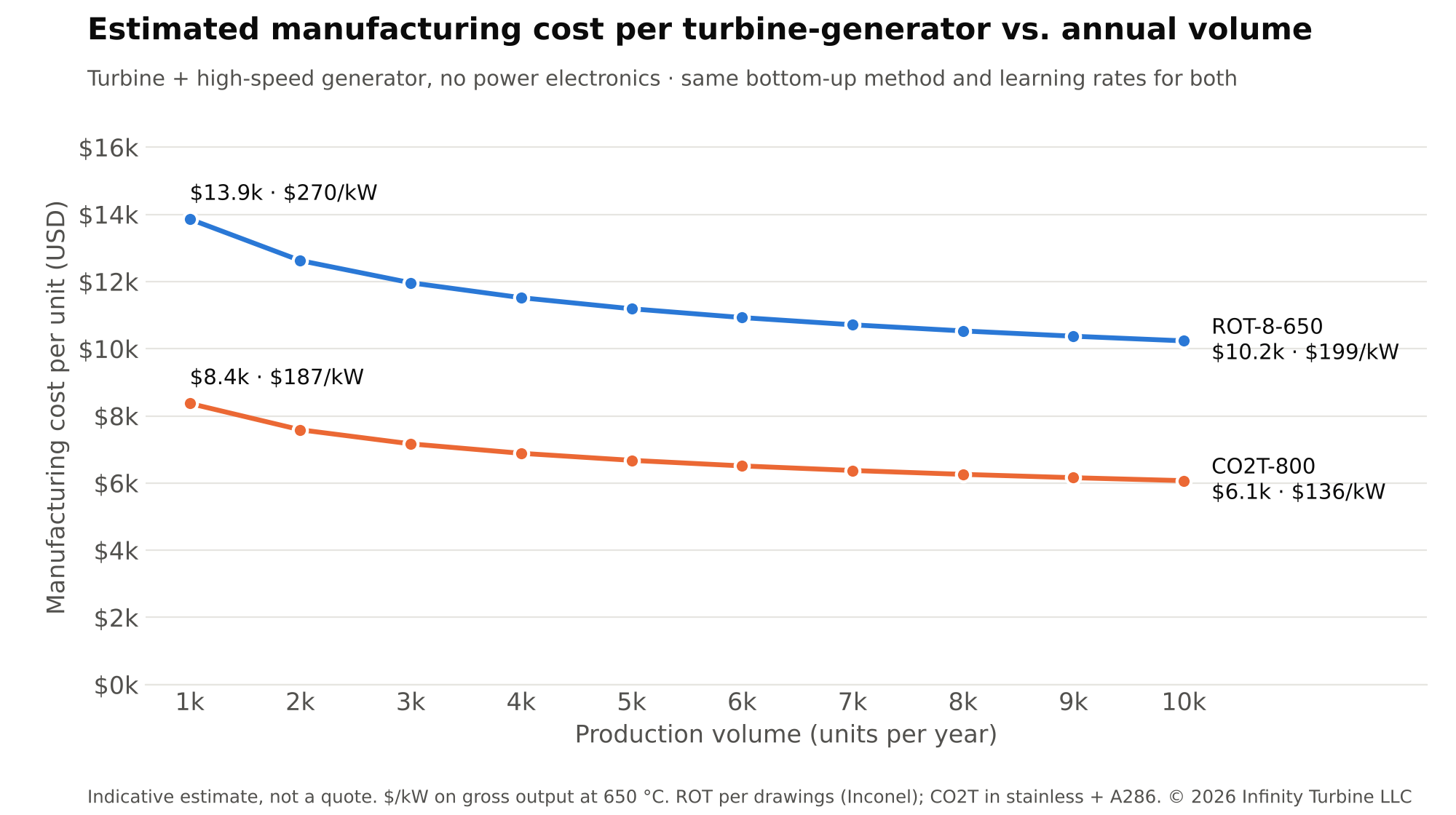
Line chart of manufacturing cost per unit vs annual volume: ROT-8-650 from $13.9k to $10.2k, CO2T-800 from $8.4k to $6.1k
OEM factorROT-8-650CO2T-800
Key processesFiber-laser engraving and electropolishing of about 1,090 passages on two Inconel 718 discs; tight flatness and axial clearance over 8 interleaved rings; Inconel machiningTurning and milling of stainless blocks; bucket milling or EDM on one A286 disc; drilled and converging-diverging nozzle inserts pressed into rings
Materials and supplyInconel 625 / 718 forgings: higher price, longer lead times, slower machining and more tool wear316H / 347H stainless and A286: widely stocked, faster to machine
GeneratorHSG-55R built in-house from the drawings: laminations, Litz coils, impregnation, magnet bonding, sleeve, magnetizing. More value kept in-house, but more process capability needed.Frameless 58 kW kit bought from the high-speed motor supply chain; housing and bearings in-house. Faster to launch, but depends on the supplier.
Product range from one designBlade heights set the flow; a different rating needs a new disc setDifferent flows and temperatures by changing the nozzle rings; same casing and wheel
Rotor stress at 650 °CLower: 207 m/s tip speed, so roughly 57 % of the CO2T disc stressHigher: 273 m/s tip speed; the A286 rotor needs a stress and creep check
Est. cost, 1,000 → 10,000 units / yr$13,900 → $10,200 per unit; $270 → $199 per kW$8,400 → $6,100 per unit; $187 → $136 per kW
Cost-reduction pathIts lower rotor stress may allow stainless blocks and A286 discs at 650 °C, which could close part of the cost gap. This needs engineering confirmation.Already on standard metals; savings now come from volume and generator sourcing

OEM verdict. The CO2T-800 is the easier and cheaper product to industrialize. It uses common processes and metals, has fewer precision features, buys its generator, and covers many ratings by changing nozzle rings. The ROT-8-650 suits an OEM that wants a higher-output premium product and can master laser micro-machining, Inconel and in-house generator building. Its lower rotor stress is a real engineering advantage.

Which needs less maintenance?

Expected answer: the CO2T-800 needs less maintenance on its flow path, while the ROT-8-650 is gentler on its bearings and generator. On balance the CO2T-800 should need less routine maintenance. Neither machine has field service history yet, so intervals must be set by testing.

ItemROT-8-650CO2T-800Advantage
Flow passagesAbout 1,090 small passages (2 mm wide, 2.8–6.3 mm high) on the rotor and stator. Fouling or erosion means stripping and re-balancing the rotor.About 104 buckets and 10 nozzles. The nozzles, which see the highest velocity, are in two cheap press-fit rings.CO2T
Clearance sensitivity8 interleaved rotating and stationary rings with tight axial gaps. Thermal growth or bearing wear can cause rubs, and leakage at the gaps costs efficiency.Impulse design: all the pressure drop is in the nozzles, so leakage at the 0.25 mm rotor clearances matters less, and the machine tolerates some wear.CO2T
Axial thrustPressure falls across the rotor stages, so a balance piston and thrust bearing are neededLittle pressure difference across the wheel, so low thrustCO2T
Shaft speed22,600 rpm; journal surface speed about 35 m/s42,400 rpm; about 67 m/s. Higher windage and more foil-coating wear per start and stop.ROT
Generator377 Hz: lower iron and windage losses, runs cooler707 Hz: higher losses; needs good stator coolingROT
Oil system and shaft sealNone: oil-free foil bearings, hermeticNone: oil-free foil bearings, hermeticEqual
Seals and teardownElastomer O-rings at block faces, renewed at teardownMetal C-ring seals, renewed at teardownEqual

Why numbering up beats scaling up

For plants up to several megawatts, many identical ≈50 kW turbine-generators running in parallel generally beat one large machine. This holds for both designs.

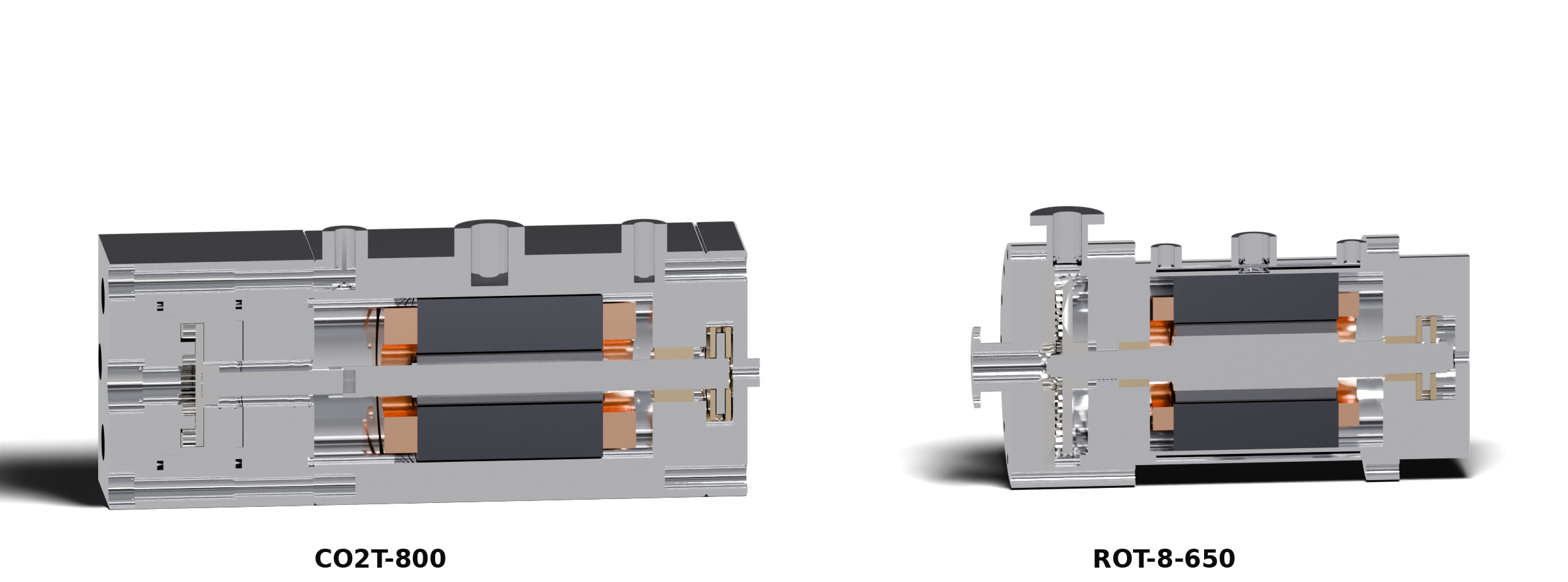
Half-section of both turbine-generators side by side showing turbine stages, generator and bearings
Half-sections at the same scale. Left: CO2T-800. Right: ROT-8-650. In both, the generator, bearings and casing take most of the space and cost, not the turbine wheel.

1 · The wheel doesn't grow with power

Turbine wheel size is set by the inlet temperature and pressure drop, not by flow. More power means a bigger generator, bigger bearings and a heavier casing, and those parts get harder and costlier faster than the power grows.

2 · High-speed generators are easier to buy small

Generators of about 50–60 kW at 20,000–46,000 rpm come from an established supply chain. Above about 100 kW at these speeds, the options narrow to specialty and aerospace suppliers.

3 · Bearings and rotordynamics

Foil bearings and slim rotors work well at the 50 kW scale. Bigger, heavier rotors push critical speeds toward the operating range and need larger bearings with less proven load capacity.

4 · Pressure casing

At 200 bar, casing wall thickness and bolt loads grow with diameter, so casing mass grows faster than output. Small casings are cheaper per kW to forge, machine and test.

5 · Volume production

A 500 kW plant takes 10 ROT-8-650 or 12 CO2T-800 units. Each doubling of production volume cuts unit cost by roughly 8–15 %, so one standard product built in thousands beats a few large custom machines.

6 · Uptime, turndown and service

One unit down costs 10 % of output, not 100 %. At low heat, units switch off and the rest stay at their best efficiency. A failed unit is swapped on site and repaired at the factory, and one design is certified once and sold many times.

Example: a 500 kW gross plant

OptionUnitsGross outputTurbine-generator cost at 1,000 / yrat 10,000 / yrOne unit out of service
ROT-8-650, numbered up10513 kW$139,000$102,000−10 %
CO2T-800, numbered up12536 kW$100,000$73,000−8 %
One 500 kW custom machine1500 kWCustom engineering, generator and bearings; low volume—−100 %

Number up correctly. Each unit must keep a wheel sized for its temperature. Shrinking the wheel to make many tiny units costs efficiency, because the buckets or blades can no longer keep pace with the CO₂ jets. Within one unit, the CO2T-800 can also take more flow by adding nozzles, up to its generator rating. Turbine-generator costs exclude the balance of system, which costs more than the turbines.

Discuss which turbine fits your heat source or your factory

Both turbines are available as built units, parts kits or plans licenses, with the high-speed generator design included.

Basis. Both machines were modeled with the same recuperated transcritical CO₂ cycle (CoolProp properties): up to 200 bar / 650 °C inlet, 39.7 bar exhaust (5 °C condensing), recuperator effectiveness 0.85, generator 95 %. Turbine isentropic efficiency is 58.7 % for the ROT-8-650 (from its design point) and 60 % for the CO2T-800 (at the best bucket speed). Outputs are gross at the generator terminals; the feed pump, power electronics and other system loads are not deducted. Manufacturing costs are indicative bottom-up estimates using the same line-item method and learning rates for both: ROT-8-650 in Inconel per its drawings, CO2T-800 in stainless and A286. They exclude power electronics and balance of system. Images are rendered from the 3D models; the CO2T-800 is shown as a concept model. All figures are estimates for comparison, not guarantees.

Copyright © 2026 Infinity Turbine LLC. All rights reserved.
ROT-8-650, HSG-55R and CO2T-800 are products of Infinity Turbine LLC.

CONTACT Email: greg@infinityturbine.com | AMP